The book with no algorithms that FDEs should read before any ML text
Provost and Fawcett teach how to think with data, the skill a forward deployed engineer needs before writing the first line of code at a client.
In brief
- Data Science for Business (O'Reilly, 2013) teaches the principles of extracting knowledge from data, not algorithms.
- Three ideas worth keeping: principles matter more than algorithms, data mining is a craft with a process, and data is an asset that needs investment.
- Read it before technical ML books, especially if you are moving from software engineering to FDE work.
The book’s official page says it plainly in its opening lines: this is not a book about algorithms. That is an odd claim for an O’Reilly title with “data mining” on the cover. For an FDE, it is exactly the reason to read it.
The book is Data Science for Business, subtitled with a reference to data mining and data-analytic thinking. It was written by Foster Provost and Tom Fawcett and published by O’Reilly Media in 2013.
It grew out of a heavily subscribed course Provost taught at NYU. According to NYU Stern, more than a dozen universities in eight countries have adopted it as a textbook, and Fortune put it on a list of must-read books for MBAs.
What use is a 13-year-old book to an FDE in 2026? At a client site, the hardest part is rarely choosing the model. It is turning a client’s vague statement into a measurable problem.
The authors set out to present the fundamental principles of extracting useful knowledge from data. They also write for readers who will not do the work themselves but want to sharpen their data-analytic thinking.
Clients bring a worry, not a problem
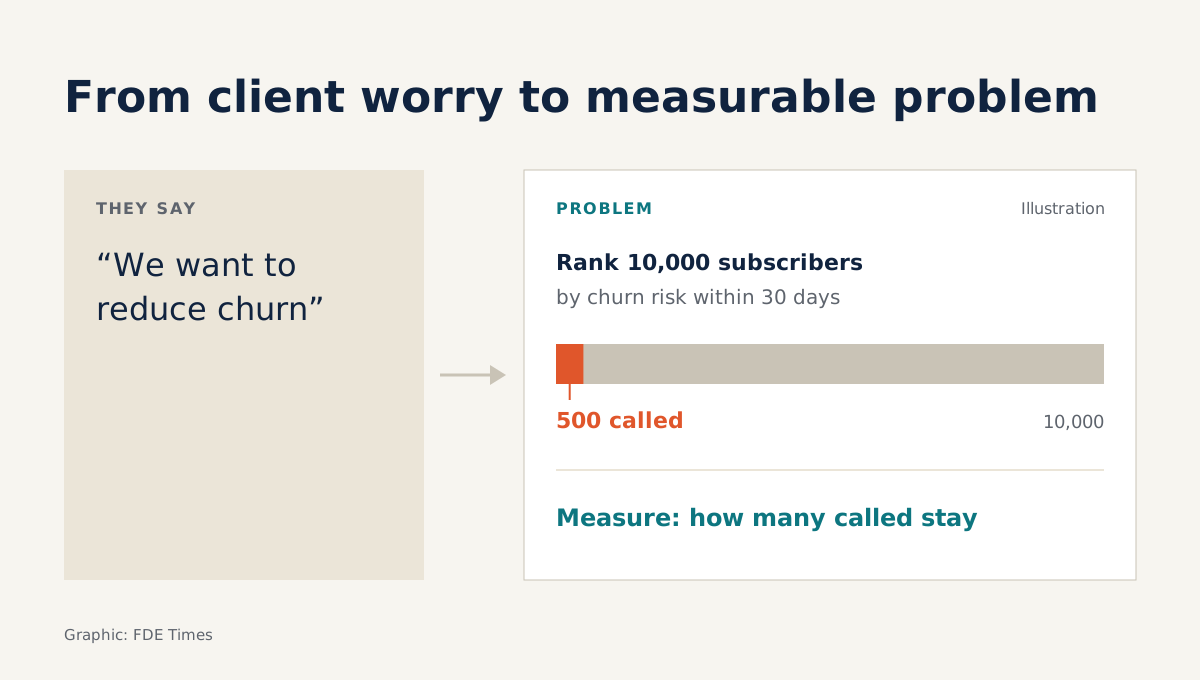
Imagine a subscription company telling you: “We want to reduce customer churn.” That is not yet a data problem. It does not say who will act, over what period, or what counts as success.
A few more questions reveal that the customer care team only has the people to call 500 of its 10,000 subscribers each month. Now the problem is clear: rank the 10,000 subscribers by their likelihood of leaving in the next 30 days, then pick the 500 most worth calling.
The problem has a specific decision (whom to call), a measurable goal (how many of those called stay), and tells you what data you need (subscriber history, who has left and when).
This is the kind of thinking the book calls “data-analytic thinking”. According to the publisher’s description, the book illustrates each principle with real business problems. That is why people who work with clients find it closer to their job than a mathematics textbook.
First idea: principles outlast algorithms
Algorithms change every year. But the question “which decision will change if we have this answer?” stays the same, whether you use a decision tree in 2013 or an LLM-based agent in 2026. The book chooses to teach the part that does not change.
Sinan Aral, a professor at MIT Sloan, has remarked that in applied data science for business, no other book is as authoritative and as accessible as this one.
For an FDE, that accessibility is immediately useful: it gives you the vocabulary to explain to an operations director why “predicting churn” and “choosing whom to call” are two different problems.
When a client brings a request, the first thing to do is write down the decision the analysis will affect. If you cannot yet write that sentence, it is too early to open a notebook.
Second idea: data mining has a process, not luck
Provost calls data mining a craft: work that takes skill, not something you finish by pressing a button. According to O’Reilly’s announcement, it has a well-defined process that raises the odds of success. That matters to an FDE because it dispels the notion that data plus a model will produce results on their own.
A process is also something you carry from one client to the next. In the subscription example, the path is: clarify the decision, define “churn”, find the data, then measure results on exactly those 500 calls. At a bank or a logistics company, the steps are the same. Only the nouns change.
Write your process down as a short checklist and use it in every discovery session. After three clients, you will see at which step failed projects usually went wrong.
Third idea: data is an asset, and assets cost money
The publisher sums up one of the book’s lessons: treat data as a business asset, one that needs careful investment to yield real value. At a client, this often leads to an awkward conversation: telling them the data they have is not enough.
Back to the example: suppose the company does not record the date a customer cancelled, only their current status. Then you cannot build a model yet.
The first job is to propose that the client invest in recording that data, and to say clearly how much effort it will take. An FDE who can say this in the first week avoids three months of empty promises.
Which interview question reveals how a candidate thinks?
The publisher’s description mentions a use few people notice: applying data science principles when interviewing data candidates. FDEs often have to assess a client’s data team or help hire for their own, so this is a skill they actually use.
Imagine giving a candidate the subscription scenario above: “The company wants to reduce churn. Where do you start?” A weak answer goes straight to the model: try a few algorithms, compare accuracy, pick the best. It sounds technical, but the candidate has not asked a single question about the client.
A good answer starts by asking questions back: who will act on the results, how many people can be called each month, how “churn” is defined, whether the system stores the cancellation date.
Only after learning that the care team can call 500 people does the candidate talk about ranking and measuring on exactly that group. A question like this tells you more than any algorithm puzzle.
Who should read it, and when
If you are a software engineer moving into FDE work, read this book before the technical ML books. If you are already an FDE, reread the sections tied to the kinds of problems clients bring you most often.
The skill should show on your CV too. Instead of writing “built a churn prediction model”, write the original business question, how you redefined the problem and the number that measured the result. A line like that shows the reader how you think, not just which tools you use.
Models will change many more times. The question “which decision will change?” remains the first one to ask when you arrive at a client.
Was this article useful?
Thanks for the feedback!