Five free weeks of security before you touch a client's systems
Harvard's free CS50 cybersecurity course teaches the habit FDEs need most: weighing risk against convenience before a client hands over access.
In brief
- Harvard's free course, taught by David J. Malan, runs five weeks at 2-6 hours a week and is organized around four layers: accounts, data, systems and software, plus privacy.
- Three ideas worth keeping: security is relative, every layer of protection makes a system less convenient, and passwords are only safe when they are hashed properly.
- Experienced engineers may find it basic; the for-credit version, CSCI E-159, adds live sections and a final project.
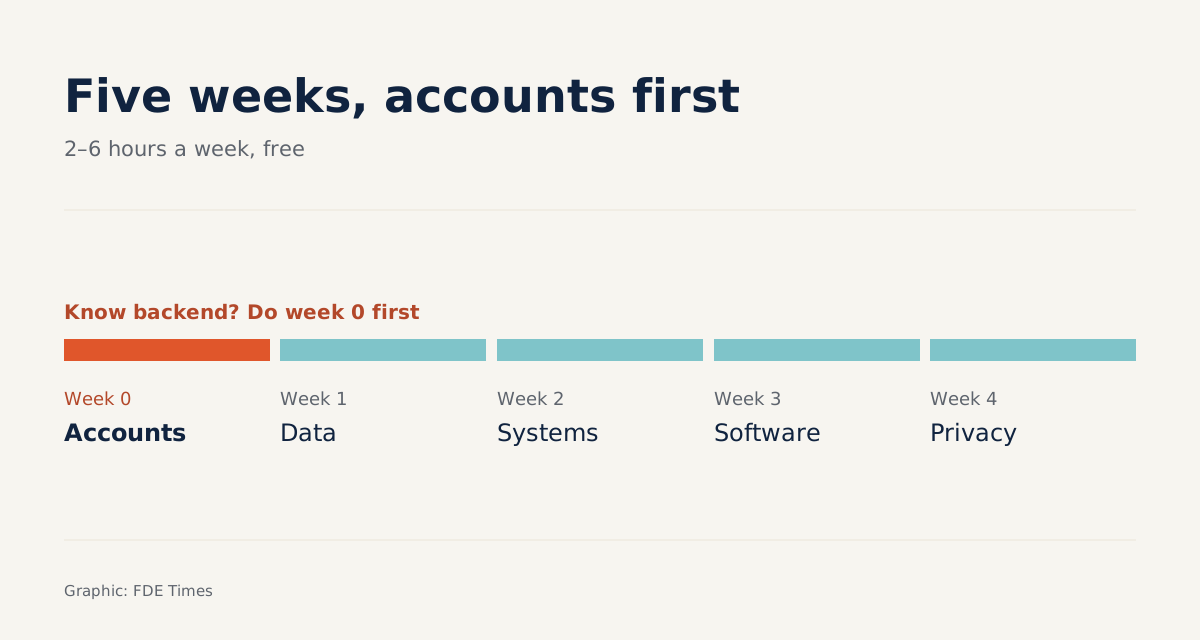
Harvard’s introductory security course takes five weeks, at 2 to 6 hours a week. Students set their own pace, and the course page lists it as free. It is taught by David J. Malan, Gordon McKay Professor of the Practice of Computer Science and the man behind the CS50 series.
For an FDE, those five weeks are worth the effort because the job happens in places product engineers rarely have to go: accounts issued by the client, the client’s real data, servers behind another organization’s firewall. In that setting, a small slip stops being an internal bug and becomes a customer incident.
CS50’s Introduction to Cybersecurity will not make you a security specialist. What it gives you is a shared vocabulary and a minimum set of reflexes, so you are not the weakest link in a deployment.
Five weeks, four layers to protect
CS50 pitches the course at technical and non-technical people alike. The material is split into five weeks: Week 0 on securing accounts, Week 1 on securing data, Week 2 on securing systems, Week 3 on securing software, and Week 4 on privacy.
The topics are concrete. They include social engineering and phishing, passwords and the brute-force and dictionary attacks against them, biometrics, multi-factor authentication and password managers.
The course also covers hashing, salting, secret-key and public-key encryption, and digital signatures. Its problem sets are built on real incidents. Anyone can take it free through CS50’s OpenCourseWare, and it is also available on edX.
Security is a relative calculation
The idea most worth keeping appears in the course introduction itself: CS50 asks students to treat cybersecurity as relative rather than absolute, a matter of risks and benefits. It sounds obvious, yet it is precisely the kind of judgment an FDE has to make every week.
When a client asks what controls a pipeline reading internal data needs, “as many as possible” helps no one.
The better move is to ask questions back: how much damage would follow if this data leaked, who has a motive to take it, and how much effort would it cost to stop them?
Every layer of protection costs convenience
The second idea follows from the first: the course frames security as a trade-off against convenience. Turn on MFA and users face an extra step at every login. Rotate keys and someone has to go and update the configuration.
The practical lesson for an FDE is to state these trade-offs up front. Lock down an environment without explaining why, and users on the client side will find a way around it, and the workaround is usually less safe than having no lock at all. Write each control, along with its cost, into the deployment docs.
Passwords are only safe when stored properly
The third idea is the most technical. CS50’s lecture notes explain that a system should store only the hash of a password, never the original. Understanding why salt matters just as much is enough to let you audit a system yourself.
Take a hypothetical case: you integrate with a client’s user table and find that the password column is hashed but unsalted. Every user who chose “123456” will then share the same hash string. An attacker only needs to hash a dictionary of common passwords once, then match it against the entire table.
When each user has their own salt, the attacker has to rehash the whole dictionary for every single user, and identical hashes no longer reveal a group of people sharing a password. That belongs in your report to the client, with a proposed fix, before the table goes into any data flow.
What order to study in, and who can skip it?
The most telling criticism comes from students. On OpenCourser the course has only 3 reviews, averaging 4.7, and one reviewer noted that technical depth is lacking in places, so experienced engineers may find it too basic. The sample is too small to draw conclusions from, but the complaint is reasonable.
So if you are already comfortable with backend work, start with Week 0, since accounts are the first thing a client hands you. Then jump to Week 4 on privacy, and only then go back to the weeks where you are weaker. If you are moving into FDE work from a less technical role, take it in order from start to finish.
Those who need the discipline of a supervised course can take the for-credit version: Harvard Extension’s CSCI E-159, worth 4 credits, also taught by David J. Malan and scheduled for Spring Term 2027.
The biggest difference from the free version is that each lecture comes with a live section of 60 to 90 minutes led by a teaching fellow, with webcams on, and the course ends with a final project.
If you know you tend to abandon self-paced courses, that is a reason to choose it; otherwise the OpenCourseWare version is enough.
On your CV, do not just list the certificate. Write one line showing you used what you learned, such as auditing how credentials were stored during an integration with a client system and what you recommended. A line like that reveals your judgment, which a certificate name or a grade cannot convey on its own.
Five weeks will not teach you to stop a sophisticated attack. They are enough to keep you from opening the door yourself to the systems a client has trusted you with.
Was this article useful?
Thanks for the feedback!
6 sources
- CS50's Introduction to Cybersecurity
- CS50's Introduction to Cybersecurity (Harvard Professional & Lifelong Learning)
- Introduction to Cybersecurity (Harvard Extension School course browser)
- CS50's Introduction to Cybersecurity, Fall 2025 syllabus
- CS50's Introduction to Cybersecurity (OpenCourser)
- Cybersecurity - CS50