The 1985 book that teaches FDEs every client has a problem
Gerald Weinberg's three laws of consulting help engineers find the real problem at a customer, and it is usually a people problem.

In brief
- 248 pages, published by Dorset House in 1985 with a foreword by Virginia Satir, now available as PDF and EPUB on Leanpub
- Three laws worth keeping: there is always a problem, it is always a people problem, and remember how you are paid
- The Raspberry Jam Rule is a warning to FDEs who take on too many customers at once
“No matter how it looks at first, there’s always a problem.” Put more simply: whatever the client tells you, there is a problem. That is the first law in The Secrets of Consulting, the book Gerald M. Weinberg wrote in 1985. Forty-one years on, it still describes what a Forward Deployed Engineer meets in the first week at a customer.
The book was published by Dorset House, runs to 248 pages and carries a foreword by Virginia Satir. The publisher pitched it at three groups of readers: consultants, people who hire consultants, and people who want to become consultants. Leanpub now sells PDF and EPUB editions under the subtitle A Guide to Giving and Getting Advice Successfully.
For an FDE, this is not a book about consulting in the slides-and-reports sense. It teaches how to work inside someone else’s organisation, where you write code and also have to get people to listen to you. If you are technically strong but new to customer discovery, it is a sensible place to start.
Three laws, read as a scoping checklist
Weinberg does not lecture on theory. According to The Personal MBA’s review, he teaches through short anecdotes and named rules, such as the Raspberry Jam Rule and Rudy’s Rutabaga Rule. Of these, the three laws of consulting are the part most worth carrying with you.
The first law says the client always has a problem. Imagine you are sent to integrate an agent into a customer-support workflow, and the person in charge says the data is clean, the API is ready, and all you need to do is plug it in.
Read through Weinberg, that statement is not an answer. It is the point where you start asking more questions: why was this project approved, and who is suffering most right now?
The second law is where the book earns its price: no matter how it looks at first, it is always a people problem. Suppose a customer’s pipeline breaks every Monday morning. You can patch the schema three times, but if the cause is that neither the data team nor the operations team owns the export file, the fourth patch will break too.
The third law is harder to hear: never forget they are paying you by the hour, not by the solution. Alik Levin, who summarised the three laws on a Microsoft blog, sets it against the packaged-services model as a counterpoint.
For FDEs the counterpoint is sharper still, because the work is usually judged by whether the system actually runs at the customer. So read this law as a prompt to ask what you are being measured by, not as advice to stretch out the hours.
Raspberry jam and a quarter of your time left free
The Raspberry Jam Rule, quoted in the excerpt Dorset House published, is a single sentence: the wider you spread it, the thinner it gets. Weinberg goes on to write several more “jam” laws. One of them observes that nobody ever complains about grape jelly, meaning that nobody cares about something bland.
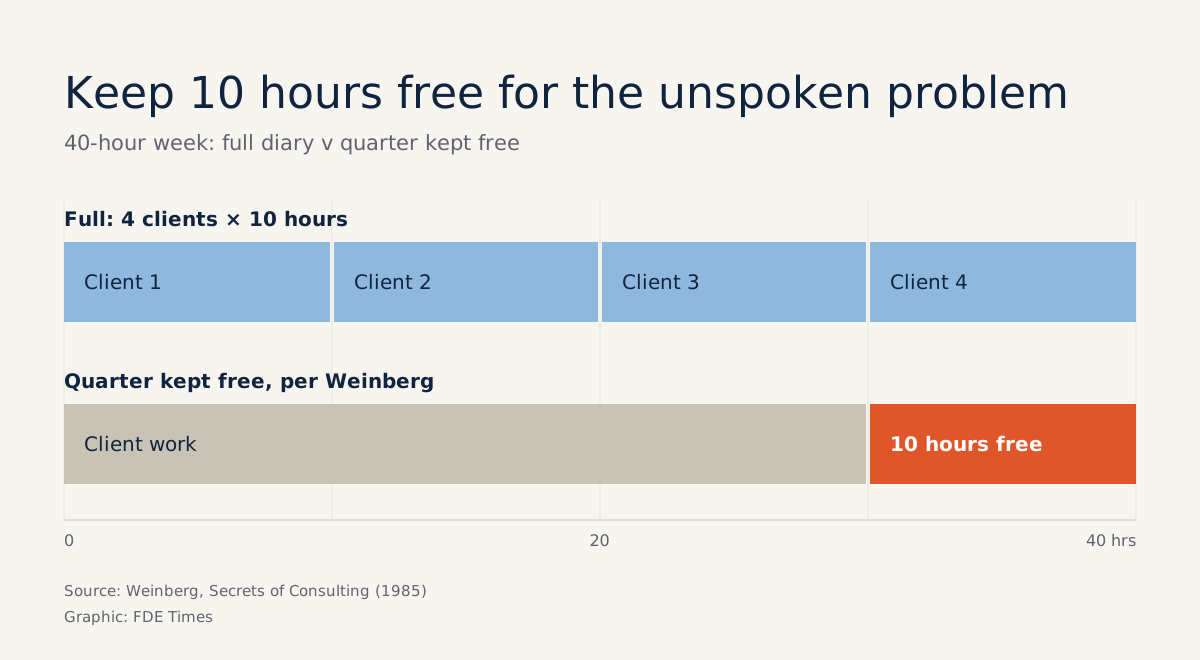
Applied to FDE work, the arithmetic is simple. Split a 40-hour week across four customers and each gets 10 hours, before you subtract the cost of switching context. By then you have become grape jelly: nobody complains, but nobody remembers what you did either.
Markus Gärtner, who calls this Jerry’s classic, says he often returns to one law: spend at least a quarter of your time doing nothing. In a 40-hour week, that is 10 hours left free.
That is the space to think, to take an unexpected call from a customer, or to notice the real problem the first law promises is there.
Who should read it, and in what order
Gärtner also stresses that the book is as much about receiving advice as giving it. The Personal MBA notes that it helps people choosing a consultant, too. For FDEs this is practical: to give advice that lands, you first have to know how to listen to customers describe their own systems.
If you are a software engineer looking to move into FDE work, read the original first. The sequel, More Secrets of Consulting: The Consultant’s Tool Kit, published by Dorset House in 2002, can wait. Diomidis Spinellis wrote in IEEE Software that it is not in the same class as the original, and that turning every idea into a law starts to grate.
The first two laws are also an interview answer
Go back to the pipeline that breaks every Monday morning, and tell it in Weinberg’s order. The customer says everything is fine, just a few minor schema errors. The hidden problem is an export file with no owner. And that is a problem between two teams, neither of which will take responsibility for its part.
Those three beats are exactly the answer you need when a recruiter asks about a time you worked with a difficult customer: what the customer said, what you found, and whose problem it turned out to be.
Your CV should follow the same logic. Instead of “integrated a data pipeline for a customer”, write that you found an export file no team owned, which was why the pipeline broke every week, and helped the two teams agree who was responsible.
If the second law holds, it is no surprise that a book written before the cloud era still describes FDE work so well. Customers’ stacks have changed many times; where the problem lives has not.
Was this article useful?
Thanks for the feedback!
7 sources
- The Secrets of Consulting: Giving and Getting Advice Successfully (Dorset House) · 1985
- The Secrets of Consulting (Leanpub)
- Three Laws Of Consulting By Gerald M. Weinberg (Microsoft Learn archive, Alik Levin) · 2008-11-12
- Remembering Jerry Weinberg: The Secrets of Consulting (Markus Gärtner) · 2022-11-14
- Excerpt from The Secrets of Consulting (Dorset House)
- Clichés Can Be Both Tiring and Helpful (IEEE Software review, Diomidis Spinellis) · 2004-05
- Secrets of Consulting review (The Personal MBA)