Why your salary counteroffer should go by email
Josh Doody's free-to-read book explains that a recruiter usually needs a written request to take to someone more senior for approval.
In brief
- Josh Doody recommends sending your counteroffer by email, because someone more senior usually has to approve it.
- Settle on the lowest salary you would accept before the offer arrives, and counter even if the offer already looks good.
- Your counter should be 10% to 20% above the base salary in the offer. The full text of the book is free to read online.
The most valuable advice in Josh Doody’s book fits in one sentence: send your counteroffer by email. This is not about avoiding an awkward conversation. Your request will probably need approval from someone more senior, so the recruiter needs something in writing to pass up the line.
If you have ever written an email that someone else took to their boss for approval, perhaps for a client, you already have half the skill you need. The book gives you a process for applying that same skill to your own offer.
A free book written like a checklist
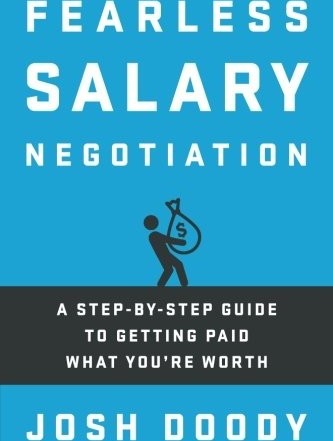
The book is Fearless Salary Negotiation by Josh Doody. Its subtitle states the goal plainly: a step-by-step guide to getting paid what you’re worth. The full text is free to read at fearlesssalarynegotiation.com, and there is also a 174-page paperback.
It covers the whole process, from understanding your market value to countering an offer. The official site does not give a publication year, but the book has been around since at least 2016: on 24 August 2016, Doody appeared on episode 274 of the Ruby Rogues podcast, which included a segment on countering in writing.
What order should you read it in?
If an offer is about to land, go straight to Chapter 4, “How to negotiate your new salary”, then open the page in that chapter on sending a counter offer, which includes a complete sample email. The earlier chapters on market value can wait until you have time to prepare for your next job move.
If you are taking the Coding Career Handbook course on Educative, you will find a lesson by Doody himself. It repeats the core idea: the best way to open a negotiation is to send a counteroffer email.
Idea one: set your floor before the offer arrives
Chapter 4 opens with a clear instruction: decide the lowest salary you would accept before you receive an offer. Doody also advises countering even if you love the offer, because otherwise you may leave money on the table.
For an FDE, the floor needs to be more than a single number. Picture an offer made up of base salary, equity and terms for travel or on-site work at clients. The sensible approach is to write down a floor for base salary, then separately list the on-site conditions you cannot accept, so you are not working everything out from scratch with the offer in hand.
Idea two: calculate your counter, don’t guess it
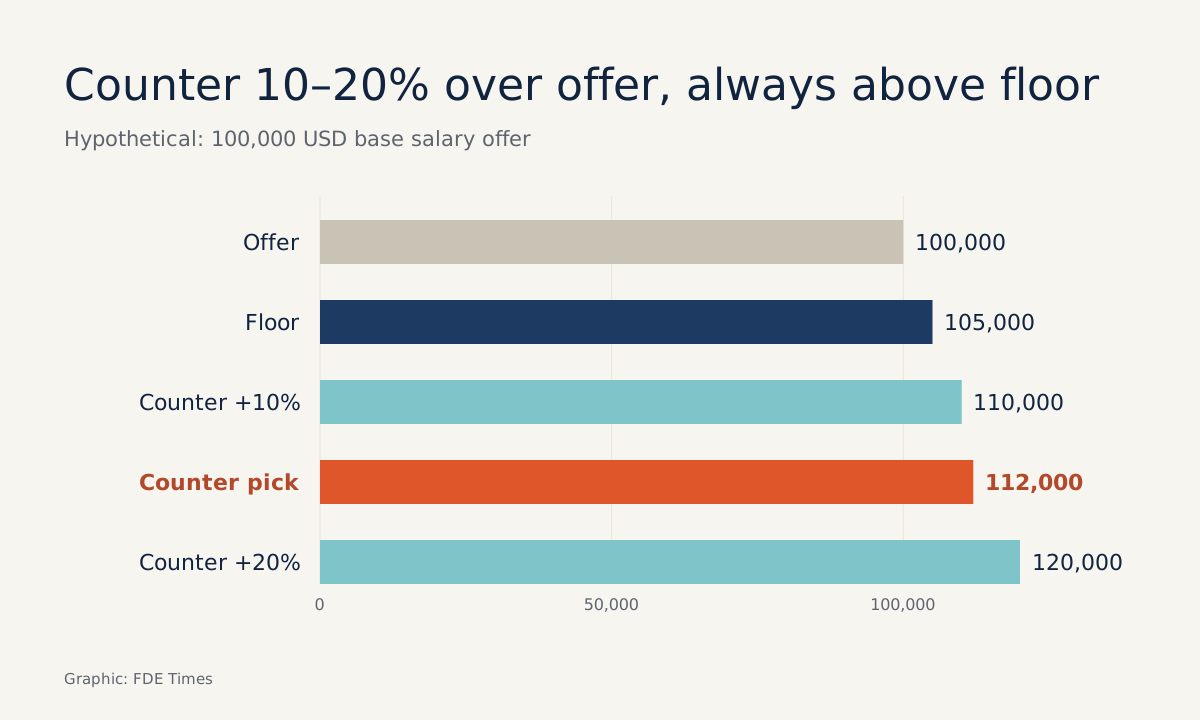
In a guest post on Lewis C. Lin’s site, Doody recommends countering 10% to 20% above the base salary in the offer. The sample email in the book fits that range: the offer is $50,000 and the candidate asks for $56,000. Multiply 50,000 by 1.12 and you get 56,000, a counter 12% higher.
Try this exercise with hypothetical numbers. The offer has a base salary of $100,000, and the floor you wrote down beforehand is $105,000. Doody’s counter range is $110,000 to $120,000. Both ends sit above your floor, so you pick a figure within that range, say $112,000.
If your floor is above even $120,000, that is a sign the offer is still too far off, and you should think carefully before going further.
Idea three: write the email for someone else to forward
Doody’s sample email opens by saying the writer spent the weekend thinking over the offer and is happy with everything, then asks to discuss the base salary a little further. After that comes a figure taken from the offer, a counter figure and a short reason. The whole email is about base salary alone.
With a multi-part FDE offer, the sensible move is to keep that spirit: make base salary the main counter figure, and mention on-site or travel terms only when they genuinely change your costs.
An email with many requests is harder to forward than one with a single number. Consider the draft below and fill in the blanks yourself:
Hi [recruiter name],

I've thought carefully about the offer for the Forward Deployed Engineer role and I'm very happy with everything. I'd like to discuss the base salary a little further.

The current offer has a base salary of [offer amount]. I'd feel more comfortable if we could agree on [counter amount], because [one specific reason, for example my most recent deployment experience].

I'm happy to talk this through by phone at [time] if that works for you.
The final reader may be a manager who has never spoken to you. The draft tells them the current offer, what you are asking for and why, with no one needing to explain anything further.
Two mistakes that blunt a counter
The book does not say outright that your counter must be above your target, but the logic of the 10–20% range leads there: the gap between offer and counter is where the two sides meet. A counter equal to your target erases that gap.
The other mistake is packing several requests into one email: more base salary, more equity, a different start date, fewer on-site days. The approver then has to weigh each item, and a single rejection can stall the whole email. Doody’s sample avoids this by discussing base salary only.
The email structure works beyond salary
Take away the salary, and what remains is a structure: acknowledge what is already agreed, make a calm, clear request with a reason, then settle the next step.
That is the same sequence you need when writing a proposal email to a client. So time spent practising this email for your own offer is also time spent practising a skill you will use again on deployments.
In FDE interviews, if you have written an email that helped someone win approval from their boss, describe it concretely: who approved it, what the email said, and what happened. That story is far more convincing than a line saying “good communicator” on your CV, and next time you have an offer in hand, you will be using that same skill for yourself.
Was this article useful?
Thanks for the feedback!
9 sources
- Read Fearless Salary Negotiation online for free
- fearlesssalarynegotiation.com (llms.txt)
- fearless salary negotiation (OpenCourser)
- An example showing how to deliver your counter offer in an email
- Chapter 4. How to negotiate your new salary
- A simple process to negotiate your starting salary · 2016-10-13
- Fearless Salary Negotiation (book notes) · 2023-10-29
- Josh Doody on Fearless Salary Negotiation
- 274 RR Fearless Salary Negotiation with Josh Doody · Top End Devs · 2016-08-24