A book for product teams that tells FDEs to meet users every week
Teresa Torres wrote for product trios, yet her three core habits fit a customer engagement almost perfectly, starting with a weekly conversation that lasts the whole project.
In brief
- Teresa Torres distilled eight years of coaching hundreds of product teams into a 237-page book, published in 2021.
- Her minimum: contact with customers once a week, with engineers included in the group doing discovery.
- For FDEs, the value lies in making discovery a steady rhythm across the project, not something that stops after the first week.
Teresa Torres spent eight years working with hundreds of product teams before setting down a rule that sounds almost too simple: at a minimum, meet a customer at least once a week. On 19 May 2021 she released Continuous Discovery Habits on Product Talk as the product of all that time.
The book was not written for Forward Deployed Engineers. Read from an FDE’s seat, though, it works as a warning about an easy trap on customer projects: doing thorough customer discovery in the first week, then keeping your head down and building for the rest of the engagement. By demo day, the customer’s needs may have shifted long ago.
If you are an FDE, or about to become one, the book is worth reading not because it is new but because it turns discovery into a habit with a proper calendar.
Written for product trios, useful for FDEs
The book was published in 2021 by Product Talk, Torres’s own company, and runs to 237 pages. In the author’s words, it is a guide for product trios to do discovery in a structured and sustainable way. The trio here is a product manager, a designer and a software engineer.
The detail worth noticing is that the engineer is part of the trio, which means the person writing the code also belongs to the group doing weekly discovery. A continuous discovery guide from Great Question puts it more bluntly in three short sentences: not one researcher each week, but the whole trio, together.
For FDEs that boundary is already blurred. On a customer site you are often the listener, the designer and the person writing the code. The book gives you a process for doing all three without neglecting the first.
Hear stories every week, not opinions
The core habit is interviewing customers every week and, in each session, collecting stories that reveal unmet needs. A story differs from an opinion in that it actually happened: “the last time you handled a returned order, what did you do?” is more reliable than “would you like feature X?”
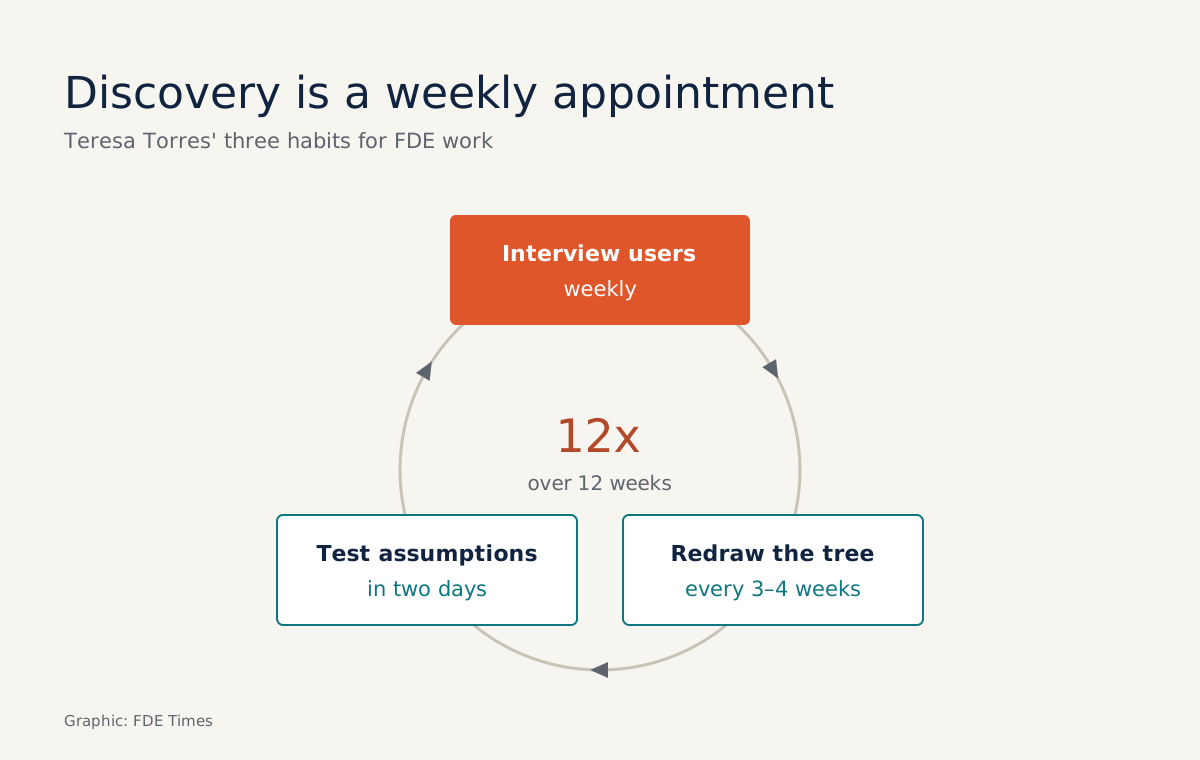
Picture a 12-week engagement deploying a ticket-classification agent for a support team. If you interview only at kickoff, you have one data point. If you keep a weekly rhythm, you have 12 chances to check whether you are still solving the right problem. A fortnightly cadence still works for some teams, but weekly is the most common.
The first thing to do at a customer is ask for a fixed time slot with end users, not with the person who signed the contract. Buyers and users often tell two different stories.
An opportunity tree instead of a list of requests
The book’s central tool is the opportunity solution tree. Product Talk defines it as a way of mapping out the paths you might take to reach a desired outcome. Put simply, every solution on the tree has to show which path leads it to the outcome.
For an FDE, the tree solves a very practical problem: the customer sends a long list of requests, and you cannot tell which ones actually move the outcome. In the support-team example, the outcome might be reducing ticket handling time. “Add an export button” belongs on the tree only if it can show a path to that outcome.
Product Talk offers a benchmark: if you interview at least weekly, the team should revisit the opportunities it has gathered roughly every three to four weeks. In a 12-week engagement, that means redrawing the tree three or four times. Each one is a good moment to explain to the customer why priorities have changed.
Test only the riskiest assumption
The third habit is not to try to prove the whole solution early on. Instead, build small tests designed specifically for the riskiest assumptions.
Go back to the ticket-classification agent. The assumption “the model is accurate enough” sounds like the most important, but the real risk may be “staff will trust the labels the agent assigns”.
A two-day test, showing staff a few dozen pre-labelled tickets and watching whether they redo the work, could save you weeks of tuning a model nobody uses.
Not revolutionary, but worth reading alongside a real project
A comment on a bookseller’s page sums it up fairly: not revolutionary, but worth reading. If you have worked in product, many of the ideas will be familiar. The book’s value is in pulling them together into a working rhythm you can sustain.
The most sensible way to read it is alongside a real project, following Torres’s own advice: start with the smallest possible step and iterate. One call a week is enough to begin; the opportunity tree can wait.
For your career, this skill stands out clearly on a CV if you state the frequency and results. A line such as “interviewed users weekly throughout a 12-week deployment, redrew the opportunity map every 3 weeks, dropped two features that could not be tied to the outcome” is far more persuasive than “strong communication skills”.
When reading FDE job ads, look for phrases like “customer discovery” or “work directly with users”: that is where this line belongs.
Every FDE knows how to talk to customers. What sets some apart is that they are still having that conversation in week ten.
Was this article useful?
Thanks for the feedback!
6 sources
- continuous discovery habits (Product Talk) · 2021-05-19
- Y Oslo 2024: When It Comes to Discovery, Something is Better Than Nothing · 2024-12-18
- Opportunity solution tree (Product Talk) · 2023-12-06
- Continuous Discovery Habits, by Teresa Torres · 2022-10-07
- Continuous discovery guide (Great Question) · 2026-09-14
- Continuous Discovery Habits (Buresund)