Write the press release before the first line of code
Amazon's PR/FAQ, set out by two former executives in Working Backwards, gives FDEs a one-page test of whether a customer's problem is actually clear.
In brief
- Colin Bryar and Bill Carr, two former Amazon executives, describe how the company writes a press release and FAQ before building a product.
- For an FDE, the PR/FAQ is a way to agree the problem with the customer on paper, while changes are still cheap.
- Read the free PR/FAQ explainer first, then the book, and skim the anecdotes.
According to AWS Executive Insights, before Amazon builds a product it writes a press release for the product it expects to launch. In other words, it writes the end of the story before any code exists. In Working Backwards, Colin Bryar and Bill Carr turn that habit into a process that people outside Amazon can learn and follow.
For a forward deployed engineer, this is more than corporate culture. On a customer site, the most expensive mistake is usually not a bug. It is building something technically correct that the customer does not need. The problem is vague, each side reads it differently, and the gap only shows up weeks later.
The PR/FAQ makes both sides read the same page and agree to it, while changing the problem still costs only a few keystrokes.
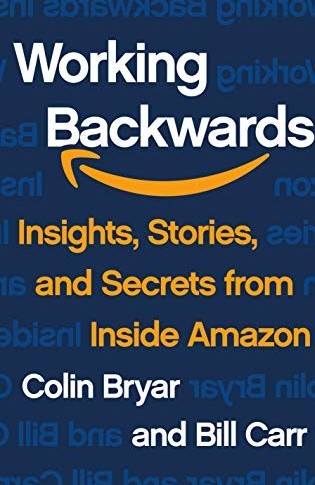
Working Backwards: Insights, Stories, and Secrets from Inside Amazon (St. Martin’s) is an insider’s account, by two former Amazon executives, of the company’s distinctive principles and processes. Publishers Weekly said organisations large and small could take lessons from it, though the personal anecdotes repeat themselves rather often.
The authors define Working Backwards as a systematic way to vet ideas and create new products. For an FDE, the most useful part is the PR/FAQ process, and it contains three ideas you can use on your next engagement.
First idea: the press release forces you to state what you are promising
The authors call writing the press release a “forcing function”, a mechanism that keeps product builders looking at the customer. The key is the order: the press release and FAQ are finished before anything is built.
AWS says the approach rests on the view that the voice of the customer is the most important input in developing any product.
Imagine you are sent to an insurer that wants to “use agents to process claims”. That is a wish, not yet a problem statement. The moment you sit down to write the opening line of the press release, the hard questions appear: who uses it, what work does it take off their plate, and what does success look like?
If the press release needs a number, say how much faster claims are handled, and neither you nor the customer knows how long they take today, you have found your first discovery question. That is what to measure before touching a prompt.
Second idea: one page, written from the user’s side
According to AWS, the press release must fit on exactly one page, and that limit forces the writer to simplify and focus on the big idea. The authors also ask for a precise description of the customer and for the benefits paragraph to be written from the customer’s point of view.
Back to the insurer. “The insurance company” is far too broad a customer. Write “the motor claims adjuster” instead and you have to ask what that person’s working day looks like and where they get stuck. One page cannot hold three user groups and five features at once, so you have to choose.
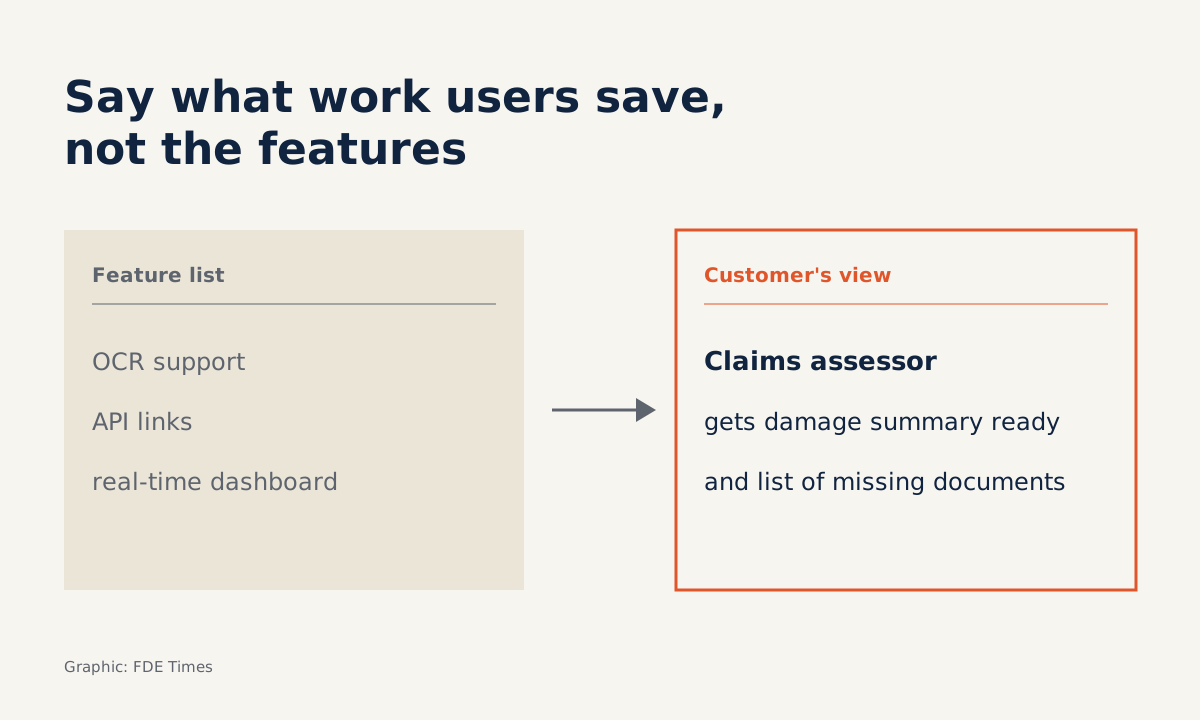
An illustrative opening could read, in full: “From today, every new motor claim that reaches an adjuster arrives with a ready-made damage summary and a list of missing documents.
They no longer have to open each attachment to check whether the customer has submitted everything. The time saved goes to the difficult claims, where their experience really decides the outcome.”
Notice that the paragraph mentions no model, vector database or pipeline. It only says what work a specific person no longer has to do, and what they do with that time instead. You can reuse the template for your own project: who, where they used to struggle, what they get now.
Choosing early also helps you: a narrow scope reaches production faster, and the results are easier to measure.
Third idea: the FAQ is where the problem gets tested
The FAQ has two parts. First comes the external FAQ, the questions customers will ask. Then the internal FAQ, the questions the team must answer. AWS is explicit that it does not include every question it can think of; it starts with the most important one.
In the insurance example, the top external question might be “who is responsible when the agent gets it wrong?”. An illustrative answer: the agent only makes recommendations, the adjuster still decides whether to approve or reject, and every recommendation is logged for later review.
The top internal question might be “which system holds the claims, and do we have access?”. An illustrative answer: the claims sit in the existing claims management system, and the customer’s IT team must grant read access to a test environment before the project starts.
Any question you cannot yet answer is a risk. Put it in the plan rather than letting it surface at the demo.
The authors stress that the best PR/FAQs come from many iterations, with feedback from a cross-functional group. On a customer site, that group is the operations staff, IT, compliance and your own team. Every revision on paper is far cheaper than a revision in code.
Three ways to get a PR/FAQ wrong
The most common mistake is writing the press release as a feature list: “supports OCR, API integration, real-time dashboard”. That list ignores the requirement to write from the customer’s side, because it describes what your team does, not the work the user is spared.
The second is cramming every conceivable question into the FAQ. With thirty questions of equal weight, the reader on the customer side cannot tell which one could kill the project. Do as AWS does: the most important question first, the rest later.
The third is harder to spot: a draft that only your own team reads. If nobody on the customer side comments over a few rounds, the PR/FAQ is just your guess, better formatted, and you lose the very benefit of settling the problem on paper.
In what order should you read?
Start with the explanation of the PR/FAQ process on workingbackwards.com and the article on product management on AWS Executive Insights. Both are free and enough to write a first draft. Then read the book to understand why the process is designed the way it is, and skim the repetitive anecdotes.
The book suits engineers who have just moved into an FDE role, or people with a strong technical background who are still used to picking up a ticket and coding straight away.
If you are changing careers, put a PR/FAQ, with the customer’s details removed, in your portfolio. When an interview turns to customer discovery or scoping, you can show a real document instead of speaking in generalities.
Next time a customer says “we want AI”, do not open the editor. Open a blank page and write the press release the customer would want to read on the day the project is done.
Was this article useful?
Thanks for the feedback!