Made to Stick: why client executives forget your best number
The Heath brothers' 2007 book shows FDEs how to turn a dry metric into a story that client leaders will repeat for them.
In brief
- Made to Stick (Random House, 2007, 336 pages) by Chip Heath and Dan Heath examines why ideas survive or die.
- The six SUCCESs traits: Simple, Unexpected, Concrete, Credible, Emotional, Stories.
- For FDEs, its main value is curing the curse of knowledge when presenting results to client leaders.
“A lie can travel halfway around the world while the truth is putting on its shoes.” The official page for Made to Stick opens with that line, attributed to Mark Twain, and it describes a familiar afternoon in an FDE’s life rather well.
You have just put a system into production, and the metrics are clearly better. Three weeks later, at the renewal meeting, the client’s vice-president asks what the project actually delivered. Nobody remembers the number. The result was not wrong. It simply did not stick in anyone’s head.
That is why a book published in 2007 still deserves a place on the desk of an engineer who works directly with clients. The technical work you can do. Getting client leaders to remember it, and to stand up for the project, has to be learnt.
Who wrote it, and what is it about?
Chip Heath is a professor at Stanford Graduate School of Business; Dan Heath is a senior fellow at Duke University’s CASE centre. Random House published the book on 2 January 2007, at 336 pages, with the subtitle “Why Some Ideas Survive and Others Die”.
The central question is simple: why do some ideas survive and others die? The authors’ site argues that every message that sticks owes it to the same six traits. A summary by Antoine Buteau lists them as Simple, Unexpected, Concrete, Credible, Emotional and Stories, abbreviated to SUCCESs.
The authors promise the book will change how you communicate ideas. Read through an FDE’s eyes, the most valuable part is how to design an idea so that other people carry it forward when you are not in the room. That is exactly the situation you often face: renewal decisions are usually made in a meeting you were not invited to.
First idea: the enemy is your own knowledge
Buteau’s summary captures the core problem in one sentence: experts can forget that their audience does not know what they know. This is the “curse of knowledge”.
Imagine you have deployed an agent that classifies support tickets for a logistics company. Your update reads: “F1 on the eval set rose from 0.71 to 0.86 after we changed the retrieval strategy.” To you, that sentence is complete. To the head of operations, it contains three unfamiliar terms and two numbers attached to nothing they care about.
On site with the client, before sending any document up the chain, reread it and ask: what would the reader need to know first in order to understand this sentence? If the answer is longer than the original sentence, rewrite it.
Second idea: open with a gap
The book teaches how to create a “curiosity gap”: pose a question that makes listeners want the answer before you give it. Many technical briefings do the opposite, opening with an architecture diagram and leaving the result for the last slide.
In the logistics example, the opening might be: “Last month, out of every ten urgent tickets, how many sat in the wrong queue overnight?” Client leaders now have a reason to listen to the next number.
Third idea: give the idea plenty to hold on to
The book is also presented with the concept of the Velcro Theory of Memory. The name alone suggests a useful image: Velcro holds because of many small hooks, so a result with only one hook, the number, falls off easily. Add a night shift and a specific person, and it gains more places to grip.
The table below applies the six traits to the same example, cell by cell.
| Trait | Typical report line | Sticky version |
|---|---|---|
| Simple | Five metrics on one slide | One sentence: urgent tickets no longer sit in the wrong place overnight |
| Unexpected | Result placed at the end | Open with a question about tickets in the wrong queue |
| Concrete | “Accuracy improved” | One specific ticket handled sooner |
| Credible | Numbers from an internal eval set | Numbers checked against the client’s own logs |
| Emotional | No people | Night-shift staff no longer have to recheck the queue |
| Stories | A list of changes | Before and after, told through one shift |
Put together, what does the update look like?
The cells in the table are only useful once they become one coherent message. Here is the same hypothetical result, written twice.
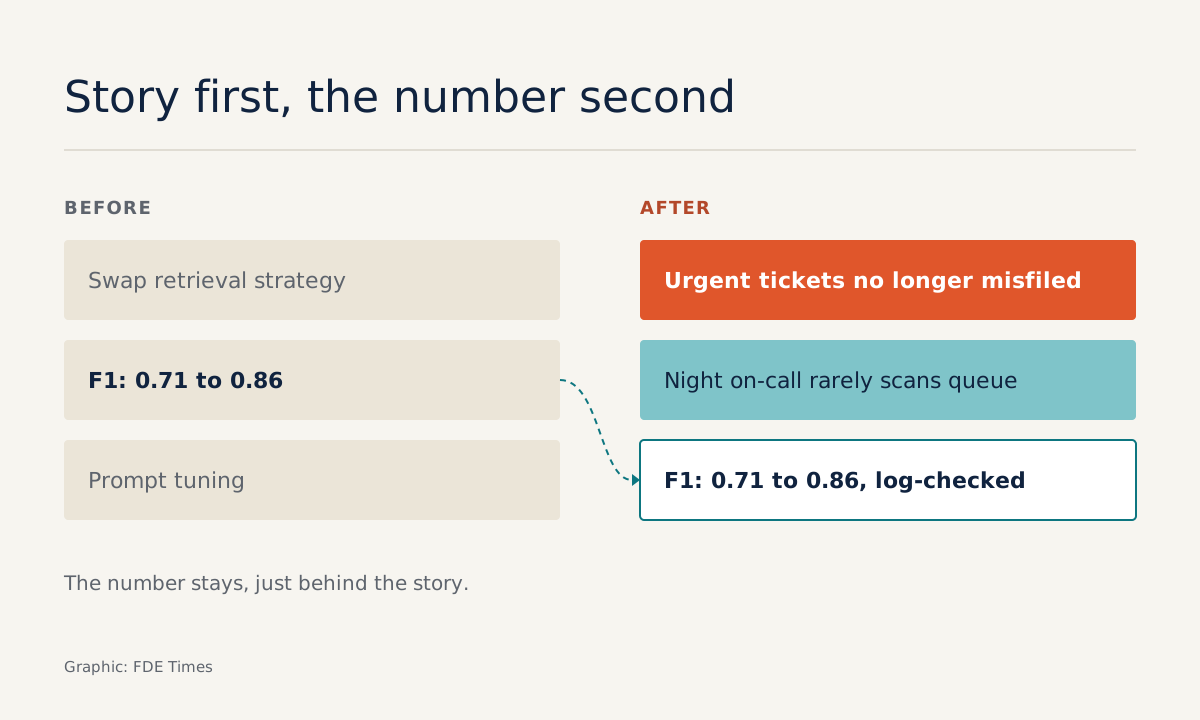
Before: “This sprint we changed the retrieval strategy for the classification agent. F1 on the eval set rose from 0.71 to 0.86. Next steps are prompt tuning and expanding the eval set.”
After: “Urgent tickets no longer sit in the wrong queue until morning. Previously, night-shift staff had to recheck the queue by hand to find misrouted tickets; with the new agent, that work has almost disappeared.
On the numbers: classification accuracy (F1) rose from 0.71 to 0.86, and the result has been checked against the company’s own support logs, not just test data. Next month, the goal is to bring the same approach to the day shift.”
The number is still there; it simply follows the story instead of leading it. The order of revision matters more than you might think: settle the core sentence first, strip the jargon next, then write the opening, and only at the end attach evidence and real people.
Then ask someone outside the team to read it and retell it a day later: what they repeat is what client leaders will remember.
What are the common mistakes in applying SUCCESs?
The first mistake is treating the six traits as a checklist and cramming all six into one sentence. The message becomes long and tangled, and loses the Simple trait itself. Each sentence should carry one or two jobs at most.
The second is getting so absorbed in the story that the number disappears. A story without evidence will not hold up when the finance team asks questions. Keep the number, but place it after the story and tie it to the client’s data. The third is opening a curiosity gap and never filling it, or filling it with a result smaller than the promise.
Who should read it, and what should they read it with?
The book suits engineers who have spent a few years writing code and are starting to report to client leadership, or who are preparing to move into an FDE role. The effective way to read it is alongside a real document: after finishing the section on one trait, open the last update you sent a client and revise it for exactly that trait.
The skill should show when you are job hunting too. If an interview asks about a time you explained a technical result to a decision-maker, have a story ready with a gap, a credible number and a specific person who benefited. Your CV lines should be written the same way, rather than listing bare metrics.
A good number earns you trust. A good story gets client leaders to carry that number into the renewal meeting for you.
Was this article useful?
Thanks for the feedback!