Splink finds duplicate customers, but the match threshold is yours
The cost of a Splink job depends on how many pairs it compares, and its reliability on a threshold that people, not the model, must choose.
In brief
- Splink links records probabilistically and works best with many weakly correlated columns, such as name, date of birth and city.
- Without blocking, the number of pairs grows with the square of the record count: 1 million records produce about 500 billion pairs.
- The match threshold is a business decision, so review the pairs that sit close to it by hand.
Take a client with a CRM, a billing system and an Excel file the sales team keeps for itself. Everyone wants “one customer, one row”, but the three sources share no common ID. Before anyone builds a dashboard or an agent, someone has to solve entity resolution, and Splink was written for that job.
Splink is an MIT-licensed Python package. Version 5.0.0 was released on September 28, 2026. Its PyPI description says it deduplicates and links records across datasets that lack a unique identifier.
The package was developed by the data science team at the UK Ministry of Justice, and NHS England uses it in its probabilistic linkage model project.
For an FDE, two numbers decide whether a Splink job is workable: how much evidence each field contributes, and how many pairs the model has to compare. Both can be worked out by hand before the first line of code.
What is a matching field worth?
Splink is based on the Fellegi-Sunter model, which assesses each field through two probabilities. m is the probability that the field matches when two records really belong to the same person; it falls short of 100% because of data entry errors. u is the probability that the field matches between two unrelated people, purely by chance.
Start with gender. The Splink documentation uses this field as an example: it has only 2 values, so two strangers still agree about 50% of the time, giving u ≈ 0.5. Robin Linacre, Splink’s author, assumes data entry errors make gender disagree in 2% of true pairs, so m = 0.02 for a mismatch and m = 0.98 for a match.
When gender matches, m/u = 0.98 / 0.5 = 1.96, which is only about 0.97 in log2. When gender disagrees, the ratio is 0.02 / 0.5 = 0.04, fairly strong evidence that these are two different people.
Now take the full date of birth. The documentation’s illustration: with ages spread evenly over about 30 years, there are roughly 10,000 possible birth dates, so u ≈ 0.0001. Between two records of the same person, the date of birth almost always matches, say m = 0.98.
The m/u ratio is now 0.98 / 0.0001 = 9,800, or log2 ≈ 13.3. A matching date of birth adds about 13 bits of evidence; a matching gender adds about 1. Linacre’s 2022 introduction makes the same point: a match on date of birth is stronger evidence than a match on gender.
The arithmetic also explains why the Splink documentation says the tool works best with many columns that are weakly correlated with one another. Each independent column adds a fresh piece of evidence. A column that merely repeats another adds no information, even though the model may count it as separate evidence.
Count the pairs before writing code
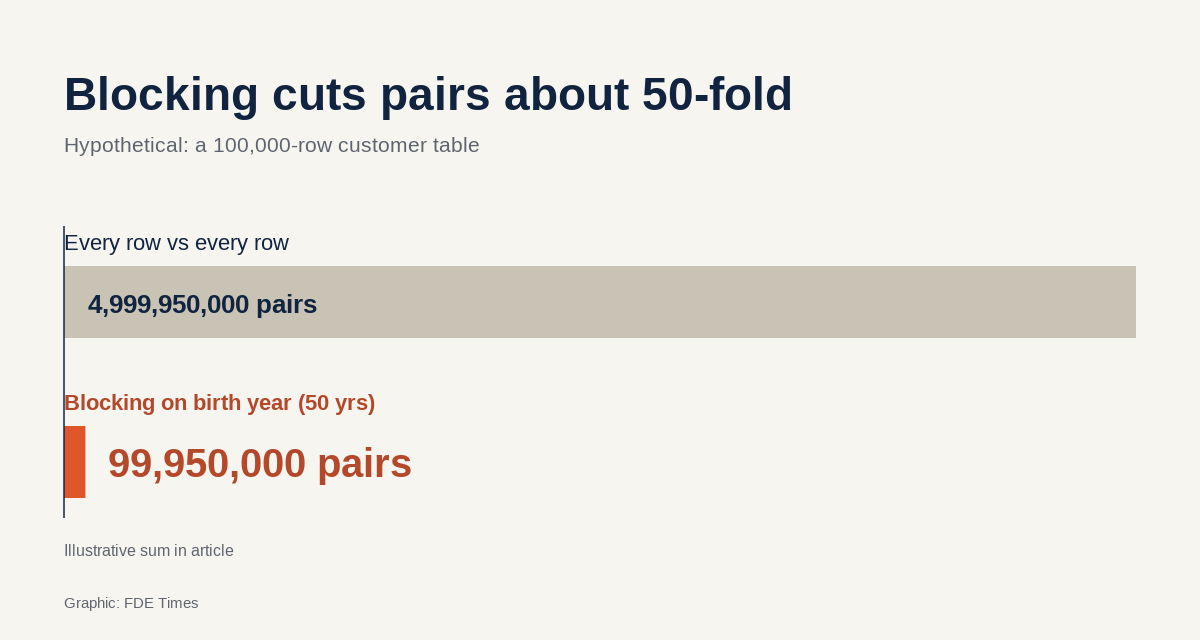
According to the blocking documentation, with no filtering the number of pairs to compare grows roughly with the square of the record count: 1 million input records produce about 500 billion pairwise comparisons. Most of them are between people who have nothing to do with each other.
Splink’s sample dataset historical_50k shows how much blocking cuts. It holds 50,000 rows on historical figures drawn from Wikidata, plus duplicates with errors. Comparing every pair means 50,000 × 49,999 / 2 = 1,249,975,000 pairs, or about 1.25 billion.
In the blocking tutorial, the rule block_on("substr(first_name, 1,1)", "surname"), which compares only records with the same first initial and the same surname, generates 407,200 pairs. That is more than 3,000 times fewer.
The cost of the rule is just as plain: two records of the same person with a mistyped surname will never be compared.
Antonia Kontaratou, author of a Splink tutorial at the National Innovation Centre for Data, calls blocking rules central to generating candidate pairs. So before a run, count how many pairs each rule produces and ask which kinds of duplicate it will miss.
In an internal benchmark on the forthcoming DuckDB 2.0 engine, a predict() job with 1 billion rows and 10 billion comparisons finished in 8.5 minutes, but on a 192-vCPU EC2 machine, not a laptop.
On a client site, most of the runtime you can control sits in the blocking rules.
When not to use Splink
According to the documentation, Splink is a poor fit for matching a single “bag of words” text column, such as a table holding nothing but one long address string. The model needs several independent fields to accumulate evidence. If the client hands over only a company name and an address string, say so plainly in discovery: either more columns are needed, or a different approach.
The second trap is highly correlated columns. Postcode and city say almost the same thing. Treated as two independent pieces of evidence, they can make the model overconfident about pairs that share only a location while every other field disagrees.
The threshold is a human decision
Because each field yields an m/u ratio, adding the log2 values across fields gives the total evidence for a pair. Take a hypothetical pair: gender matches (+0.97), date of birth matches (+13.3), but surname disagrees.
Suppose data entry errors make the surname disagree in 5% of true pairs, while two strangers almost always have different surnames: the ratio is about 0.05, log2 ≈ −4.3.
The total is 0.97 + 13.3 − 4.3 ≈ 10 bits. The threshold is a point on this same scale: set it at 8 and the pair is merged; set it at 12 and it is kept apart. Same pair, two conclusions, and the model does not pick the cut-off for you.
The score at which two records count as the same person has to be chosen by the people running the project. It is a trade-off between wrongly merging two customers and missing a duplicate, and the client needs to understand which way they are leaning.
The UK Ministry of Justice’s algorithmic transparency record says it uses detailed manual review to reduce the risk of false matches and tries to quantify error rates. A team that has run Splink at the scale of a government department still needs human eyes, so a client project should not skip this step either.
On a client site, invite the person who knows the data best to sit with you and go through a few dozen pairs near the threshold. The session helps set the threshold and shows the client why the results can be trusted.
What to learn first, and what to put on a CV
Learn Fellegi-Sunter before the API. Once you can compute m, u and log2 by hand, as with gender and date of birth above, and add them into a score for a pair, you can explain every result to a client.
Next, practice blocking, because that is what decides whether a job runs fast or runs all night. Production comes last: scheduled runs, versioned outputs, and the ability to recover when a run breaks.
When reading FDE job postings, look for roles that involve consolidating customer data from several systems. That is where this skill pays off immediately. On a CV, do not just write “used Splink”. Write how far you cut the pair count, how you chose the threshold and whom you reviewed the results with.
A good matching model is only the starting point. What the client will remember is that the customer table is still right the following week, and that when someone asks why two records were merged, you can answer.
Was this article useful?
Thanks for the feedback!
12 sources
- splink · PyPI · 2026-09-28
- Splink documentation (home)
- The Fellegi-Sunter Model - Splink
- m and u values in the Fellegi-Sunter model | Robin Linacre's blog · 2023-09-22
- What are Blocking Rules? - Splink
- Choosing blocking rules to optimise runtime - Splink
- SplinkDatasets - Splink
- Splink 5.0.0 released - Splink · 2026-09-28
- MoJ : Splink Master Record · 2025-10-06
- Splink: fast, accurate and scalable record linkage · 2022-09-23
- Data Deep Dive - Unlocking entity resolution: An end-to-end guide to overcoming unique identifier challenges with Splink · 2023-11-09
- Probabilistic Linkage Model - NHS England Data Science