The line between an FDE and a Solutions Architect is one commit
Job ads mix up "solutions" and "customer-facing", so find out who owns production code before you take a role that may turn out to be drawing diagrams.
In brief
- FDEs own production code at the client; Solutions Architects deliver architecture documents and usually stop at proof-of-concept.
- FDEs come in after the sale, embedded deep in rollout and operations; the SA role is pre-sales technical advice.
- When reading a job ad or writing a CV, look for evidence of commits to production, not diagrams.
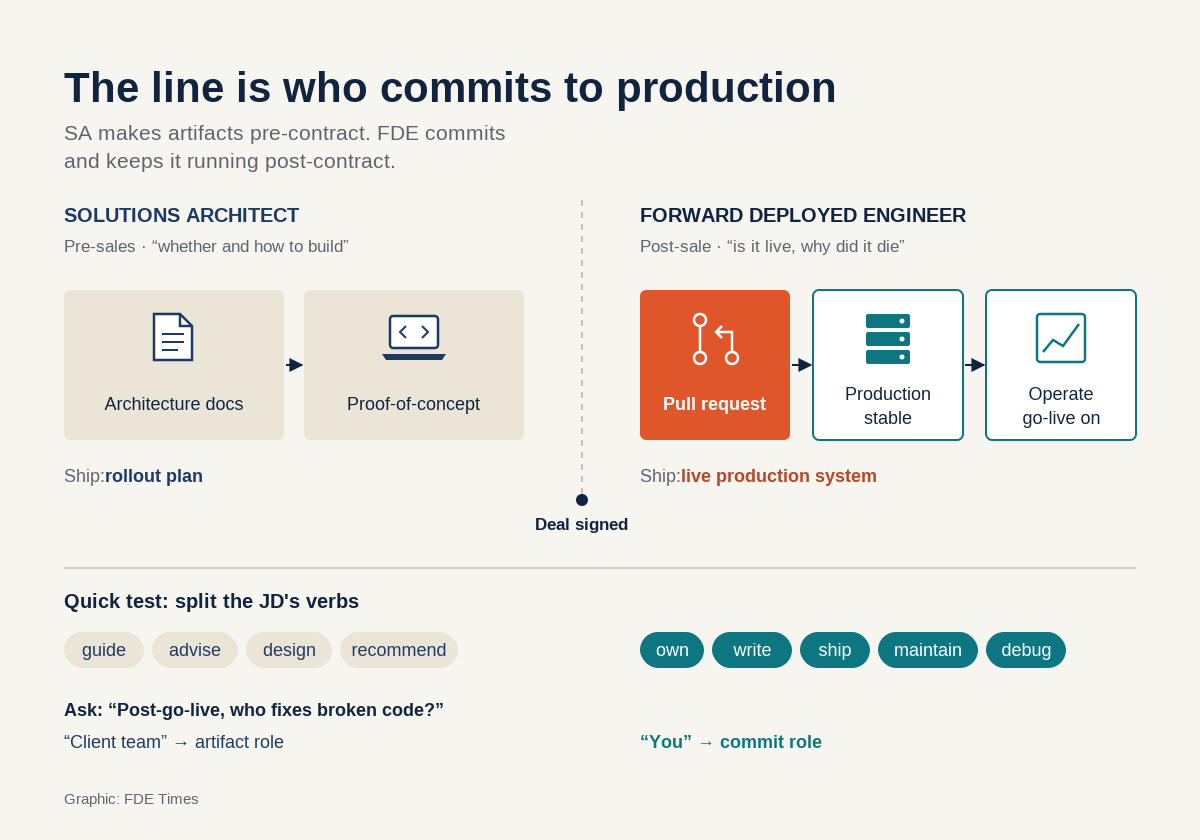
Netguru draws the line in one sentence: Forward Deployed Engineers own the code that runs in production, while Solutions Architects produce architecture deliverables. So nobody misses the point, it adds that an SA creates artifacts, not commits.
Take a first kickoff at a large client. On the table sits a thick architecture design: clean diagrams, every arrow pointing the right way. Nobody in the room is stuck on whether the design is right. The question that goes unanswered is who will open the first pull request against the client’s repo.
That question is where the FDE role ends and the Solutions Architect role begins. A developer thinking about moving into FDE work needs to grasp it before anything else. Plenty of job ads use “solutions”, “architecture” and “customer-facing” interchangeably, so you can accept a job drawing diagrams while believing you will be shipping code. Or the other way round.
A design doesn’t run; a commit does
Start with what gets handed over. Aced’s comparison table puts the two side by side: the FDE delivers a working production system for a specific client, while the SA delivers a deployment plan. On code, the FDE ships and maintains continuously; the SA, according to the same table, usually stops at proof-of-concept.
The timing differs too. Aced places the FDE after the sale, deep in rollout and operations. Anthropic, by contrast, describes its Solutions Architect position as a pre-sales role: a technical adviser to enterprise clients who shapes architecture choices and helps them integrate Claude, without holding the client’s production code.
The two descriptions fit together. The SA stands before the contract and answers “should we build this, and how?” The FDE stands after it and answers “is it running yet, and why did it just go down?”
Companies write the line in verbs
For anyone still in doubt, the job ads of companies hiring for the role settle it. OpenAI, in its FDE listing for San Francisco, asks candidates to own technical delivery across multiple deployments, from the first prototype to stable production. The same listing includes writing and reviewing production code, both frontend and backend, in Python, JavaScript or an equivalent stack.
Palantir’s FDSE listing describes engineers embedded directly with clients to build applications, LLM workflows and production solutions designed around each client’s reality. It is also clear about the cost: expected travel of 25–50%, depending on team and location.
Capicua puts the responsibility more bluntly: writing production code directly on the client’s infrastructure and data.
Note the verbs: own, write, review, build, ship. These FDE descriptions lean heavily towards acting on code, a contrast with the verb “guide” in Anthropic’s SA listing. That is the fastest test when skimming a job description on your phone.
Same problem, two ways in
A hypothetical case shows the difference in practice. An insurance company wants to use an LLM to classify and route claims. Both an SA and an FDE are brought in.
The SA sits down with the client’s CTO and asks about volume, SLAs and where the data is allowed to go. The output is a document: the ingest flow, the classification step, the routing step, the model choice, the fallback plan. It may come with a proof-of-concept notebook run on a few hundred samples to show the idea is feasible.
The document is approved, the contract is signed, and the SA moves on to the next client.
The FDE takes that document and clones the client’s repo. They find that the real claims table has a status column nobody mentioned in the document, that the internal auth system blocks new service accounts, and that the nightly pipeline runs before the data has synced. None of the three appears anywhere in the design.
The FDE fixes the migration, writes an auth adapter, changes the schedule, opens a pull request, waits for the client’s platform team to review it, then watches the dashboard through the first week after go-live.
Consider two replies to the same Friday-afternoon message from the client: “The schema just changed, it has to run on Monday.” The SA, true to the role, replies that the document needs updating and the estimate revising. The FDE replies with a link to a pull request. Both are doing their jobs. They are simply different jobs.
Check which side you are being hired for
Step one: read the job description and pull out the verbs. If most of them are guide, advise, design and recommend, it is an SA role even if the title says “engineer”. If they are own, write, ship, maintain and debug, it is an FDE role even if the title says “solutions”.
Step two: in the interview, ask one specific question: “After go-live, if code I wrote causes a bug, who fixes it?” If the answer is “the client’s team” or “the product team”, you are discussing an artifact role. If it is “you”, it is a commit role.
Step three: ask about timing and place. Do you come in before or after the contract is signed? Does the code run in the client’s infrastructure or in the company’s demo sandbox? What share of your time is on site with the client? Palantir answers the last question in its job ad; where companies are vague, you have to ask.
Step four: write your CV by the same logic. A line such as “designed the architecture for system X” tells an FDE hiring manager that you produce artifacts. A line such as “shipped system X to production at client Y and maintained it through three releases” says you produce commits and answer for them. The second line is what they are looking for.
Common mistakes
The biggest mistake is thinking an FDE is just “an SA who can code”. Many SAs are excellent coders. What separates the roles is whose name is on the commit that actually runs, and who has to answer when it breaks. A proof-of-concept running on a laptop, however good, is still an artifact.
The second mistake is treating a pre-sales demo as a deployment. A demo exists to prove capability and close the deal. A deployment exists to survive the client’s dirty data, unfamiliar auth and batch schedules. If all your “customer-facing” experience is demos, you do not yet have evidence for an FDE role.
The third mistake is dodging operational responsibility once you are an FDE. Aced places the FDE “deep in rollout and operations” for a reason. Ship and disappear, and you are doing an SA’s job with an FDE’s level of risk.
This week’s exercise
Open your CV and mark each line of experience: which lines describe artifacts, and which describe commits that actually ran. Pick one artifact line and rewrite it as something you shipped and maintained, or admit that you do not yet have that evidence.
A design says how a system should run. The FDE is the one responsible for making it run.
Was this article useful?
Thanks for the feedback!
6 sources
- Forward Deployed Engineer vs Solutions Architect: Hire the Right Role · 2026-09-23
- Forward Deployed Engineer vs Solutions Architect (2026)
- Solutions Architect, Applied AI (Anthropic)
- Forward Deployed Engineer - SF (OpenAI, Built In) · 2025-08-05
- Forward Deployed Software Engineer (Palantir)
- About The Forward Deployed Engineer Role · 2026-07-23