Palantir gives deployment to two people. At a startup, you are both
The Echo finds the right problem and the Delta builds; doing both means knowing which mode you are in, and writing the brief that links them.
In brief
- At Palantir, Echo (Deployment Strategist) finds the right problem and drives adoption, while Delta (FDE) writes the production code that solves it.
- Echo without Delta can only manage relationships and delivers no product. Delta without Echo can easily build for the wrong problem.
- Many AI startups have no Echo team, so the FDE plays both roles. The handoff brief between the two modes is the skill most worth practicing.
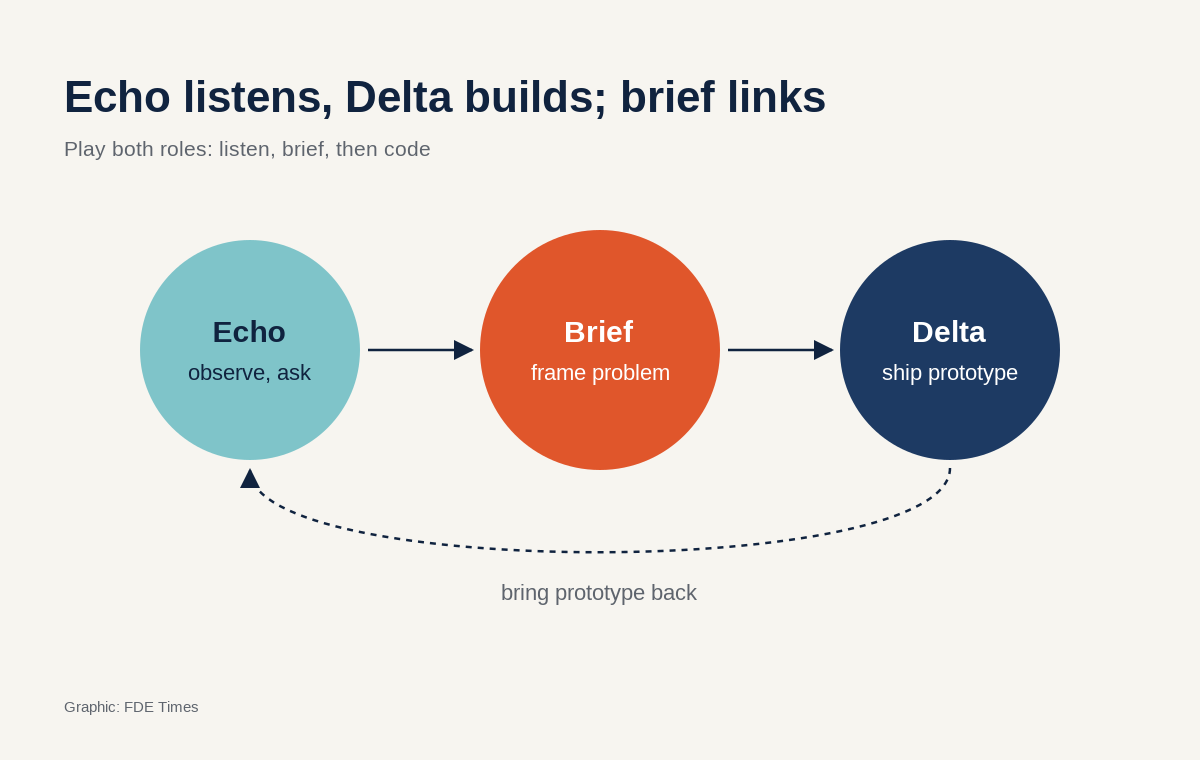
At Palantir, deployment work is split between two people. Echo identifies the right problem; Delta builds the solution to it. If you are an engineer who writes production code, your role is Delta, the Forward Deployed Engineer.
If your strength is deep knowledge of an industry and managing customer relationships, you are closer to Echo. At most AI startups, though, you will have to do both.
Your first week at a customer site, and the first meeting already brings three conflicting requests. The head of operations wants a dashboard, accounting wants an Excel export, and the IT team has a single instruction: don’t touch the database. Part of you wants to open the laptop and start coding; part of you wants to ask ten more questions.
Palantir does not ask one person to absorb both of those pulls. One analysis of the model describes the two-person pairing as designed so that both pressures are always present, always competing and correcting each other. If your team has no one in the Echo role, the people who do well are the ones who know which mode they are in at any given moment.
Palantir Delta vs Echo: how do they differ?
Delta is Palantir’s internal name for the Forward Deployed Engineer. Echo is the Deployment Strategist, responsible for the business side and adoption. In the original structure, Echo was an analyst who sat with the customer and brought deep domain expertise. Delta took the problem Echo had defined and quickly built a working prototype.
| Aspect | Echo | Delta |
|---|---|---|
| Also called | Deployment Strategist | Forward Deployed Engineer |
| Focus | The customer’s mission, stakeholders, adoption, operations | Technical execution |
| Core work | Use-case discovery, defining the right problem | Building a working prototype fast, then turning it into a solution |
| Typical background | Military, healthcare, forensic accounting; usually not software engineers | Engineers who write production-quality code |
| Owns | The customer relationship and adoption | The code and the delivered solution |
| Closest to | Product manager | Engineer |
The last row needs a caveat. A 2022 Palantir post, as quoted elsewhere, says that in theory Echo leans toward product management and Delta toward engineering, but in practice both roles blend. The table is best read as each role’s center of gravity, not a hard boundary between two people.
Delta also differs from a product engineer (Dev). According to a 2019 Palantir document, as quoted, a Dev builds one capability for many customers, while a Delta builds many capabilities for one customer.
The value lies in the handoff
One assessment of how the two roles depend on each other is blunt: an Echo team without Deltas can only do relationship management and delivers no product. The reverse is easy to infer. A Delta without an Echo may code quickly, but for a problem the customer does not actually have.
Many AI startups today have no Echo team, so the FDE does both jobs at once. The handoff between the two roles then often lives only in your head, and that is where it breaks. You think you understand the customer when you have really only heard the loudest person in the meeting.
Example: late shipments at a cold-storage warehouse
Take a hypothetical deployment for a cold-storage company, where the initial request is “build a dashboard to track late orders.” In Echo mode, you don’t mention dashboards yet. You go to the warehouse and sit next to the shift lead, and the conversation might go like this.
You: Were any orders late this morning?
Shift lead: Three. The truck arrived but the goods hadn’t left the freezer room.
You: How did you find out?
Shift lead: The driver called.
He opens the dispatch team’s Excel file to check whether anyone had started picking the order.
You: If you’d known 30 minutes earlier, what would you have done differently?
Shift lead: I’d have pulled people from another area to pick it in advance.
At this point the problem has changed. The customer doesn’t lack a dashboard. What they lack is an early warning when an order is close to its truck arrival time and nobody has started picking it. You turn that into a brief:
HANDOFF BRIEF — Cold storage, morning shift
1. User: shift lead, on the warehouse floor, phone only
2. Bottleneck: truck has arrived, goods still in the freezer room
3. Current workaround: driver calls, shift lead checks the dispatch Excel file
4. Decision they want to make earlier: move staff over to pick the order
5. Minimal prototype and constraints:
   alert when an order is <30 minutes from truck time and nobody is picking it;
   read-only data access, no writes to IT's database
Now you switch to Delta mode. The brief has pinned down the user, the timing and the constraints, so a polished interface can wait. A job that reads the dispatch file every five minutes and texts the shift lead is enough to test over a single shift.
The brief also pushes accounting’s Excel export request out of this cycle. You log it for the next one.
Doing both roles yourself: the concrete steps
The first step is to separate your time. Set aside blocks of the day purely for observing and asking questions, and forbid yourself from proposing solutions during them. In Echo mode, the best questions are about where users get stuck and how they currently work around it, not about features.
The second step is to write the brief before you code, even if you are its only reader. If you can’t fill in “decision they want to make earlier,” your Echo work isn’t finished. Once every section is filled in, give yourself a short deadline, because Delta’s value lies in getting a working prototype quickly.
The third step is to take the prototype back to the warehouse floor and return to Echo mode. Check whether users actually use it, because adoption is the part Palantir makes Echo responsible for. Then update the brief for the next cycle.
Three common traps
The most common trap for people with a technical background is skipping Echo. You hear “dashboard” and build a dashboard, then find out two weeks later that the main user stands on the warehouse floor and never opens a computer. The opposite trap is staying in Echo mode too long: meeting after meeting, excellent relationships, nothing shipped.
The third trap is harder to see: doing Delta work with a Dev’s mindset. You start generalizing the alert for every warehouse and every order type, when Delta’s job is many capabilities for this one customer. It is better to note what could be reused and pass it to the product side.
Frequently asked questions about Delta and Echo
Is Delta the same as an FDE? Yes. Delta is Palantir’s internal name for the Forward Deployed Engineer, and Deltas write production-quality code.
Does Echo need to code? According to analyses of the model, Echoes are usually not software engineers. They often come from the military, healthcare or forensic accounting, and they own the customer relationship and adoption.
Does anyone outside Palantir split the two roles? Most AI startups have no Echo team, so the FDE covers both. When reading a job description, check whether the company hires a separate “Deployment Strategist” or expects the FDE to handle discovery too.
Showing both roles on your CV
If a company wants its FDEs to handle discovery, don’t just list your stack on your CV. Write in sequence: whom you observed, what problem your brief pinned down, what you shipped and after how many days. Recruiters will see that you can do both Echo’s and Delta’s work.
Palantir assigns two people to this job so that two pressures, understanding the right problem and shipping fast, are always present and correcting each other. When you carry both, the skill to practice is recognizing which hat you are wearing before you walk into the meeting.
Was this article useful?
Thanks for the feedback!
7 sources
- What is Delta? Meaning & Definition
- Echo and Delta: The Two Modes of One Craft
- The Difference Between a Forward Deployed Engineer and a Consultant With a Better Title Is One Design Decision
- A Comprehensive Analysis of Palantir's Forward Deployed Engineering Model
- How Palantir Invented the Forward Deployed Engineer Model
- Forward deployed, Palantir style
- Deployment Strategist vs Forward Deployed Engineer