An FDE's real working day begins at the client's standup
The hardest habit to learn is triaging the client's overnight messages, catching blockers in their standup and turning vague requests into tasks before writing any code.
In brief
- Paraform says most FDEs work on the client's calendar. FDE Academy says the day's priorities get settled at the client's standup.
- Clients tend to report problems asynchronously, so FDEs have to triage before the working day starts. It is the skill that most clearly separates the strong FDEs from the rest.
- The main job in standup is to catch blockers and turn vague requests into concrete tasks. Building comes after.
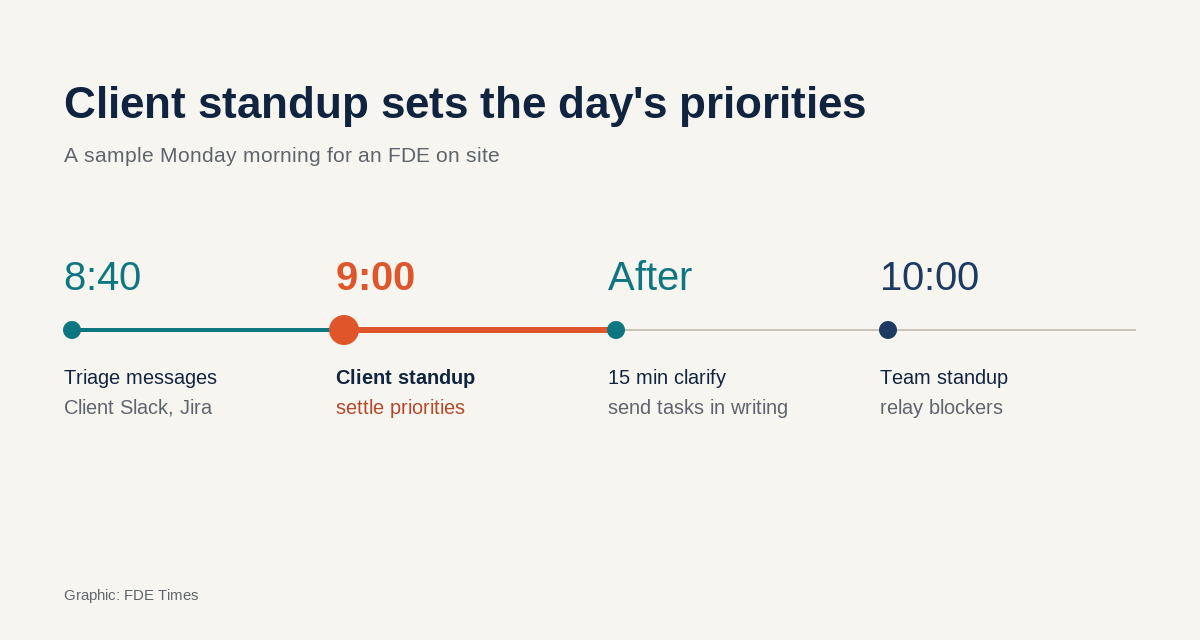
It is 8:40 on a Monday morning and the engineer has just sat down at a desk in the client’s office. The client’s Slack holds four messages sent on Sunday evening, and their Jira has one new ticket. The client’s engineering team holds its standup at 9:00. The engineer’s own company does not hold its standup until 10:00.
Engineers who come from product work tend to treat the 9:00 meeting as “the client’s thing” and the 10:00 meeting as the real work. FDEs see it the other way round. Paraform observes that most forward deployed engineers work on their client’s calendar rather than their own company’s.
FDE Academy also writes that FDEs embedded with a client team attend the client’s standups too, and that this is the meeting where the day’s priorities actually become clear.
For a developer hoping to move into FDE work, this may be the hardest habit to change, because it reverses how you decide what to do first. Sitting through all the meetings is not enough. What needs practice is three small habits: triage before standup, catch the blockers during standup, and turn what the client says into tasks.
The gap to fill sits in the client’s calendar
PostHog defines an FDE as someone placed inside a client’s team to close the gap between what the product can do and what the client actually needs, sometimes working directly from the client’s office. That gap rarely shows up in your own company’s backlog.
It usually surfaces at the client’s standup, when a data engineer complains, say, that a pipeline is stuck because nobody has granted read access to a table.
The time spent at the client is also greater than many expect. A Palantir posting for a Forward Deployed Software Engineer on its US government work requires candidates to be on the client’s site four to five days a week, and describes the job as working directly with customers, often on site, to understand and solve their problems.
PostHog says its FDEs attend a lot of meetings, do a lot of work directly with customers and often travel 20-50% of the time. When most of the working week happens inside the client’s building, their rhythm becomes yours.
The sample week Paraform describes makes the point. On Monday, the FDE attends the client’s standup and sets the week’s priorities around whatever is blocking them; only on Tuesday does the focus shift to building in the client’s environment, on real data and within their deployment constraints.
Before 9:00: walk in with answers
FDE Academy notes that clients often report problems asynchronously, so these need to be triaged before the working day begins, and it treats triage as the skill that most clearly shows which FDEs are good. Covering several accounts at once makes it harder, because you have to decide for yourself where to look first.
The aim of triage is to be able to say in standup “I’ve looked at it, here’s the hypothesis, here’s the ETA” instead of asking “what happened?”. Take a hypothetical logistics client, starting with the most urgent item:
TRIAGE — Monday, before client standup (9:00)
Sources: client Slack (4), client Jira (1)

[P0] This morning's inventory report is empty
  Impact: operations team can't confirm orders this morning
  Hypothesis: last night's ETL job failed reading the new table
  Next: check job logs, give an ETA in standup
The other two items are lighter, followed by one question the client has to decide:
[P1] Wants a "source warehouse" column on the dashboard
  Impact: more convenient, but blocks nobody
  Next: ask in standup who uses it and what decision it informs
[P2] Asking how to export CSV
  Next: send the docs link, no need to raise in standup

Client decision needed: who approves read access to the new table?
The ranking rests on three questions: is anyone blocked, who is blocked, and whose decision is needed to unblock them. The order in which messages arrived, or how urgent the sender sounds, does not count.
In standup: translate the client’s words into tasks
According to Blockchain Council, an FDE’s job in client meetings is to turn requests such as “we need better visibility into risk” into concrete technical tasks. Standup is where such phrases turn up most often, usually tucked between two progress updates, and they are easy to miss.
Continuing the same example, the exchange might go like this:
Head of operations: This week operations needs better visibility into late-delivery risk. FDE: Where are you tracking risk today? Head of operations: An Excel file, someone updates it by hand on Friday afternoons. FDE: If you saw it earlier, what would you do differently: reassign trucks, warn customers or switch warehouses? Head of operations: Switch the dispatch warehouse.

FDE: How far ahead do you need to know about a delay to switch warehouses in time? Head of operations: At least 24 hours.

→ Task: alert on orders at risk of delay at least 24 hours ahead, grouped by warehouse
→ Recipient: shift lead at each warehouse
→ Done when: shift leads receive the alert before the order cut-off
The whole exchange takes about a minute. You do not design the solution in standup; you only ask enough to know who will act, what they will do and how much warning they need. The rest goes into a 15-minute conversation straight afterwards, followed by a written task the client confirms.
The internal standup still matters, in a different role
Putting the client’s calendar first does not mean skipping your own company’s standup. At the internal meeting, you bring back the client’s blockers and spell out what you need from the product or platform team.
Blockchain Council describes the FDE’s working rhythm as a loop of triage, discovery, build, test, train, document, then repeat. Applied to a single day, the loop starts with the triage note before 9:00, moves to discovery during standup, and only then gets to opening the editor.
This sequence can be practiced in your current job. Each morning, read every request sent since the previous evening and write a three-level triage note. In the meeting, raise the P0 first with a hypothesis and an ETA, then listen for vague phrases and keep asking until you know who will do what differently.
After the meeting, send the tasks in writing. At the end of the day, check whether what you worked on matched the blockers from that morning.
Five common mistakes
The first mistake is attending the client’s standup as a spectator: listening and taking notes but taking on no work. The client will quickly see you as an outsider. The second is bringing your own company’s calendar into the client’s meeting room, for instance reporting internal sprint progress when they only want to know when the inventory report will run again.
The third is triaging in the order messages arrived, or by whoever chases hardest. The fourth is debugging during standup, which stretches a 15-minute meeting to 45 and wastes the whole client team’s time.
The fifth is the hardest to spot: understanding a request in your head but never writing it back for the client to confirm, and discovering on Friday that the two sides understood it differently.
How to show this on a CV
When reading an FDE job description, look for phrases such as “on-site”, “% travel” or “embedded with customer teams”. They tell you who will own your calendar. The number of days on the client’s site listed in the description is the quickest way to picture a real week in that role.
On your CV, instead of writing “collaborated with stakeholders”, be specific: which client team or internal users you met with daily, what kinds of requests you triaged, and which feature a vague request became in your hands. Expect to be questioned in depth on that very story, so pick one you can tell in full detail.
Anyone can attend meetings. The skill worth practicing is leaving the client’s meeting room holding exactly the work that needs doing.
Was this article useful?
Thanks for the feedback!
5 sources
- What is a forward deployed engineer? A complete guide (Paraform) · 2026-09-03
- A Day in the Life of a Forward Deployed Engineer: What the Work Actually Looks Like (FDE Academy) · 2026-04-10
- A Day in the Life of a Forward Deployed Engineer: Real-World Tasks and Challenges (Blockchain Council) · 2026-06-22
- WTF is a forward deployed engineer? (and why everyone is hiring them) (PostHog) · 2026-02-11
- Forward Deployed Software Engineer - US Government (Palantir, Lever)