At IBM, the forward deployed engineer is one of three or four
In IBM's Forward Deployed Unit, the FDE directs agents, splits ownership with teammates and leaves behind systems the client can run without them.
In brief
- IBM describes the FDU as a small, permanent unit in which the FDE shares a seat with the architect, alongside an outcome owner and a domain expert.
- IBM tasks the FDE with orchestrating AI assets and agents into business solutions, so the core skills are dividing work and reviewing output.
- The six-person team at launch and the three- or four-person team in September are two different IBM descriptions, not a measured trend.
When IBM launched its Forward Deployed Unit (FDU) on May 14th 2026, it claimed that a six-person pod could do the work of a 30-person team. That was IBM’s own claim about what the model can do, and the announcement came with no data to back it.
By September, another IBM article described a typical unit of just three or four people, with the FDE sharing a seat with the technical architect. The two figures are two separate descriptions of the model by IBM. They do not match, and they should not be read as evidence that the teams are steadily shrinking.
If you are used to the OpenAI-style FDE, an engineer who owns the client’s problem all the way to production, the FDU puts you somewhere quite different. You are one of three or four people, with a whole force of agents alongside you, and your job is to assemble all of it into something that works.
One strong engineer, or a whole system?
OpenAI writes that the FDE’s job is to solve the client’s problem robustly enough that the client is willing to own it once it runs in production. Its FDEs do not need to know the industry on day one, but they are responsible for learning it. Everything rests on one person with broad abilities.
IBM spreads those abilities across several people. The launch announcement describes the FDU as made up of domain experts to redesign processes, architects to connect strategy with execution, and engineers. Verdict, reporting on the launch, likewise described a pod of technical, business-process and architecture specialists.
In a June analysis, IBM called the FDE the fourth role, alongside the person responsible for client outcomes, the domain expert and the architect. The company tasks the FDE with orchestrating AI assets and agents into business solutions.
IBM also says the unit is permanent and does not disband after each project. It frames this as a shift in consulting: fewer recommendation decks, and more systems built by the engineers themselves.
As the FDE in an FDU, you do less of everything yourself, but you have to make your work fit with everyone else’s and with the agents’.
Three people, fifteen agents: the first week
Take a hypothetical example. The procurement department of a manufacturer wants to automate matching supplier invoices against purchase orders. The unit consists of an owner of the business outcome, you (FDE doubling as architect), a procurement specialist, and about fifteen agents.
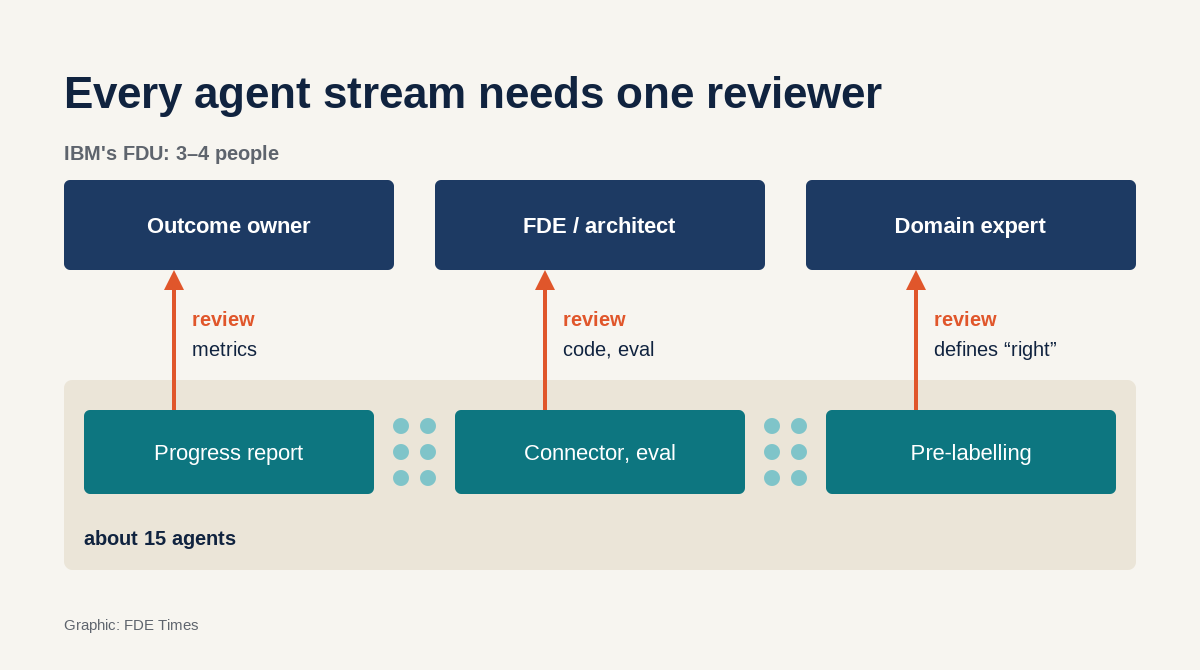
The solo FDE’s instinct is to start coding on day one. In an FDU, the first job is drawing boundaries: which decisions belong to whom, which agent takes work from whom, and who reviews that agent’s output. The table below shows one way to split it.
| Role | Owns decisions on | Delegates to agents | Reviews output |
|---|---|---|---|
| Outcome owner | Success metrics, priorities | Compiling progress reports, measuring metrics weekly | Business metrics against targets |
| FDE / architect | Integration architecture, access, deployment approach | Generating connectors, extracting invoices, writing tests, running nightly evals | Code and eval results |
| Domain expert | What a correct match is, which exceptions need a human | Drafting user interview questions, preliminary labeling | The definition of “correct” in the eval set, labeled samples |
The last column is the one most often left empty. Fifteen agents running in parallel produce more output than three people can read. So each agent stream needs exactly one reviewer with clear criteria, such as reviewing a random sample or only passing work once the eval clears an agreed threshold.
Note, too, that the definition of a “correct match” belongs to the domain expert, not to you. A solo FDE has to learn the domain and infer this through customer discovery sessions. In an FDU, the skill you need is turning your teammate’s answers into test cases that run.
Agents are colleagues with access badges
When agents work inside a client’s systems, whoever holds the architect role takes on a block of work few people plan for. The safe approach is to manage each agent like a new employee account.
An agent should have its own identity, receive only the permissions it needs, go through the same access-request process as a person, and have every action logged somewhere the client’s security team can read. The invoice-extraction agent needs read access to the invoice folder. It does not need write access to the ERP.
Present the list of agents and each one’s permissions to the security team in the first week. Letting them discover it midway through is the surest way to turn a routine conversation into an investigation.
Training wheels only help if they come off
Forrester likens FDEs to training wheels on a bicycle: genuinely useful, immediately, on the condition that someone eventually takes them off. The FDU, by contrast, is a permanent IBM unit. Precisely because the unit does not disband on its own, the question of what the client will ride on afterwards has to be asked early.
The practical answer is a set of handover assets. For the invoice-matching example, that set should include versioned prompts, an eval set whose definition of “correct” is signed off by the domain expert, a data mapping, the list of agents and their permissions, and a runbook so the client’s team can rerun the evals themselves when the model changes.
Create the folder for these assets on day one and have each role fill in its part throughout the engagement. Leave it to the final week and you will only manage to hand over documents describing the system, when what the client needs is assets that run.
Where people stumble when moving to a unit model
The most common mistake is the solo-minded FDE who keeps hold of every decision. You define what counts as correct instead of the domain expert, or change the success metric without asking the outcome owner. The result is three people holding three versions of the same truth.
The second mistake is treating agents as personal tools. An agent running on your tokens and your permissions sits outside the client’s access process, and vanishes from the system the moment you leave the project.
The third mistake is measuring productivity by the number of agents running. IBM pairs a small unit with a large agent force and sets it against an old-style project needing about 300 people for 12 to 15 months.
That comparison only means something when each agent’s output has a reviewer and an eval attached; fifteen unchecked streams are fifteen sources of errors.
What this changes on your CV
When reading a job posting, work out whether you will be the only engineer at the client or one role in a multi-skilled team. The two jobs call for different skill sets, so the question is worth asking in the first round.
The OpenAI-style model needs someone resourceful across a wide range who learns the domain on their own. The unit model needs someone who can draw boundaries, govern agents and hand over.
On your CV, do not just list what you built. Describe how you worked with domain experts, how you granted permissions to automated components, and what the client could run on its own after you left.
If you are applying to a team that works on the unit model, have a concrete story ready for each of these points.
IBM writes that a unit’s capacity is now limited by senior judgment at the hardest points, and that the volume of tasks produced by junior staff is no longer the measure. For an FDE, that judgment is graded on the day the training wheels come off: whether the client can keep riding on its own.
Was this article useful?
Thanks for the feedback!
7 sources
- A New Way to Make AI Actually Work in the Real World (IBM Newsroom) · 2026-05-14
- IBM: New Forward Deployed Units Model Aims To Accelerate Enterprise AI Deployment · 2026-05-17
- AI is tightening consulting teams—and raising the bar for who's on them · 2026-09-21
- IBM Consulting's field model for scaling AI and transformation · 2026-06-18
- IBM rolls out FDU (Verdict) · 2026-05-15
- Forward deployed engineering means...
- Forward-Deployed Engineers Are The Training Wheels For AI Reinvention · 2026-07-30