Ten customer interviews in, the best signal is the workaround
A one-page snapshot per session, clusters counted by interview and four filters turn ten sets of notes into one problem worth weeks of work.
In brief
- Write a one-page snapshot right after each session, while the stories are still fresh, and only then synthesize across sessions.
- A cluster is strong only when many interviews mention it, customers raise it unprompted, and a workaround already exists.
- Before choosing, measure how much time the current process costs or how many errors it causes, then ask whether anything needs to be built at all.
Jakob Nielsen issued a warning that every FDE doing discovery should tape beside the screen. People, he argued, can come up with an opinion about anything, and they will do so when asked.
The warning becomes more dangerous at the moment you sit in front of ten files of notes and have to decide what to build.
By the tenth interview, memory has started to play tricks. The most recent session sounds loudest, the most articulate speaker seems most right, and a director’s offhand “if only we had a dashboard” can easily drown out a story an operations clerk told in careful detail.
The synthesis decides where the team will spend several weeks of effort. It therefore needs a process; gut feel is not enough.
The process below has three layers. Each interview is condensed into one page. The observations are grouped into clusters. Then the clusters pass through a few filters until only one problem remains.
No synthesis until every session has a snapshot
Teresa Torres, author of Product Talk, proposes the interview snapshot: a template exactly one page long for quickly capturing what you learned from an interview. She recommends writing it immediately after the interview, while the stories are still fresh. Leave it until the end of the week and you will be recording your own impressions instead of the customer’s words.
Snapshots matter because they turn ten interviews of different lengths into ten documents in the same format, which can be laid side by side and compared. Give each page a few fixed sections: the interviewee’s role, the specific story they told, the workaround they use, the cost of the current process, and a handful of memorable verbatim quotes.
The most important section follows from Nielsen’s warning. Separate two kinds of notes: what the customer raised without prompting, and answers to your direct questions. A simple “volunteered” or “asked” tag beside each line is enough; when you filter clusters later, that tag tells you which ones to trust.
Cluster the notes first, name the clusters later
Nielsen Norman Group defines affinity diagramming as organizing related observations, ideas or findings into distinct clusters. The method has three stages: first create the notes, then group them into clusters or themes, and finally prioritize the clusters and decide the next step.
In practice, copy each observation from the snapshots onto its own card and write the interview code on it, such as P3 or P7. The code lets you count how many sessions a cluster appears in, not merely how many cards it holds. One person making the same point five times still counts as one session.
NN/g recommends doing this with the whole team, to encourage discussion and make decisions easier. It also warns about dominant people or personalities who can pull the group in one direction.
When the team cannot agree on priorities, NN/g suggests dot voting: each person gets a fixed number of votes and sticks them on the clusters they consider important.
A worked example: ten sessions with a warehouse dispatch team
Take a hypothetical case. An FDE interviews ten people at a warehousing and logistics company, including dispatchers, shift leads and one person from finance. After the cards are grouped, three clusters are worth discussing.
| Cluster | Sessions mentioning | Volunteered | Workaround | Current cost |
|---|---|---|---|---|
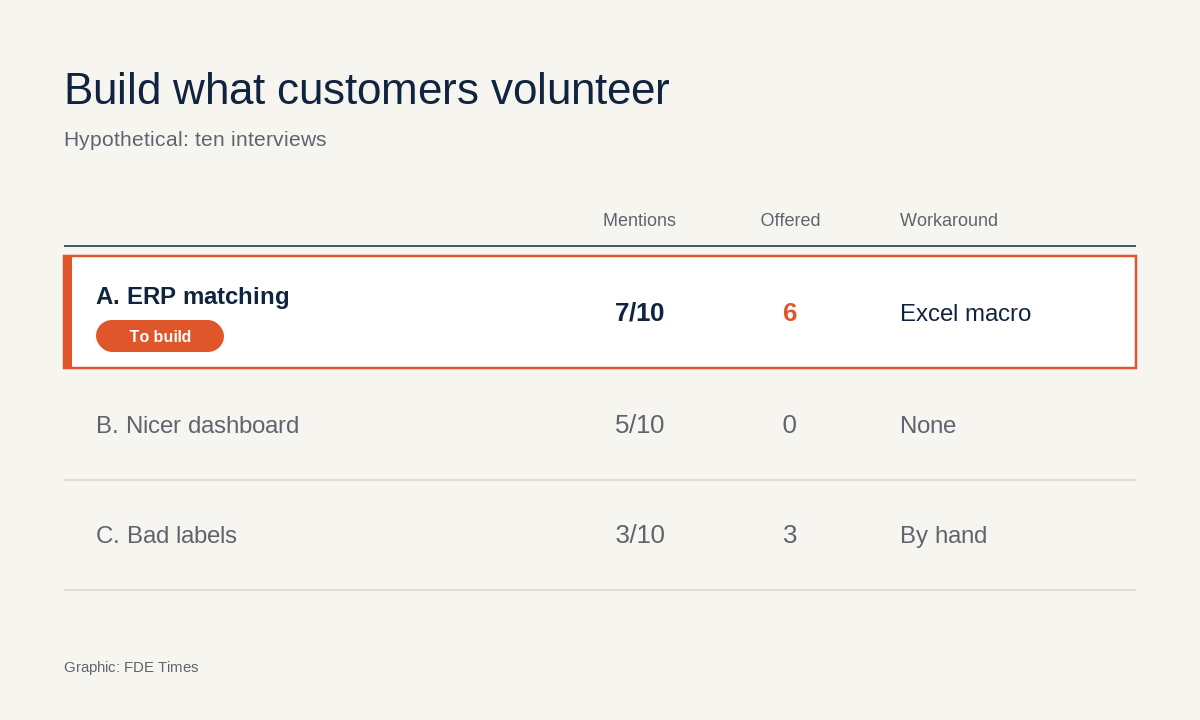
| A. Reconciling orders between the ERP and spreadsheets | 7/10 | 6 | An Excel macro a shift lead wrote himself | About 45 minutes per person per day |
| B. Wanting a nicer dashboard | 5/10 | 0 | None | Nobody could estimate it |
| C. Shipping labels printed wrong | 3/10 | 3 | One person checks them by hand | A few shipments returned each week |
Cluster B looks big because five people mentioned it, but all five mentions were answers to the question “would you like a dashboard?” This is precisely the kind of opinion Nielsen described: invented on the spot because someone asked. Nobody raised it unprompted, and nobody had improvised a way to get it.
Cluster A is different. Educative’s Forward Deployed Engineer course observes that workarounds are often the clearest signal of where the real operational pain lies. In this example, a shift lead had written an Excel macro by hand just to make reconciliation less grueling.
The course also stresses knowing how much time the current process costs, or how many errors it causes, before proposing a solution. Seven people at 45 minutes each adds up to 315 minutes a day, more than five working hours.
Cluster C has real evidence but fails the next filter. The same course points out that not every workflow problem is an AI problem. If the labels print wrong because of a configuration step or a handoff procedure, the right fix is to change the process. No new system is needed.
The final filter is whether the problem generalizes. In a First Round Review piece on hiring FDEs, the argument is that what one customer asks for is often a problem many others share.
Reconciling data between an ERP and spreadsheets is very likely to show up at other customers too, so cluster A both helps this client and adds value to the product.
What to do in the first week
After each interview, spend fifteen minutes writing the snapshot before opening email or Slack. Once you have about ten sessions, copy the observations onto cards tagged with session codes and invite at least one colleague, or someone from the client side, to cluster them with you. Name a cluster only after its cards are sitting together.
Next, build a table like the one above. For each cluster, fill in the number of sessions mentioning it, the number of volunteered mentions, the workaround and the current cost. Where a cell has no figure, mark it as unknown and schedule a follow-up with the right person, because an empty cell is a finding too.
Finally, put the remaining clusters through two questions: does this problem really need software, and do other customers have it?
Torres uses an opportunity solution tree to bring the opportunities from every snapshot together into a single picture. Your synthesis should end in a similar way: one page stating the chosen problem, with the reason each other cluster was dropped.
The mistakes that skew a synthesis
The most common mistake is counting cards instead of sessions. One talkative person can generate ten cards and make a cluster look like a company-wide concern. The second is mixing what customers volunteered with answers to leading questions, exactly as with cluster B in the example.
The third is naming a cluster after a solution, such as “needs a chatbot.” Once the name is a solution, the team stops asking what the actual problem is.
The fourth is letting one senior voice decide how the cards are arranged. NN/g has warned that dominant people can steer a group off course, so the facilitator needs to actively draw out the quieter participants. When the team genuinely disagrees on priorities, switch to dot voting instead of arguing further.
The last is choosing a cluster before measuring its cost. Without a figure like “315 minutes a day,” you will struggle to defend the choice to the project sponsor, and later you will have no baseline to prove the value delivered.
The same skill helps in a job search
When an FDE job posting mentions working directly with customers or customer discovery, there is a good chance you will be questioned on exactly this skill. Have an answer ready to the question: what did you decide to build, and why?
A story with a number of interviews, a workaround, a cost and a cluster you deliberately dropped is far more persuasive than a list of features you shipped.
On a CV, phrase it along these lines: interviewed ten users, chose one problem out of three clusters, saved X hours a day. That sentence shows you can listen to customers, count, and say “not yet worth building.”
The people who read your synthesis will not remember all ten interviews. What should stay with them is a sentence like this: seven of ten sessions raised this problem, and a shift lead wrote his own macro to put up with it. Find that sentence before writing the first line of code.
Was this article useful?
Thanks for the feedback!
5 sources
- Affinity Diagramming (Nielsen Norman Group) · 2024-04-26
- The Interview Snapshot (Product Talk, Teresa Torres) · 2024-02-21
- Interviewing Users (Nielsen Norman Group, Jakob Nielsen) · 2010-07-25
- Running customer discovery (Educative, Forward Deployed Engineer course)
- So You Want to Hire a Forward Deployed Engineer (First Round Review) · 2026-02-24