Steve Blank's founder course doubles as an FDE discovery manual
Each lesson in the free Udacity course, from value proposition to costs, becomes a question to put to the client in your first week on site.

In brief
- How to Build a Startup (Udacity EP245) is a free beginner course taught by Steve Blank and Kathleen Mullaney, built around Customer Development.
- The core idea: a startup is searching for a business model, and an FDE on a customer site is searching for the real problem.
- Take Value Proposition, Customer Segments and Customer Relationships first; leave the rest for later.
In 2012 Steve Blank put his Lean LaunchPad course online with Udacity. More than a decade later the course is still there under the name How to Build a Startup. It is free, and its course page was last updated on 14 November 2025. It was written for founders, but an FDE who has just been handed a new project will find that it speaks directly to the daily job.
The reason lies in one sentence Udacity uses to introduce the course: a startup is an organisation searching for a business model. Replace “startup” with “deployment project” and you have an FDE’s first week on a customer site. You do not yet know who really uses the product, who signs off, or which problem is worth solving. Everything is still being searched for.
What is the course?
On Udacity, How to Build a Startup carries the code EP245, is rated beginner level and is taught by Steve Blank and Kathleen Mullaney. Udacity is now owned by Accenture. The course consists of video lectures, quizzes and homework, just as Blank described it at launch in 2012.
The whole course is built around Customer Development, which Blank himself calls the formal methodology he devised for the search for a business model. According to Udacity, the course contains the full eight-session Lean LaunchPad curriculum for learning and testing hypotheses.
The syllabus on the course page runs to about 13-14 lessons. It starts with Value Proposition and Customer Segments, moves through Channels, Customer Relationships and Revenue Model, then on to Partners, Resources, Activities & Costs.
Every lesson is a question to put to the customer
The lesson titles sound like business vocabulary. Translate them into the language of an engineer on a customer site, though, and each becomes a specific discovery question. The table below is a suggested reading, not the course’s own wording.
| Course lesson | Question the FDE takes to the customer |
|---|---|
| Value Proposition | If the system works, which of the customer’s tasks gets faster or cheaper, and how is that measured? |
| Customer Segments | Who uses it every day, who buys it, and who has the power to say “no”? |
| Channels | How do results reach users: through a tool they already open, or a new dashboard nobody opens? |
| Customer Relationships | Who is the point of contact, how often do you meet, and who reports when the system is wrong? |
| Revenue Model | Whose budget pays for the project, and what does that person need to see to renew? |
| Partners, Resources | Which data, access rights and IT teams do you depend on? |
| Activities & Costs | What has to be done by hand each week to keep the system running? |
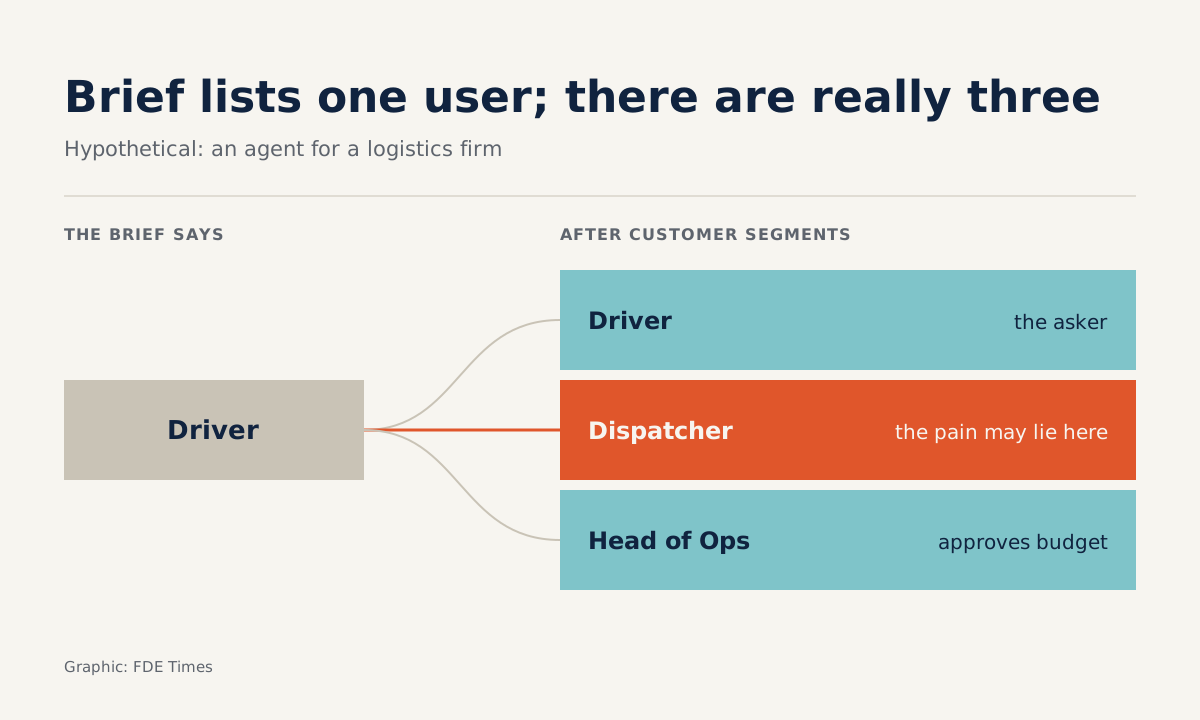
Consider a hypothetical example. A logistics company wants an agent that answers drivers’ questions. The requirements document names “drivers” as the users. Work through the Customer Segments lesson and you split them into three groups: drivers who ask questions, dispatchers who currently answer on their behalf, and the head of operations who approves the budget.
Each group yields a different hypothesis. Perhaps drivers do not want to type while driving. Perhaps the real pain sits with dispatchers, who spend half a shift answering the same question over and over. If you build for drivers while the value is felt by dispatchers, the demo still looks good but nobody uses it.
Three ideas worth keeping
The first: everything you know on day one is only a hypothesis. The course forces you to write hypotheses down and test them, and that habit saves an FDE from the most expensive mistake of all: building exactly what the requirements document says rather than what the customer needs.
The second: “the customer” is not one person. Once you name the user, the buyer and the approver separately, you know whom to ask which question, and you know when a “yes” carries no weight because it came from someone without the authority to decide.
The third lies in the format. Because there is homework, you have to take your hypotheses out and test them, rather than just watching videos to the end. Discovery is a hands-on skill, like debugging, and you only get better after many rounds of asking the wrong question and asking again.
In what order should you take it?
If you are an engineer short on time, start with Value Proposition and Customer Segments, the two lessons closest to a first kickoff meeting.
Next come Customer Relationships and Channels, which serve the stage of fitting the system into real workflows. Leave Revenue Model and the Partners, Resources, Activities & Costs group for later, when you start having to prove value and worry about renewal.
The course suits software engineers who want to move into FDE work best, along with first-year FDEs who find they are good at building but often ask the wrong questions. If you already have a few years in solutions engineering or consulting, much of the content will be familiar, but the canvas framework is still worth having to give discovery sessions more structure.
For your career, look for FDE job postings that mention “customer discovery” or “scoping”. That is where you tell a concrete story in an interview: what your initial hypothesis was, what evidence showed it was wrong, and how you changed course.
On a CV, a line such as “tested 5 hypotheses with 3 user groups before writing the first line of code” carries far more weight than “worked directly with customers”.
Founders learn Customer Development to avoid building a company nobody needs. FDEs learn it for a humbler but no less important reason: to avoid deploying a system nobody opens.
Was this article useful?
Thanks for the feedback!
3 sources
- How to Build a Startup | Udacity
- The Lean LaunchPad Online · 2012-09-06
- Steve Blank's Lean LaunchPad Course is Live · 2024-10-23