For healthcare FDEs, Stanford's clinical data course comes first
Engineers can skim the machine learning module; what they lack is a sense of where hospital data goes wrong, and the course leaves FHIR for them to learn alone.

In brief
- Stanford launched the series in 2020 with four courses; it now has five including a capstone, and is aimed at both clinicians and engineers.
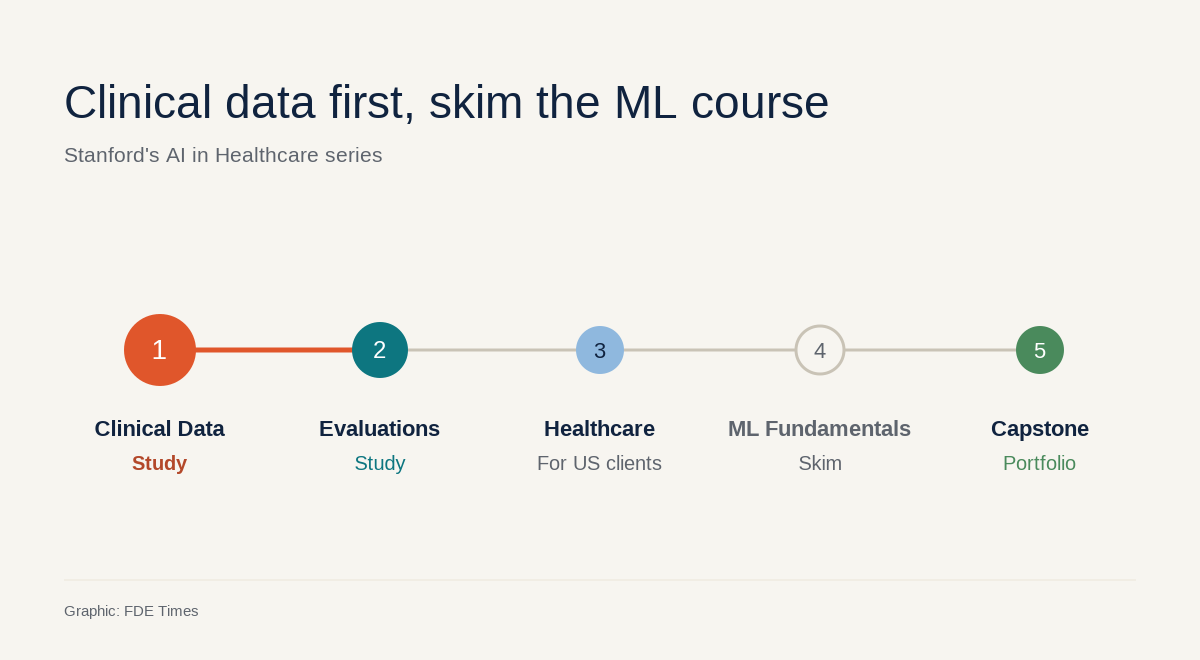
- Engineers should start with Introduction to Clinical Data and Evaluations of AI Applications, and skim the foundational ML course.
- Healthcare FDE job ads ask for FHIR, HL7 and EHR integration, but the listed modules of the two core courses do not mention them, so you have to fill that gap yourself.
Hippocratic AI’s ad for a Forward Deployed Engineer (Mid/Senior) spells out what it prefers: healthcare IT experience, including EHR integration with Epic, Cerner and Athena, plus FHIR and HL7. At Medplum, one day on the job might mean debugging a complex FHIR integration and the next leading an architecture workshop.
Medplum still treats healthcare or health-tech experience as a plus, not a requirement. A software engineer who has never worked for a hospital can still get in.
Read the two ads together and the advantage clearly lies in understanding healthcare data and systems. Stanford’s AI in Healthcare series is one way to start closing that gap, provided you take it in the right order.
One series written for two kinds of student
On Coursera the program is called the AI in Healthcare Specialization, offered by Stanford Online. The Stanford Center for Health Education announced it in a press release on August 10, 2020. At the time the series had only four courses: Introduction to Healthcare, Introduction to Clinical Data, Fundamentals of Machine Learning for Healthcare, and Evaluations of AI Applications in Healthcare. A fifth, the AI in Healthcare Capstone, was added later.
The Coursera page says the program is written for both healthcare providers and computer scientists. That detail should shape how you study it. Because it serves both sides, the series contains courses an engineer will find entirely new and others covering ground they already know.
Fundamentals of Machine Learning for Healthcare is the clearest example. It targets people without a technical background who work in healthcare, health policy and pharmaceutical development. If you have ever trained a classifier, much of it will be revision.
The program’s official page is at online.stanford.edu/programs/artificial-intelligence-healthcare, and according to the Coursera FAQ the series cannot be taken for free. If you are paying, spend most of your time on the courses that are genuinely new to you.
Start where the data can be wrong
The first course to take is Introduction to Clinical Data. It offers a framework for mining medical data both effectively and ethically. Its modules cover data generated by the healthcare system, how time is represented, building analysis-ready datasets, unstructured data and electronic phenotyping.
One of its learning objectives is worth copying down: learning to work with data that may be systematically biased. For an FDE, that sentence is close to a job description. A model can tolerate data that is wrong at random. Data that is wrong according to a pattern teaches the model the wrong pattern.
Take a hypothetical example. A clinic wants an agent to flag diabetic patients, and you filter on diagnosis codes in the EHR.
If some patients were only described by doctors in free-text notes and never coded, your list will miss exactly that group, every single time.
Unstructured data and electronic phenotyping both appear in the course’s module list. When you reach those sections, bring the example above and test yourself: does the way you define your patient cohort miss cases that exist only in free-text notes?
So the first job at a healthcare client is to ask about every data field: who enters it, when, and for what purpose. Write the pipeline only once you have the answers.
The evaluation course is the FDE’s course
The second course to take is Evaluations of AI Applications in Healthcare. Its aim is to teach the principles and practical considerations of bringing AI into clinical workflows. The modules also cover deployment, bias and fairness, and the regulatory environment.
This is the part of the work FDEs have to carry and research teams usually leave alone. A model that is accurate in a notebook is still useless if its output appears on a screen nurses never open, or if it performs markedly worse on one group of patients.
After this course, practice mapping a client’s clinical workflow before discussing metrics.
A suggested order for engineers
| Order | Course | How to approach it |
|---|---|---|
| 1 | Introduction to Clinical Data | Study closely, do all the exercises |
| 2 | Evaluations of AI Applications in Healthcare | Study closely, note down questions about workflow and regulation |
| 3 | Introduction to Healthcare | Take it if your clients are in the US; otherwise treat it as a case study |
| 4 | Fundamentals of Machine Learning for Healthcare | Skim, stopping only at the medical examples |
| 5 | AI in Healthcare Capstone | Do it last and turn it into a portfolio project |
Introduction to Healthcare covers the foundations of the US healthcare system: clinics, hospitals, pharmaceuticals, insurance and finance, along with the problems of cost, quality and access.
If your clients are elsewhere, use the same list of topics as a set of questions for learning their healthcare system, then compare where it resembles the US model and where it differs.
The capstone is the most valuable part for a job application. Students use a de-identified dataset created specifically for the series, containing both EHR data and images, to build a risk-stratification decision-support model.
When you put it on your CV, do not just list the AUC. Write which data biases you dealt with and where in the clinician’s workflow the model would sit.
The gap you have to fill yourself
Both ads mention FHIR. Hippocratic AI also asks for HL7 and integration with Epic, Cerner and Athena. The modules listed for Introduction to Clinical Data and Evaluations of AI Applications in Healthcare mention none of these standards.
Treat the course, then, as the first half of your preparation. The second half is a small self-directed project: reading and writing FHIR resources and mapping them onto the dataset you built in the Clinical Data course.
Start with the diabetes example above. Pull Patient and Condition resources from a FHIR test server, build a patient list from diagnosis codes, then record the cases this filter could miss.
With both halves in hand, you can tell a recruiter that you understand where the data goes wrong and also know how to get it out of a hospital’s systems.
Was this article useful?
Thanks for the feedback!
10 sources
- AI in Healthcare Specialization (Stanford Online, Coursera)
- Stanford Center for Health Education Launches Online Program in Artificial Intelligence in Healthcare to Improve Patient Outcomes · 2020-08-10
- Introduction to Healthcare (Coursera)
- Introduction to Clinical Data (Coursera)
- Fundamentals of Machine Learning for Healthcare (Coursera)
- Evaluations of AI Applications in Healthcare (Coursera)
- AI in Healthcare Capstone (Coursera)
- Online Courses (Stanford Division of Computational Medicine)
- Forward Deployed Engineer (Mid/Senior) - Remote w/Travel (Hippocratic AI) · 2026-10-01
- Forward Deployed Engineer (Medplum Careers)