Coding agents need a spec first, even in a client's legacy codebase
Paul Everitt fits the method into a course of 1 hour 26 minutes, but checking that the agent built what was specified is still your job.
In brief
- A short course from DeepLearning.AI and JetBrains, taught by Paul Everitt, running 1 hour 26 minutes
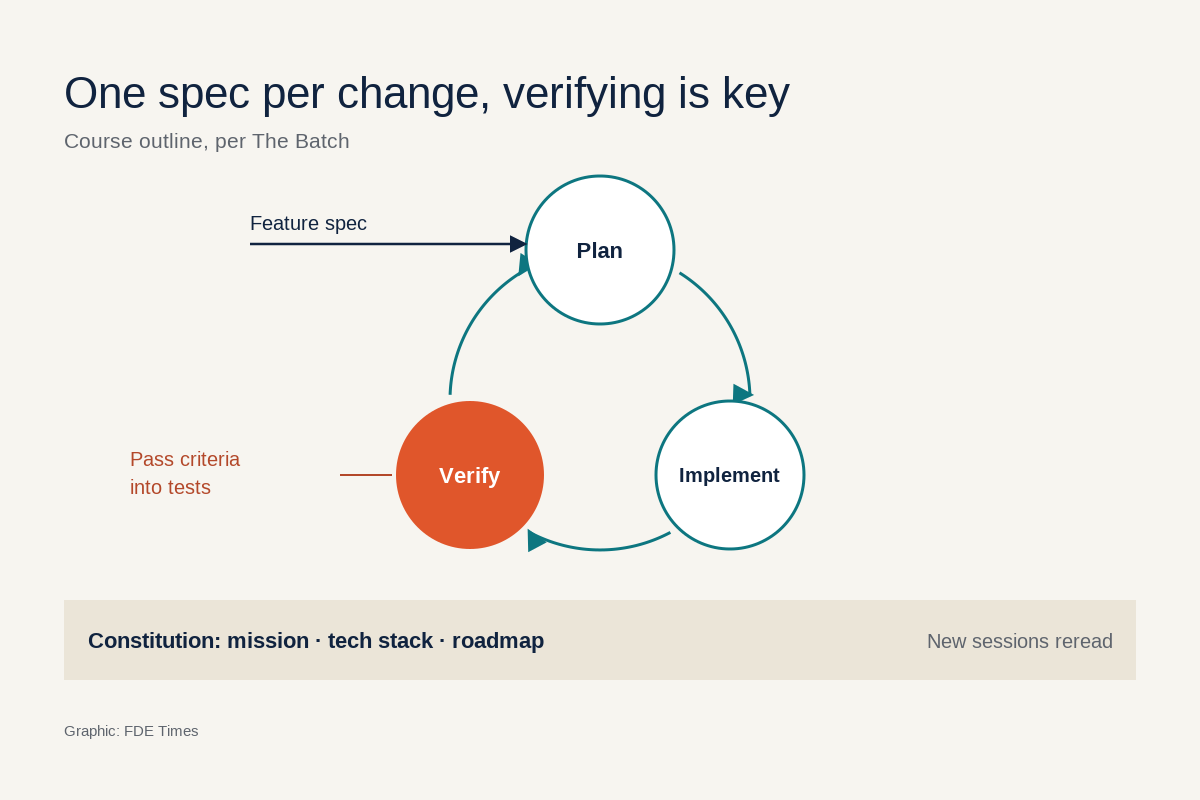
- Three things worth keeping for FDEs: the constitution, one branch per feature with a plan-implement-verify loop, and a way into legacy codebases
- A spec does not guarantee the agent gets it right: when verification finds a gap, you must decide whether to fix the code or the spec
The landing page of a course on coding agents opens with a blunt observation: vibe coding is fast, but the code it produces often does not match what you asked for. That is the premise of Spec-Driven Development with Coding Agents, a short course DeepLearning.AI made with JetBrains.
For a Forward Deployed Engineer, code that does not match the request costs far more than it does on a product team. The requirements come from the client, are often vague, and tend to shift between meetings. If your agent gets them wrong, you are the one who explains it to the client.
That makes the course worth a close look. It teaches you to write the requirements down before the agent writes any code, so that you, the client and the agent all work from one shared description.
Who teaches it, and what it covers
The instructor is Paul Everitt, Developer Advocate at JetBrains. The course page, marked as updated on November 13, 2026, lists a running time of 1 hour 26 minutes, short enough to finish in an evening.
The companion repository, sc-spec-driven-development-files on GitHub, received its first lesson folders and README on April 13, 2026. Clone it before watching the videos: the value of the course lies in redoing each step yourself, not in listening to the lectures.
Idea one: a constitution keeps context across sessions
The course has you write a “constitution” for the project together with the agent, covering mission, tech stack and roadmap. The opening lesson names a concrete benefit: specs keep the agent from gradually losing context between sessions and preserve the things that must not change.
The more agent sessions pile up on the same client project, the easier it is for some session to forget a constraint such as “client data must not leave the VPC” or “use only the Postgres version the client already runs”. The constitution is where such rules are written down once, and every new session reads them again.
Idea two: one branch per feature
The opening lesson describes feature development loops: each feature lives on its own branch and goes through three steps, plan, implement and verify. The crucial word is “each”. You do not hand the agent a large request in a single prompt.
Take a hypothetical case. The client wants to “export the orders report to a file”. The spec for that feature has to answer: CSV or Excel, which columns, which time zone, how many rows at most, who is allowed to press the export button. Each answer becomes an acceptance criterion that the verify step can check.
Writing a spec like this is also customer discovery. The questions you cannot answer while writing it are exactly the ones to bring to the next client meeting, before the agent writes a single line of code.
Idea three: legacy code is where FDEs actually work
The course separates two entry points. Greenfield projects start from scratch; for brownfield codebases, the constitution is generated from the running code itself. The second path is the one closer to FDE work: you rarely get to start from an empty repo.
One way to apply it in your first week on site is to have the agent read the repo and draft a constitution describing the current system, then ask the client’s engineers to correct it. That document serves as onboarding material and as the foundation for every later change.
What happens when verification fails?
The course is best read with a skeptical eye. Birgitta Böckeler, testing other spec-driven tools, Kiro, spec-kit and Tessl, on martinfowler.com, wrote that she often found the agent ultimately did not follow all the instructions. She also said she would rather review code than review piles of markdown files.
Her remarks concern those tools, not Everitt’s course. But they point to exactly where you need to be ready: the verify step will sometimes slip.
An independent paper on arXiv describes the decision at that moment: change the code to match the spec, or revise the spec. GitHub Spec Kit automates part of this with a converge step, which compares the codebase against the spec, plan and tasks, and adds new tasks if something is missing.
For an FDE, choosing to revise the spec is never yours alone. If the agent drifted because the spec was wrong, that is a signal to go back to the client. Keep specs short, write acceptance criteria as runnable tests, and read the code rather than just rereading the markdown.
Who should take it, and in what order
The course recommends basic knowledge of a programming language and prior experience with LLM-based coding tools. If you have used agents for a few months and been frustrated when they missed the point, this is the best time to take it.
Watch the sections on the constitution and the feature development loop first, follow along in the companion repo, and only then try the brownfield path on an old repo of your own.
For your career, turn the exercises into evidence. A portfolio repo with a constitution, a few per-feature specs, matching tests and notes on a failed verification shows employers that you can turn vague requirements into work that can be checked.
When an FDE job posting asks for someone who can “work with ambiguous requirements”, this is the skill to demonstrate in the interview.
Agents will keep writing code faster. The person clients trust will still be the one who can write down what the client actually needs.
Was this article useful?
Thanks for the feedback!
6 sources
- Spec-Driven Development with Coding Agents - DeepLearning.AI
- Spec-Driven Development with Coding Agents - DeepLearning.AI (Introduction lesson)
- Commits · https-deeplearning-ai/sc-spec-driven-development-files
- Understanding Spec-Driven-Development: Kiro, spec-kit, and Tessl · 2025-10-15
- Spec-Driven Development: From Code to Contract in the Age of AI Coding Assistants · 2026-01-30
- spec-kit/docs/quickstart.md · github/spec-kit