The book that helps FDEs speak the language of a client's IAM team
Wilson and Hingnikar follow an account from creation to removal, but their 2022 chapter on OAuth security now needs RFC 9700 open beside it.
In brief
- Yvonne Wilson and Abhishek Hingnikar's book (Apress, second edition, 2022) runs from provisioning through OAuth 2, OIDC, SAML 2 and SSO to deprovisioning and troubleshooting.
- In enterprises the client's identity team usually holds the rights to configure SSO, so an FDE's value lies in knowing what to ask for and how to read the errors.
- The OAuth security material should be read with RFC 9700 (January 2025). OAuth 2.1 is still an Internet-Draft, and the companion GitHub repo belongs to the 2019 print edition.
Arcade’s Forward Deployed Engineer job page describes one type of candidate it wants as an “Identity & Security Practitioner”: someone with deep fluency in OAuth 2.0, OIDC, SAML, SCIM, token lifecycles and delegated auth. Anyone aiming for that role can treat the list as a syllabus.
The client’s side of the table shows why these protocols matter. To configure SAML SSO for an enterprise application in Microsoft Entra ID, you must be a Cloud Application Administrator, an Application Administrator or the owner of the service principal. In large companies those rights usually sit with the client’s identity team.
So FDEs rarely get to press the buttons themselves. The job is to brief the IAM team precisely enough that they configure things correctly the first time, and to read the errors when something breaks. Solving Identity Management in Modern Applications teaches you to speak that team’s language.
A book that follows an account from start to finish
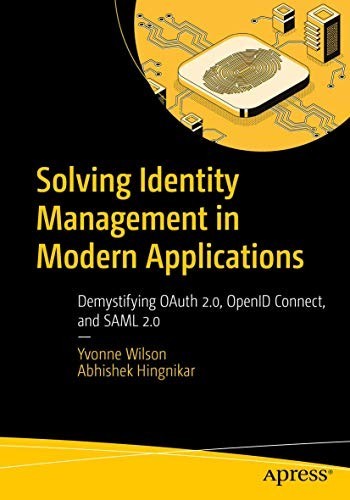
The book is by Yvonne Wilson and Abhishek Hingnikar, subtitled “Demystifying OAuth 2, OpenID Connect, and SAML 2”. Apress published the second edition as an ebook on November 17th 2022 and in paperback on November 18th 2022.
The publisher’s author notes describe Wilson as co-founder and Chief Strategy Officer of XploitDefense, and Hingnikar as working at Okta. Both may have moved on since.
According to the publisher, the book moves from provisioning through authentication to authorization, with added material on troubleshooting and common mistakes. The table of contents has chapters on provisioning, OAuth 2, OpenID Connect, SAML 2, Single Sign-On, Deprovisioning and Troubleshooting. This edition adds an overview of OAuth 2.1 and a section on the OAuth 2.0 Device Authorization Grant.
The publisher pitches it at developers, application and enterprise architects, product owners and anyone else involved in an application’s identity solution.
Three ideas worth taking to a client site
The first is that identity has a lifecycle that does not end at the login screen. Microsoft’s documentation says that using SCIM together with SAML or OpenID Connect gives administrators a complete, standards-based access management solution.
At the first meeting with a client, then, ask how accounts are created and revoked as well as how SSO works.
The second is that every stage of that lifecycle has someone holding the key. With SAML, for example, Okta’s guidance says the service provider (your application) needs the identity provider’s public certificate to verify signatures. The client’s IAM team holds that certificate, so it belongs on the list you send them before the integration session.
The third is that SSO will break, and in predictable ways. Okta’s guidance notes that SSO can stop working when the SAML configuration contains an error, or when the SAML endpoint on the IdP side changes.
Say a client reports one morning that nobody can sign in. The two causes Okta lists are the first things to check, and the book’s Troubleshooting chapter should be read before that call comes in, not during it.
The order to read it in
If you are on a project, follow the client’s systems. For an enterprise client running SAML, start with the SAML 2 and Single Sign-On chapters, then Troubleshooting. If you are building APIs or agents that call services on a user’s behalf, start with OAuth 2 and OpenID Connect.
Then go back to provisioning and deprovisioning. Do not skip them: as the first idea above makes clear, SSO without account creation and revocation covers only half the lifecycle.
Where the book has aged
Because the book came out in 2022, three things are worth knowing. The OAuth 2.1 draft it summarizes is still an Internet-Draft of the IETF oauth working group; the latest revision as of late October 2026 is draft-ietf-oauth-v2-1-17, and it has not become an RFC.
RFC 9700, the Best Current Practice for OAuth 2.0 security, was published in January 2025 and updates the security advice in RFCs 6749, 6750 and 6819. The book’s OAuth 2 chapter should be read alongside it.
The third point is smaller but can waste time. Apress’s official GitHub repository is the companion to the 2019 print edition, and its v1.0 release matches the code in that printed book, with no corrections or updates yet. If you have the 2022 edition, do not assume the repo’s code matches your copy.
Turning Arcade’s posting into a syllabus
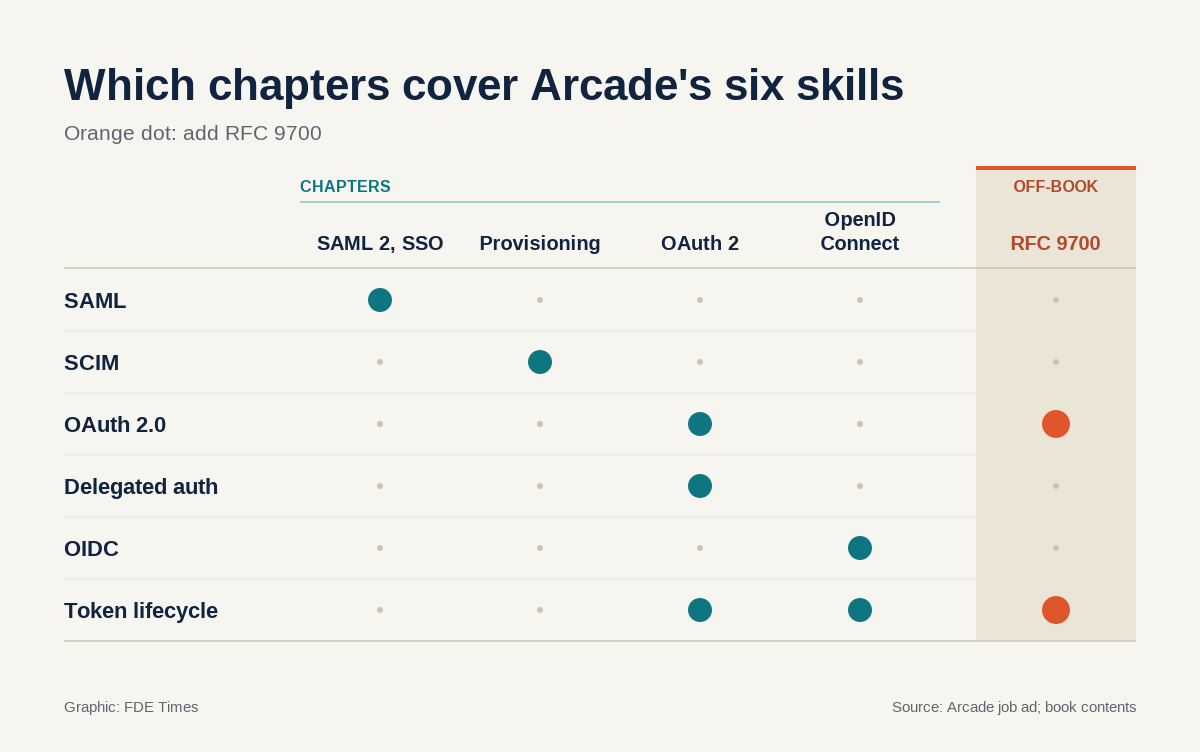
Arcade’s posting names six skills, and each has a place to study it in the book or its companion material. The table below is one way to map them, with evidence you can build yourself and put on a CV.
| Skill in the posting | Where to read | Evidence to build |
|---|---|---|
| SAML | SAML 2 and Single Sign-On chapters | SAML SSO on a dev tenant, verifying signatures with the IdP’s certificate |
| SCIM | Provisioning and deprovisioning chapters, Microsoft’s SCIM documentation | A SCIM endpoint that receives users and groups from Entra ID |
| OAuth 2.0 | OAuth 2 chapter, with RFC 9700 | An app that calls an API protected by OAuth 2.0 |
| Delegated auth | OAuth 2 chapter | An agent that calls a service on a user’s behalf |
| OIDC | OpenID Connect chapter | An OIDC sign-in flow for the same app |
| Token lifecycle | OAuth 2 and OpenID Connect chapters, RFC 9700 | Notes on how the app handles expired tokens |
Once the first two rows are built, a CV can carry a specific line such as “integrated SAML SSO and SCIM provisioning with Entra ID, with a troubleshooting runbook”. That says far more than the word “OAuth” sitting in a skills list.
The rights to configure SSO stay with the client. What the FDE controls is walking into the meeting with the right questions and the right list of requests.
Was this article useful?
Thanks for the feedback!
8 sources
- Solving Identity Management in Modern Applications: Demystifying OAuth 2, OpenID Connect, and SAML 2 · 2022-11-17
- GitHub - Apress/solving-identity-management-in-modern-applications
- draft-ietf-oauth-v2-1 - The OAuth 2.1 Authorization Framework · 2026-10-30
- RFC 9700 - Best Current Practice for OAuth 2.0 Security · 2025-01
- Enable SAML single sign-on for an enterprise application - Microsoft Entra ID · 2025-07-10
- Tutorial - Develop a SCIM endpoint for user provisioning to apps from Microsoft Entra ID · 2026-09-15
- Understanding SAML | Okta Developer
- Forward Deployed Engineer — Careers at Arcade