Why a basic four-hour Python course is worth an FDE's time
The final chapter of DataCamp's course, on record linkage, matters most, but learn blocking before you run it on real client data.
In brief
- Adel Nehme's four-hour course, with 4 chapters and 44 exercises, teaches the kind of dirty data FDEs keep running into at clients.
- Three ideas worth keeping: assert your data types, enforce range constraints, and use record linkage for near-duplicates.
- The data types lesson never mentions pd.to_numeric, and blocking for large datasets is outside the course, so read the pandas docs and the Python Record Linkage Toolkit docs too.
“The customer table has duplicates that aren’t really duplicates.” AI Codex uses that line to describe what usually happens when an FDE runs the first real query on a client’s data. The data is usually worse than the client says, and the problems surface the moment you touch it.
LeadDev tells a familiar story too: in a client’s legacy system, free-text fields had been filled in for years, a different way each time, so long as it worked at the time. Many tables would not join with one another.
Before any agent or dashboard can run, that mess has to be cleaned up. This is why a short, seemingly basic course such as DataCamp’s Cleaning Data in Python is worth four hours of an FDE’s time.
What do the four hours cover?
The course is taught by Adel Nehme, VP of Content at DataCamp. The current version was published on December 15, 2025. The course page opens with a line familiar to anyone in the trade: data scientists spend 80% of their time cleaning and manipulating data and only 20% analyzing it. The prerequisites are Python Toolbox and Joining Data with pandas.
There are four chapters. Common Data Problems has 11 exercises, Text and Categorical Data Problems has 10, Advanced Data Problems has 11 and Record Linkage has 12. Take them in the order the course sets out, so that by the final chapter the basic cleaning steps are second nature.
Idea one: with the wrong data type, the code still runs and the result is wrong
The first chapter teaches you to check the type of every variable before doing anything else. The tools are .dtypes, .info(), .str.strip(), .astype() and the assert statement.
Take an orders table from a retail client where the revenue column is stored as strings such as “1200 “, with a trailing space. When you sum that column, pandas raises no error; it concatenates the strings.
The course teaches a three-step fix: strip, convert with astype, then write an assert that stops everything if the column still has the wrong type. The data types lesson does not mention pd.to_numeric. According to the pandas documentation, setting errors=‘coerce’ turns values that cannot be parsed into NaN; the default, ‘raise’, throws an error straight away.
At a client, use both. The code below combines them on the same orders table:
import pandas as pd

# Step 1: measure first. coerce turns broken values into NaN instead of crashing the whole call
raw = orders["revenue"].str.strip()
num = pd.to_numeric(raw, errors="coerce")
bad = num.isna() & raw.notna()   # count only the NaNs created by coerce
print(bad.sum(), "rows could not be parsed as numbers")
print(orders.loc[bad, "revenue"].head(10))

# Step 2: the course's approach, on the parseable rows: strip, convert, then assert
clean = orders.loc[~bad & raw.notna()].copy()
clean["revenue"] = clean["revenue"].str.strip().astype("int")
assert clean["revenue"].dtype == "int"
The number from the first print is the one to bring to the meeting, because it shows the client how many rows are broken. The second print shows how they are broken.
Idea two: a value of the right type can still be absurd
The same orders table might contain order dates in the future. Chapter one teaches range constraints to remove data points like these, and dropping duplicate rows so nothing is counted twice.
Chapter three goes further with uniformity: a single weight column, say, where some rows are in pounds and others in kilograms. It also teaches cross-field validation and how to handle missing values.
Chapter two targets exactly the free-text fields LeadDev describes, such as categories typed five or six different ways. The first job at a client is to turn these rules into asserts that run on every data load, rather than fixing things by hand once and leaving them.
Idea three: near-duplicates are where the cost lies
AI Codex observes that true duplicates are easy to deal with; near-duplicates are the expensive ones. The course’s final chapter tackles exactly this. You learn to link datasets with typos or differing spellings by computing similarity between strings. The last exercise merges two restaurant review datasets.
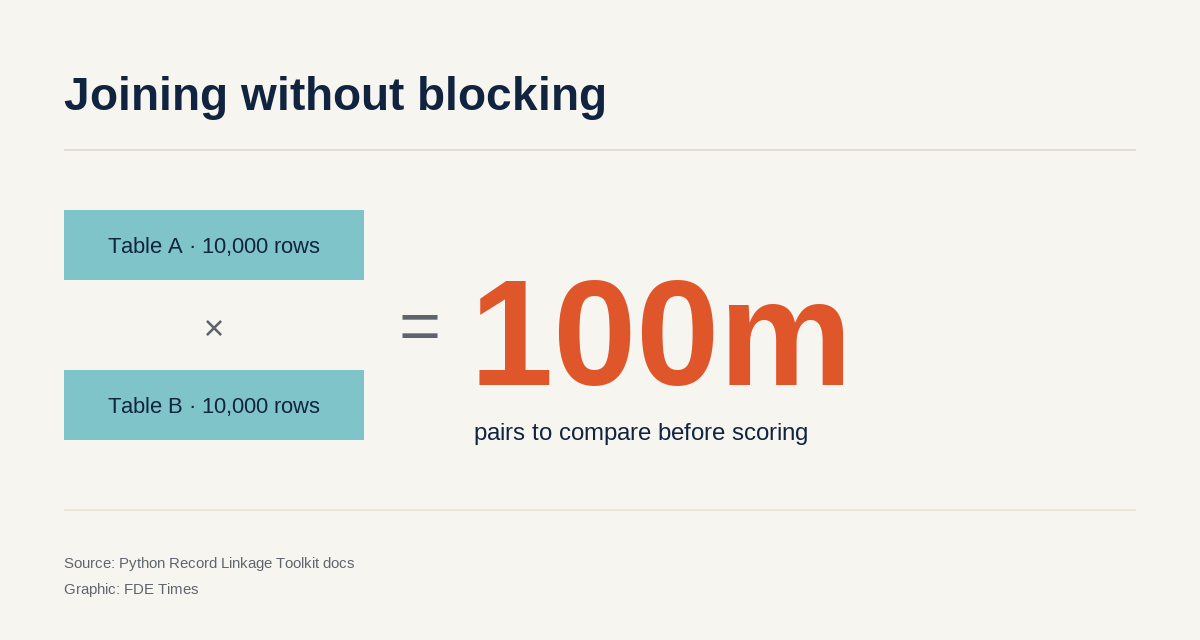
There is a limit the course does not spell out. Comparing every pair across two tables of 10,000 rows each means 100 million pairs. The Python Record Linkage Toolkit documentation explains why indexing and blocking are needed.
The Python Record Linkage Toolkit is a library for linking records, within a single data source or across several. With blocking, only pairs that share a surname are compared, so most pairs are discarded before any similarity is computed. Once you finish chapter four, read the library’s documentation next.
Who should take it, and how should it go on a CV?
The course suits backend or frontend engineers moving into FDE work who have not done much with pandas. If you already know pandas, skim the first three chapters and spend your time on Record Linkage.
Do not put a line such as “completed Cleaning Data course” on your CV. Build a small project on public data and record the before and after: how many rows were coerced to NaN, how many near-duplicate pairs were linked, and how far blocking cut the number of pairs to compare.
The first real query on a client’s data will usually expose duplicates that aren’t duplicates. At that point, what helps most is being able to tell the client exactly how many rows are affected.
Was this article useful?
Thanks for the feedback!
7 sources
- Cleaning Data in Python | DataCamp · 2025-12-15
- Cleaning Data in Python – Common Data Problems (DataCamp Campus)
- Cleaning Data in Python – Record Linkage (DataCamp Campus)
- pandas.to_numeric — pandas documentation
- About — Python Record Linkage Toolkit documentation
- When the client's data is worse than they said (AI Codex) · 2026-08-21
- The reality of being a forward deployed engineer (FDE) (LeadDev) · 2026-10-14