The 13-hour finance course that prepares FDEs for the CFO's questions
You don't need an MBA, only enough NPV to hold your ground when a client's finance team tests your business case.
In brief
- OpenAI's posting for a Deployment Lead in Forward Deployed Engineering makes the role own the value case and ROI, from baseline to reporting to the exec sponsor
- James Weston's course (Rice, Coursera) has 5 modules totaling about 13 hours; module 2, on NPV, IRR and sensitivity analysis, is the best value
- Review the income statement and balance sheet before starting, because some learners found the course is not really for complete beginners
OpenAI’s posting for a “Deployment Lead, Forward Deployed Engineering” states plainly that the hire will form impact hypotheses, lock in baselines and KPIs, measure before and after deployment, and report to the exec sponsor. It is a leadership role rather than an engineering posting, yet it shows where the job is heading as you move up.
At that level, working code is only half the job. The other half is walking into a meeting with the client’s finance director and answering the question they ask of every project: is this worth the money, compared with putting it to work somewhere else?
If you have never learned how to answer that, “Finance for Non-Finance Professionals” from Rice University on Coursera, taught by James Weston, is a compact way to close the gap.
What does the course cover?
The course page describes itself as a short survey that covers every major topic of an MBA-level finance semester. Coursera lists the duration as 1 week at 10 hours a week. The five modules are listed at 3, 2, 2, 3 and 3 hours, so adding up the module times on the page gives about 13 hours.
The course follows the logic of a business case. Module 2 teaches capital budgeting, the method for deciding whether to spend money at all. Module 3 teaches how to measure the cash a business generates.
The capstone in module 5 is the Sunrise Bakery case: the bakery’s finance director weighs a large capital expenditure. She has to trade off spending money today against generating more free cash flow in the future, which is the same problem your client sets with every deployment.
A discount rate can flip the NPV
Module 2 runs about 2 hours and covers NPV, IRR, payback period, return on capital and sensitivity analysis. The NPV rule itself is simple: positive means go, negative means drop it.
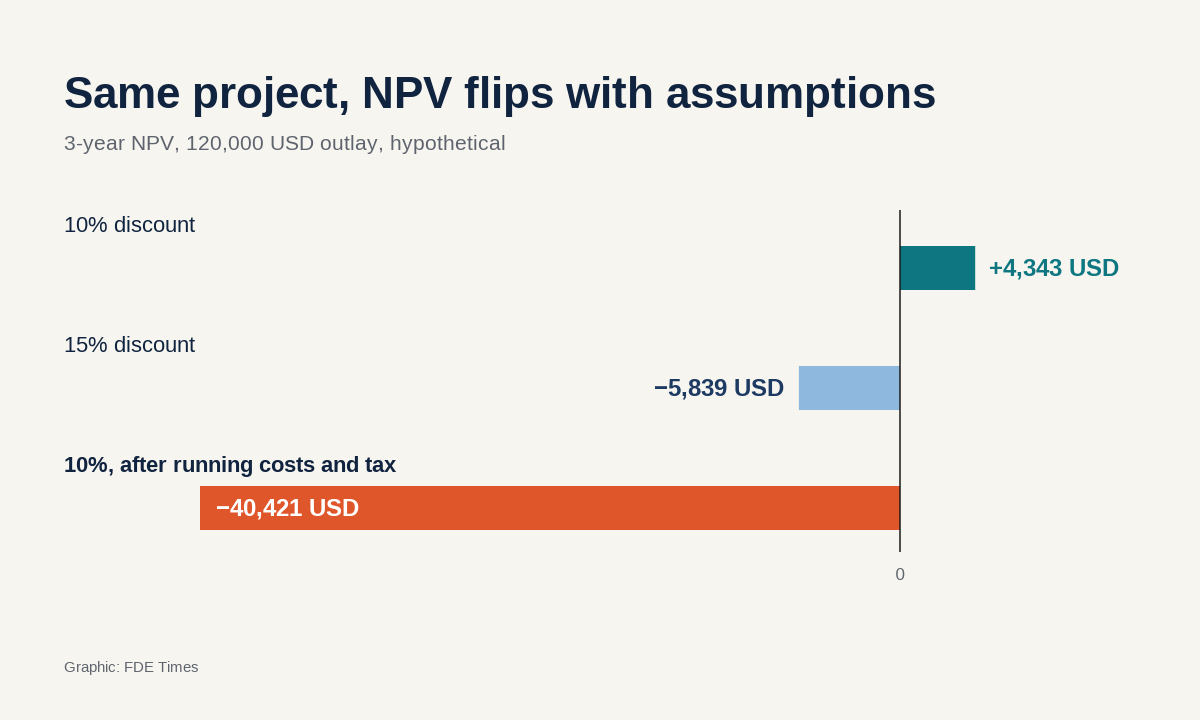
The hard part lies elsewhere. Take a hypothetical agent deployment that costs $120,000 up front and brings the client $50,000 a year in cash flow for 3 years. Discounted at 10%, those three payments have a present value of about $124,343, so the NPV is about +$4,343.
Raise the discount rate to 15% and the present value falls to about $114,161, putting the NPV at about −$5,839. The project and the cash flows stay the same, and the conclusion reverses.
Real textbooks show the same effect. The open textbook Principles of Finance 2e from OpenStax has an example of a $16,000 embroidery machine with six years of cash flows: its NPV is $2,836 at 9%, just $42 at 14% and −$442 at 15%.
So where does the 10% or 15% come from? OpenStax notes that companies often do not know their cost of capital precisely and have to estimate it, which is why analysts plot NPV across a range of rates to see how sensitive the decision is.
You do not need to calculate that rate for the client. Ask their finance team which rate they use, and use that one.
A savings figure on a slide is not yet cash flow
Module 3 works through the income statement and balance sheet to find every source of cash coming in and every payment going out, and from there arrives at free cash flow. OpenStax defines free cash flow as operating cash flow minus capital expenditure, so an upfront infrastructure purchase pulls it down in year 0.
Apply this to the example above. Suppose the $50,000 is a “savings” figure on a slide rather than cash flow, and the system costs an extra $10,000 a year in infrastructure and the client’s operations team’s time.
The FinOps Foundation stresses that the true total cost of ownership of AI must include upfront costs, recurring costs and hidden costs.
Then comes tax. In capital budgeting, revenues and costs are multiplied by (1 − tax rate), because savings raise taxable profit. With an assumed tax rate of 20%, and ignoring depreciation for simplicity, (50,000 − 10,000) × 0.8 leaves only $32,000 a year.
Discounting $32,000 at 10% over 3 years gives about $79,579, so the NPV drops to about −$40,421. A project that looked profitable on the slide loses money even at the more forgiving discount rate. Before presenting any savings figure, subtract the recurring costs and tax yourself.
In what order should you take it?
Two learner complaints deserve attention. Irene, who gave it 3 stars in 2021, felt you need basic accounting such as the income statement and balance sheet to keep up, even though the course page says no finance background is required.
Robert, also 3 stars, in 2018, found the jump from the introduction to NPV to the final project, with its many documents, too steep.
So spend an evening reviewing the two financial statements before you begin. Then work through modules 2 and 3 carefully, redoing the calculations with figures from your own project, and move faster through the rest.
Leave the Sunrise Bakery capstone for last and treat it as a business-case rehearsal. Robert’s comment suggests that practicing a few small NPV problems first will make that jump less steep.
A first exercise: one spreadsheet, two discount rates
HatchWorks, a services firm, has a blog post on measuring FDE ROI. According to the post, AI ROI arguments most often hit a dead end because nobody measured the “before” state. Without a baseline there is no cash flow to discount, so that is the first job at any client.
The next common mistake is presenting a single NPV, as if the discount rate were a constant. If the finance team uses a different rate, that figure loses its value, and your proposal loses its weight with it.
The exercise that fixes this takes under an hour. Open a spreadsheet, label years 0 to 3, put the investment in year 0 (as a negative number) and the net cash flow after recurring costs and tax in the following years, then discount at 10% and 15%.
If the two NPVs have opposite signs, as in the example above, you have the question to bring to the meeting: at what discount rate does the finance team approve projects? When you present, include the full sensitivity table so they can see for themselves how far the project holds up.
On your CV, “built automation agent” says little. A convincing line has three steps: “Set the pre-deployment operating cost baseline; calculated net cash flow after infrastructure costs and tax; presented the exec sponsor with a 3-year NPV and a sensitivity table at 10% and 15% discount rates.”
Thirteen hours of study will not make you a finance expert. But the next time a finance director asks, “What discount rate are you using?”, you will have the answer ready instead of promising to get back to them.
Was this article useful?
Thanks for the feedback!
10 sources
- Finance for Non-Finance Professionals | Coursera (Rice University)
- Finance for Non-Finance Professionals | Coursera (Rice University)
- Finance for Non-Finance Professionals: Learner Reviews | Coursera · 2018-03-28
- 16.2 Net Present Value (NPV) Method - Principles of Finance 2e | OpenStax · 2026-06-24
- 16.6 Using Excel to Make Company Investment Decisions - Principles of Finance 2e | OpenStax · 2026-06-24
- 5.6 Operating Cash Flow and Free Cash Flow to the Firm (FCFF) - Principles of Finance 2e | OpenStax · 2026-06-24
- The Effect of Income Taxes on Capital Budgeting Decisions (Managerial Accounting)
- Cost Estimation of AI Workloads | FinOps Foundation · 2025-09-15
- Deployment Lead, FDE - SF | OpenAI
- How to Measure the ROI of a Forward Deployed Engineer · 2026-09-16