Why FDEs should reread The First 90 Days before every new client
Michael Watkins wrote for people stepping into a new job, but forward deployed engineers go through that same transition with every customer they join.
In brief
- Watkins says the first task in a new role is to learn fast. For an FDE, that means checking what the client describes against the real data.
- Count the days to the break-even point, the moment you start creating value, and turn that number into a line on your CV.
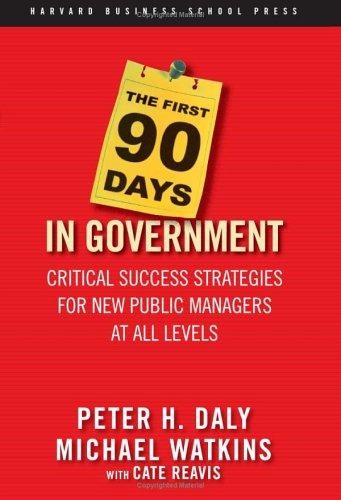
- The edition on sale is the 2013 Updated and Expanded edition, at 304 pages. A revised 336-page edition with new material on AI is due on February 2, 2027.
Colin Jarvis of OpenAI says FDEs work amid a great deal of ambiguity, and that what a customer describes during scoping often fails to match the reality of their data and systems. In other words, at every new customer you have to get up to speed from scratch.
Michael D. Watkins wrote a whole book about those first months, The First 90 Days. He wrote it for people who have just taken on a new role inside a company. An FDE takes on a new role every time they walk into a new customer.
The publisher introduces the book with a warning: missteps in the first three months of a new role can be damaging, and can even derail your path to success altogether. For an FDE, that cost arrives sooner and is far more visible than it is for a newly appointed executive.
OpenAI’s FDE job posting, quoted by The Pragmatic Engineer, describes the work as embedding closely with customers, understanding their domain and building solutions alongside them. Palantir writes that its engineers work with customers, often on site.
Each engagement, then, is a transition in miniature, and the person grading you there is the customer.
Ninety days is no deadline, but it is when people judge you
Watkins does not treat the number 90 as a magic formula. He says that if you reach day 91 without having done everything you needed to, there is no cause for panic, because it is not over. But in a 2009 interview he noted that 90 days is usually enough for the people around you to see whether you are heading in the right direction.
For an FDE, those people are the project sponsor on the customer side, the operations team that has to use what you build, and whoever holds the budget. They form their impressions sooner than you think.
The book’s three ideas are easier to grasp through an example. Take an FDE who joins an insurance company to build an agent that helps process claims. The scoping session says every claim record sits in a single data warehouse and is fully labeled.
The first job is to learn, and to learn fast
According to Will Patrick’s reading notes, page 47 of the book says the first task in making a successful transition is to accelerate your learning. Jarvis’s remark above shows why this is even more urgent for FDEs: the gap between description and reality is an everyday occurrence.
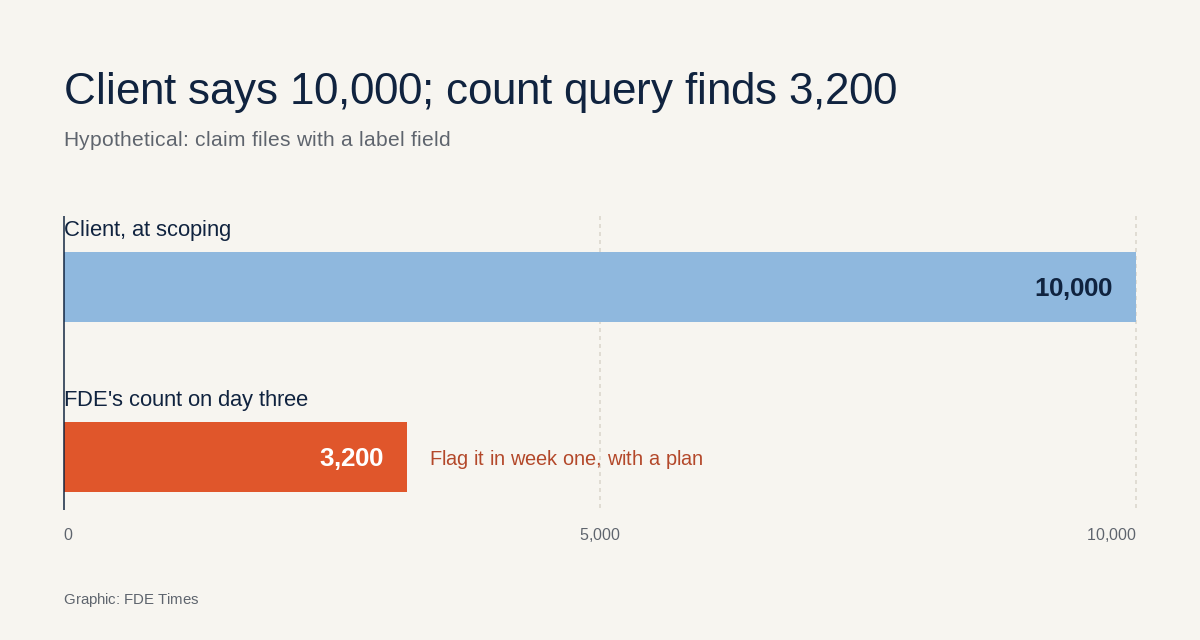
Back at the insurance company, with hypothetical numbers. The client says there are 10,000 records, all labeled. On day three, the FDE runs a count query and finds that only 3,200 records have a label field. Auto claims are almost fully labeled; the other types are sparse.
The skill lies in the next step. The FDE writes one page for the sponsor: the number the client gave, the number counted, which record types have enough data, and a proposal to start with auto claims. The gap is raised in week one, with a plan attached, instead of surfacing in week ten as a failure.
Count the days to break-even
Watkins uses the idea of a break-even point: at some moment you become a net creator of value, and the sooner you reach it, the better. Until then, the customer has to let its staff teach you without getting anything back.
At the insurance company, the day-three memo already points to the break-even point: the agent correctly summarizes auto claims for one claims team, and that team uses it every day.
One record type in real use is worth more than ten on a slide. So fix that milestone in the first week, then plan the work backward from it.
You have authority over no one
Page 201, again according to Will Patrick’s notes, says that to succeed in a new role you need the support of people over whom you have no direct authority. It describes the FDE’s position precisely: you manage no one at the insurance company, yet you need IT to grant access and claims handlers to set aside time to try what you built.
Watkins, writing with Lavoie and Stehli for IMD, says a classic trap is arriving with “the answer” already in hand. FDEs are the most likely to fall into it, because you bring a product with you and are eager to demo it.
Jina Yoon writes on the PostHog blog that an FDE’s top priority is to understand the customer’s problem in depth. A demo shown too early crowds out that work.
Who should read it, and which edition
The edition on sale from Harvard Business Review Press is the Updated and Expanded edition, 304 pages, published on May 14, 2013, with a subtitle promising to help readers get up to speed faster and smarter.
A revised 336-page edition is due on February 2, 2027. According to its Apple Books description, it adds a First 90 Days Transition Roadmap and material on hybrid work, remote work and AI.
If you are a software engineer looking to move into FDE work, read the 2013 edition now rather than waiting for 2027. The three ideas above do not depend on the newly added AI material.
If you are already an FDE, reread the sections on accelerated learning and on building support in the week before you join a new customer. Will Patrick’s notes make a compact summary for review.
For your career, this ramp-up skill can be expressed as a number. On your CV, state the number of weeks from your first day at a customer to the first use case in real use.
In interviews, tell the story of your first week along the same lines as the example above: the number the customer promised, the number you counted, and what you proposed next.
Watkins wrote about a single transition in a career. A good FDE is one who can repeat it at every customer, and reach break-even faster each time.
Was this article useful?
Thanks for the feedback!
9 sources
- The First 90 Days, Updated and Expanded: Proven Strategies for Getting Up to Speed Faster and Smarter (HBR Store) · 2013-05-14
- The First 90 Days, Newly Revised and Updated (Apple Books)
- The First 90 Days (ghi chép sách của Will Patrick)
- 029: Gaining Quicker Traction in Your New Role with Dr. Michael D. Watkins (How to be Awesome at Your Job) · 2016-06-27
- Personal Branding Interview: Michael Watkins · 2009-11-12
- Hit the ground running: Transitioning to new leadership roles (IMD) · 2014-05
- What are Forward Deployed Engineers, and why are they so in demand? (The Pragmatic Engineer) · 2025-08-12
- WTF is a forward deployed engineer? (and why everyone is hiring them) · 2026-02-11
- Forward Deployed Software Engineer (Palantir, Lever)