Why legacy modernization projects die halfway through
Marianne Bellotti argues that most efforts fail because they lose momentum, so the work should start with small scopes that carry outsized impact.
In brief
- Bellotti argues that most modernization projects fail because they stall when the work is only half done.
- Legacy systems are rarely slow. The usual problem is brittleness: complexity, lost knowledge, and changes that break things elsewhere.
- The book is strong on people and on keeping momentum, and weak if you need a step-by-step technical method.
Marianne Bellotti points to a very ordinary cause of failure: most modernization efforts collapse because they stall when the work is only half done.
That will sound familiar to any FDE who has been sent to a client running a system that is a decade or more old. On day one, the natural reflex is to propose a rewrite. Martin Fowler has written that this plan, which sounds so simple, replacing the old system with a rebuilt one, has mostly ended in dismal failure in the cases he and his colleagues have seen.
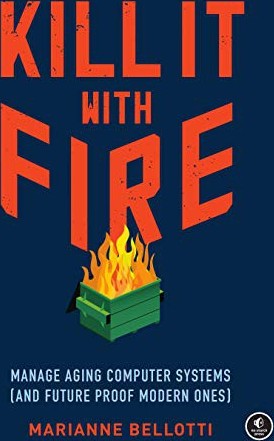
Bellotti’s Kill It with Fire: Manage Aging Computer Systems (and Future Proof Modern Ones), published by No Starch Press on March 17, 2021, was written to stop that reflex. The publisher’s description says plainly that the “burn it down” approach to an ailing system usually costs a great deal of money and time.
For FDEs this is a core skill. You rarely get to work on a blank page: whatever you bring has to live alongside, and gradually replace, what the client already has.
A book that trains judgment
Laura Nolan, reviewing the book for USENIX ;login:, warns that anyone looking for a systematic modernization methodology will be disappointed. That is a real limitation. But by Nolan’s own account, the hard part of modernization is “the system around the system”, and at a client site that usually means the people, goals and trust surrounding the code.
The book’s three ideas worth keeping become clearer when applied to a concrete case. Take a hypothetical insurer with a nightly batch job whose code is hard to read and which nobody dares touch. The client has brought you in because “the system is too old”, and the question is where to start.
Legacy systems are rarely slow. They are brittle
Bellotti writes that most of the projects she has worked on had no performance problem. Far more common was brittleness: systems so complex, and so stripped of institutional knowledge, that every change had unexpected effects.
For the batch job, that changes the diagnosis entirely. If the job still finishes on time every night, rewriting it to run faster solves a problem the client does not have. The real problem is that nobody dares to change it, so the first worthwhile task is adding logging and alerts to learn how long the job runs and where it fails.
Chapter 5 condenses this advice into two parts, as brian d foy’s reading notes record: look at the real problem, then find a small scope with a large impact. The architectural consequence, as Alex Chan draws it, is to split a monolith only when you truly need to, because fixing what is not broken both slows the project and erodes trust.
Lost momentum kills projects
Nicolas Carlo, in his summary of the book’s main ideas, calls loss of momentum the leading cause of failure in large projects, ranking it above technical mistakes.
Alex Chan reaches a similar conclusion: modernization projects fail because they lose momentum rather than because of technical problems. Will Larson, writing independently of the book, adds the cost: migrations that start but never finish often create significant technical debt.
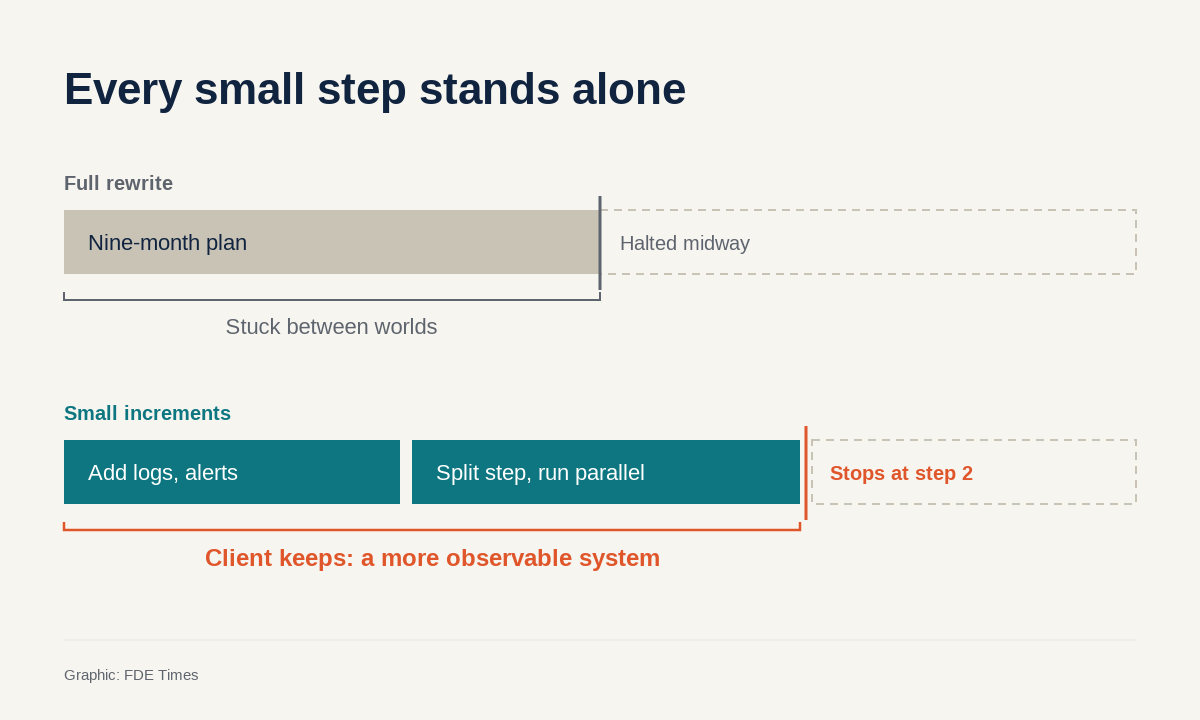
Back at the insurer. A nine-month plan to replace the batch job with a new service could die at the first budget cut, leaving two systems with neither one finished. The incremental approach works differently: once monitoring is in place, you extract one small calculation step, run it in parallel and compare its results with the old version.
Each step of that kind stands on its own. If the project stops after the second step, the client still has a system that is easier to observe, and is not stuck between two worlds.
Momentum also needs a measure. SHARE’s article on Bellotti’s approach stresses that without clearly communicated goals and suitable metrics, a modernization project has no path forward. For the batch job, the metric can be as simple as the number of failed runs per month, or the number of steps running in parallel that match the old version.
The hard part surrounds the code
The institutional knowledge Bellotti says has been lost does not live in the code. It lives in the heads of the people who used to run the job, or left the company with them. That is why “the system around the system” is where an FDE should step in first.
The person who wrote the batch job may still work at the company, and a rewrite proposal can sound like a criticism of their work. Larson warns of a longer-term consequence too: abandon one migration, and people will be deeply skeptical the next time they are asked to take part. For an FDE, that trust is the capital that gets you more work at the same client.
Before presenting an architecture, find out who owns the system, who is affected if it breaks, and who has the power to stop the project. Then ask them where every fix has caused something to break: that is the best risk map you will have.
Who should read it, and in what order?
If you are an FDE or want to become one, and the sorest point at your client is the people and the pace of the project, open chapter 5 first. Then read Fowler’s piece on the Strangler Fig and Larson’s writing on migrations to fill the methodology gap Nolan says the book leaves.
When a job posting mentions integrating with a client’s existing systems, a story like the batch job is well worth telling in a CV and in interviews. Describe how you identified the real problem, added monitoring first, which small step you extracted to run in parallel, and which metric you used to track progress.
Bellotti’s lesson is, in the end, a modest one: a legacy system improved one small finished piece at a time is worth more than an elegant rewrite that stops halfway.
Was this article useful?
Thanks for the feedback!
9 sources
- Kill It with Fire by Marianne Bellotti (Penguin Random House) · 2021-03-17
- Marianne Bellotti's Path for Successful Modernization Projects · 2022-06-22
- Kill It With Fire (USENIX ;login: online, review by Laura Nolan) · 2021-07-16
- To modernize your legacy apps, first stop being ashamed of them · 2023-06-08
- Kill it with Fire, by Marianne Bellotti – alexwlchan · 2026-08-01
- Notes on Kill It With Fire · 2021-10-17
- The key points of Kill It with Fire
- Migrations: the sole scalable fix to tech debt. · 2018-04-15
- Strangler Fig · 2024-08-22