Giving a client bad news means having three conversations at once
A book from the Harvard Negotiation Project team behind Getting to Yes shows FDEs how to separate facts, feelings and identity before they call the client.
In brief
- The book is by Douglas Stone, Bruce Patton and Sheila Heen, who are linked to the Harvard Negotiation Project. The third edition came out in 2023.
- Both sides usually agree on the facts and differ only in how they read them, so arguing about who is right rarely settles anything.
- Bad news touches the feelings and identity of both sides, including the FDE who has to deliver it.
When Penguin Random House describes Difficult Conversations, it lists “negotiating with a client” alongside simply saying “No”. The book first appeared in 1999. The third edition, 400 pages long, came out on August 22, 2023, and it is still sold as a handbook for the conversations everyone would rather avoid.
For a Forward Deployed Engineer, those conversations come every week: a deployment that has slipped, a model that has not reached the accuracy that was promised, client data that turns out worse than expected. Writing good code does not help you deliver that news. This book does, because it gives you a way to break a hard call into parts you can prepare in advance.
A book from the team that wrote Getting to Yes
All three authors are linked to the Harvard Negotiation Project. Bruce Patton co-founded it and co-wrote Getting to Yes with Roger Fisher and William Ury. Fisher also wrote the foreword. Douglas Stone and Sheila Heen teach at Harvard Law School.
Harvard’s Program on Negotiation describes the 2023 edition as a step-by-step method built on nearly thirty years of research. Its authors teach negotiation, so the book is best read as a procedure with steps to practice. It is not a source of inspiration.
Arguments about facts are usually arguments about interpretation
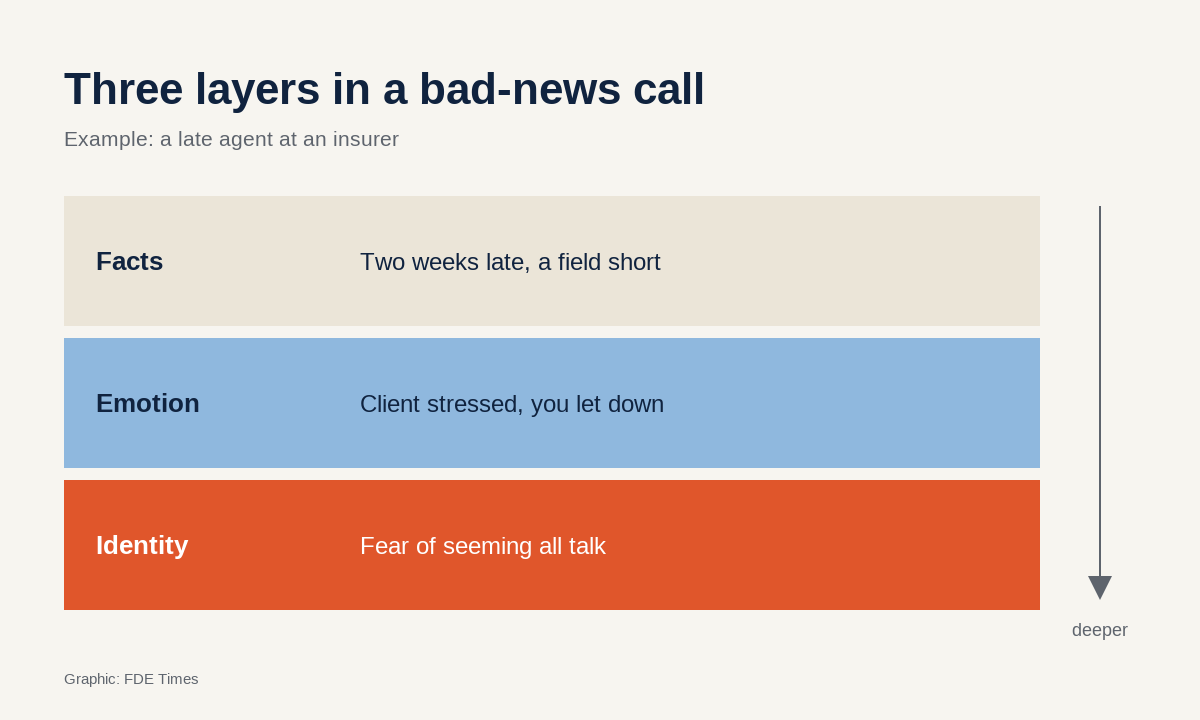
The book rests on one idea: every difficult conversation is really three conversations. The first layer is about “what happened”.
The summary by Beyond Intractability identifies a common mistake: people assume they are arguing over a factual question. In fact, the two sides usually agree on the facts and differ only in how they interpret them.
A hypothetical example makes the point. An agent you are deploying for an insurance company is two weeks late because its records table is missing a required field.
Both sides accept two things: the system is two weeks late, and the data is missing a field. The client concludes that your team was careless. You conclude that their data is dirty.
Any call that tries to prove who is right will stall.
The book offers two pieces of advice for exactly this situation. The first is to avoid leaping from impact to intent. If the client’s head of operations speaks sharply, that is the impact the bad news has had on them. It tells you nothing yet about their motives.
The second is to drop the blame. According to the book, focusing on whose fault something is is a bad idea because it keeps people from learning the real cause. In the example above, the first job is to work out with the client why that field was missing without anyone noticing in the first week. Deciding who was wrong can wait.
Feelings are why the call is hard, and hiding them does not help
The second layer is feelings. The book says plainly that difficult conversations are difficult precisely because feelings are involved. Engineers tend to want to skip this part and go straight to the new timeline. The book advises the opposite: say what you are feeling before rushing to judge which feelings are justified.
At the insurance company, that might take a single honest sentence before the remediation slide goes up: you are disappointed because you promised a go-live date, and you understand their operations team is under pressure from above. A client who hears that sentence will find the technical part that follows easier to take in.
Bad news also hits the identity of the person delivering it
The third layer runs deeper still. A difficult conversation can threaten how someone sees themselves. The summary sets out three identity questions: am I competent, am I a good person, and am I worthy of love.
For an FDE, the competence question is the one most easily hit. When you have to admit a deployment is late, it is tempting to get defensive, blame the data, or promise a new date too soon to prove you are still good at the job.
Knowing in advance that the call touches your own identity helps you keep a clear head. The same applies on the client side: the person who championed your project in front of their leadership is worried about their own reputation.
Three lines to write before you pick up the phone
The simplest way to use the framework is to write three lines before the hardest call of your week, one for each layer. The first line records the facts both sides agree on. The second records the feelings you think the client has, along with your own.
The third records what the call makes you worry about regarding your own competence. In the insurance example, the three lines would read: two weeks late because a required field is missing; the operations team is under pressure, and you are disappointed because you promised a go-live date; you are afraid of being seen as an engineer who makes empty promises.
Once the third line is written, you will see at once which sentence in your script is a defensive one. Cross it out before the client gets to hear it.
Read the three-conversations section first, the feedback book later
If time is short, read the three-conversations framework closely first, since that is the part you can use on your next call. Then read Thanks for the Feedback, also by Stone and Heen. It deals with receiving criticism that is hard to hear, and hearing complaints from clients is part of an FDE’s job too.
Software engineers with two to eight years of experience who want to move into FDE work should read this book early. If a behavioral interview asks how you once broke bad news to a stakeholder, the three-layer framework gives you a ready way to tell the story.
Tell it in order: the facts both sides agreed on, the feelings you named, and how you moved the meeting from blame to finding the cause. On a CV, a line describing how you kept a client through a missed deadline is worth more than one that says “strong communication skills”.
A demo that runs smoothly does not need this book. The call to announce a delay does, and the best time to read it is before the phone rings.
Was this article useful?
Thanks for the feedback!