The DeepLearning.AI eval course that stops agent bugs coming back
Its two most useful lessons for FDEs are how to check an LLM judge and how to turn every production failure into a regression test.
In brief
- A 15h7m course from DeepLearning.AI and Arize AI, taught by Laurie Voss, at Intermediate level
- The most valuable parts are validating an LLM judge (Module 3) and turning production failures into regression tests (Module 5)
- You need only Python, basic pandas and some experience calling an LLM API; no prior knowledge of evals or statistics
DeepLearning.AI’s “Evaluating and Improving Agentic Applications” runs to 15 hours and 7 minutes, with 28 videos, 6 code examples and 10 graded assignments. From Module 1 it spells out something many teams forget when they demo to a client: one successful run is not enough to call an agent reliable.
For an FDE, that is daily life. You tweak a prompt for the client, try three questions by hand, see that it works and deploy. A week later an old bug resurfaces just before a meeting with the client’s leadership. The course teaches how to break that cycle, and its most valuable part shows how to turn each production failure into a regression test.
Who made the course and why it matters
The instructor is Laurie Voss, Head of Developer Relations at Arize AI and a co-founder of npm. The course was built with Arize AI, the team behind the open-source Phoenix platform. The course page says it was updated on November 11th 2026.
Because Arize sells tooling, the course is best read as a method rather than a product pitch. Its promise is to find where an agent breaks and fix it without guesswork. Traces, datasets and experiments are general concepts, so the method is worth carrying into projects where the client uses something other than Phoenix.
The entry bar is low: you should be able to read and write Python, know basic pandas and have called an LLM API before. No experience with evaluation, tracing or statistics is required. The level is listed as Intermediate. Graded work and the certificate require a DeepLearning.AI Pro subscription.
In what order to take it
The course has five modules: Foundations of Evals; Observing and Benchmarking Agents; Building Evaluators You Can Trust; Evaluating Agent Actions and Outcomes; Improving Agentic Applications. If time on the engagement is tight, take modules 1, 3 and 5 first.
Module 1 gives you the argument for persuading a client to stop testing the agent with a handful of manual questions. Module 3 teaches you to test the grading tool itself. Module 5 closes the loop. Modules 2 and 4, on tracing and on evaluating agent actions, are best taken once the project has real traces to inspect.
If you already know tracing, you can skim Module 2. Do not skip Module 3, even if your LLM judge seems “good enough”.
Do not trust a judge you have not measured
Module 3 teaches how to measure the reliability of an LLM judge with precision, recall and Cohen’s kappa. It sounds dry, but it is where clients press FDEs hardest: “Who graded this 92% pass rate?”
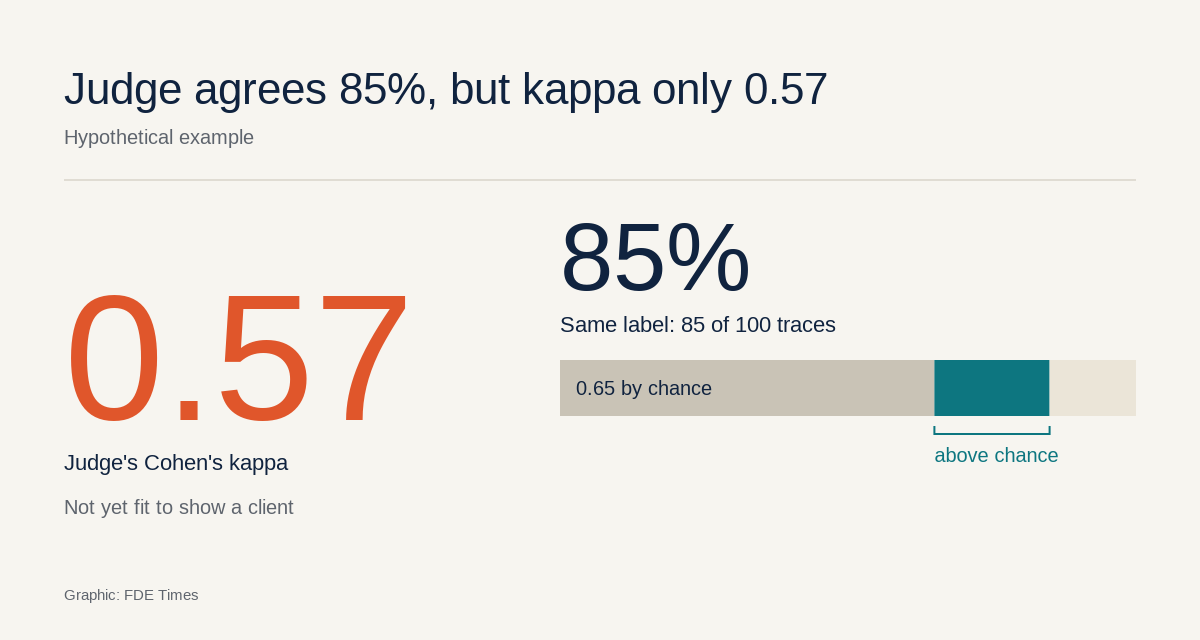
Take a hypothetical set of 100 traces you have labeled yourself, 20 of which are genuinely broken. The judge flags 25 traces as broken and gets 15 of them right. Precision is 15/25 = 60%, recall is 15/20 = 75%. The two of you agree on 85 of the 100 traces, which sounds good.
Yet part of that 85% is agreement by chance. The judge says “broken” on 25% of traces and the human on 20%, so chance agreement is 0.25×0.20 + 0.75×0.80 = 0.65.
Kappa = (0.85 − 0.65) / (1 − 0.65) ≈ 0.57. The judge is useful, but its scores are not yet good enough to go into a client report without someone reviewing them.
Production failures are the best dataset you have
Module 5 teaches you to compare agent versions on the same set of cases with the same evaluator, and then to turn production failures into regression tests. In a conversation in this module, Aparna Dhinakaran, a co-founder of Arize, says evals in production matter because they help you find the next set of problems to fix.
Hamel Husain, who writes independently about evals, described a similar practice back in 2024: keep updating tests based on newly observed failures, as users challenge the AI or as the product changes. The two views meet at the same point. A good test suite is not written up front. It grows out of the times the agent breaks.
For FDEs this is a real professional advantage. You sit closer to the client’s data and users than anyone on the product team. Every ticket the client files is a case that no public benchmark contains.
Experiments over spot checks
Arize’s “Ship Real Agents” workshop, also led by Laurie Voss, follows a sequence very close to the course: start from traces, classify failures by root cause, then use datasets and experiments to validate changes instead of eyeballing a few samples.
The Phoenix documentation describes an experiment as rerunning the same inputs against the changed version, then comparing eval results to confirm whether the change actually improved anything.
This mechanism is the backbone of regression testing. When the client wants to switch models because a cheaper one is available, there is no need to argue on gut feel. You run both versions on the same dataset and put the comparison table on the screen.
What to study and what to skip
Study the judge-measurement and version-comparison sections closely, because you will use both skills on every engagement that involves an agent. The hands-on tool walkthroughs can be covered quickly: interfaces change, the method does not.
On a job application, the certificate by itself says little. What belongs on a CV is a line such as: “built a regression suite from production failures, with a judge validated by kappa, comparing versions before every release”.
Hiring managers will not ask how many videos you watched. They will ask what you did, the last time an agent broke at a client, to make sure the failure never came back.
Was this article useful?
Thanks for the feedback!
6 sources
- Evaluating and Improving Agentic Applications - DeepLearning.AI · 2026-11-11
- Evaluating and Improving Agentic Applications - DeepLearning.AI · 2026-11-11
- A conversation with Aparna Dhinakaran, co-founder of Arize AI - DeepLearning.AI
- Ship Real Agents: Hands-on Evals - Arize Docs
- Arize Phoenix documentation
- Your AI Product Needs Evals · 2024-03-29