Blaming the client's users is the quickest way to learn nothing
Sidney Dekker's 248-page field guide teaches FDEs to ask what happened rather than who broke it, and to explain why a mistake made sense at the time.
In brief
- By Sidney Dekker, third edition, CRC Press, 248 pages; John Allspaw calls it required reading for the software industry.
- Core idea: 'human error' is a symptom, and the investigator's job is to explain why the action made sense at the time.
- Drawbacks: the book is somewhat repetitive and written for high-risk industries, so read it alongside the PagerDuty and Google SRE postmortem guides.
John Allspaw, then SVP of Infrastructure and Operations at Etsy, wrote the foreword to a field guide aimed at high-risk industries and concluded that for software engineering and the Internet it should be considered required reading. The book is Sidney Dekker’s The Field Guide to Understanding ‘Human Error’.
The third edition, published by CRC Press, runs to 248 pages and carries a 2014 copyright. Dekker earned his PhD at Ohio State University in 1996, and his publisher describes him as a professor at Griffith University in Brisbane, Australia.
For an FDE, the book answers a very practical question.
When a system you deployed fails at a client and their manager says “our staff made a mistake”, how do you run the review so that you blame neither their users nor your product, and still find what needs fixing?
“User error” is where the investigation starts
The book’s introduction calls reflexes like this a symptom of the “Bad Apple Theory”: the belief that your system is basically safe.
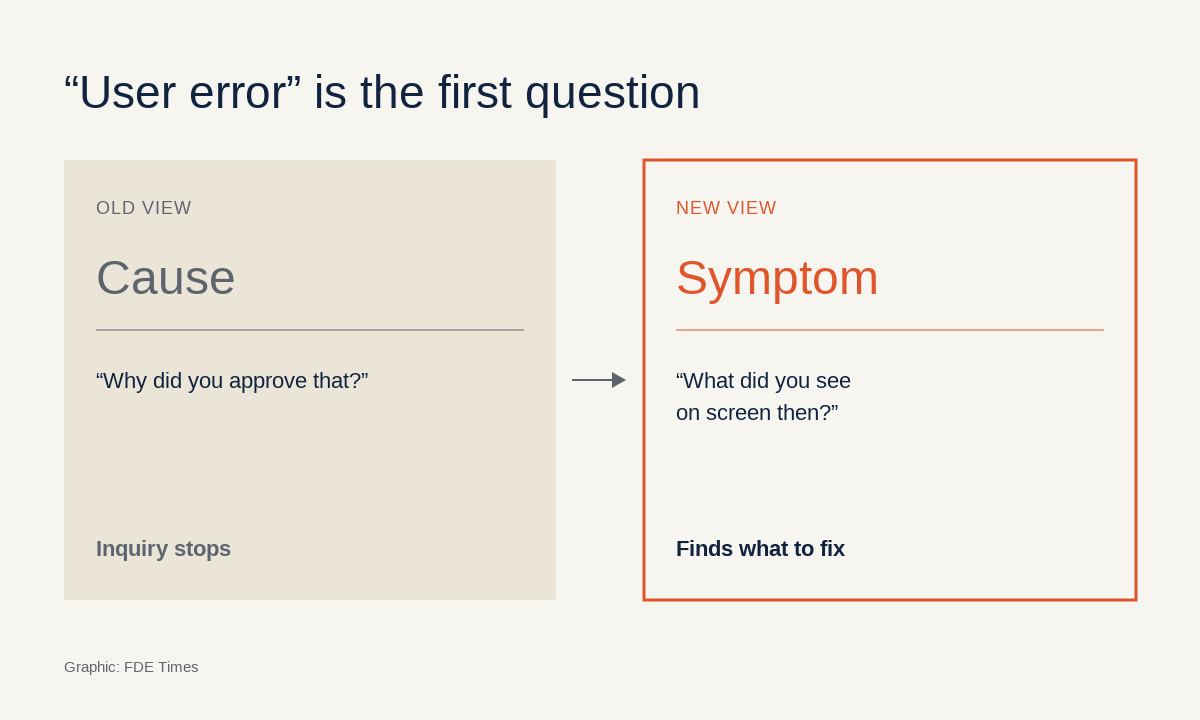
Rob Miller, in a 2021 review, summarizes Dekker’s “new view”: human error is a symptom of a deeper problem, whereas the old view treats it as the cause of trouble.
Take a hypothetical case. You deploy an agent that proposes dispatch orders for a logistics company; a warehouse worker approves a wrong proposal and goods ship to the wrong address. Under the old view, the story ends at “he approved it without checking”.
Under the new view, that is only the first question. What did the approval screen show? How many proposals did he have to approve per hour? How long had the agent been right without a break, long enough to make careful checking seem redundant? Every answer points to something you can fix in the deployment. Firing someone fixes nothing.
Trade indignation for explanation
The table of contents includes a chapter with a memorable title: “Trade indignation for explanation”. It sits next to sections on hindsight bias, building a timeline and making recommendations. Together those three sections amount to the procedure for a good review.
Allspaw made the same point in his 2013 piece on how Etsy learns from failure: saying what people should have done does not explain why the action made sense to them at the time.
At Etsy, engineers whose actions contributed to an incident give a detailed account of what they did, when, what effects they observed, what they expected and what they assumed, without fear of punishment or retribution.
Back to the warehouse worker. Your timeline should be written from where he stood, with what he knew at 2pm, not what the whole room knew at 5pm. Writing it that way is the most direct defense against hindsight bias, a subject the book gives a section of its own.
Ask “what”, not “why”
For questions you can use in the meeting room straight away, read Dekker alongside two practical guides. PagerDuty’s postmortem guide says a blameless review focuses on how a mistake happened rather than who made it.
It advises avoiding “why” questions because they force people to justify themselves, and justification leads straight to assigning blame.
The difference sounds small but changes the whole atmosphere of the room. “Why did you approve that order?” makes the warehouse worker defend himself in front of his boss. “What did you see on the screen at that point?” invites him to tell the story, and that story holds the data you need.
The postmortem culture chapter in Google’s SRE book starts from a simple assumption: everyone involved had good intentions. The Howie guide on PagerDuty’s site goes a step further with the idea of being “blame-aware”: admit that everyone tends to blame, name it, then move past it and get to work.
At a client site, where you do not control their culture, this approach is more realistic than pretending nobody in the room is angry.
What order to read in, and what not to expect
Terence Eden, in an August 2026 review, observed that a field guide like this can hardly avoid being somewhat repetitive. Rob Miller notes that it is clearly written for high-risk industries and situations.
Software engineers will have to map the book’s ideas onto their own incidents themselves, and can skim the repeated passages. The easiest way in is to start with Allspaw’s “Learning from Failure at Etsy”, where those ideas were already running inside a software company.
Then read Dekker, concentrating on the chapters on hindsight, timelines and recommendations. Finally, open the PagerDuty guide and the Google SRE postmortem chapter for question templates and document templates you can use immediately.
The book suits FDEs with two or more years of experience who have been on call for incidents, or who are about to lead their first engagement. In career terms, this skill is easier to demonstrate than you might think.
On a CV, a line like “led a blameless incident review with the client that led to changes in the product’s approval interface” says more than “strong communication skills”.
In a behavioral interview, when asked about an incident, tell it through the timeline and each person’s assumptions, then finish with what changed in the system. An interviewer who has read Dekker will likely recognize the way of thinking.
The next time someone at a client site says “user error”, you will know it is the moment to open your notebook, not to close it.
Was this article useful?
Thanks for the feedback!
7 sources
- The Field Guide to Understanding 'Human Error', 3rd Edition (Routledge)
- Review: The Field Guide to Understanding ‘Human Error’ (Roblog, Rob Miller) · 2021-10-17
- Learning from Failure at Etsy (Kitchen Soap, John Allspaw) · 2013-09-30
- The Blameless Postmortem (PagerDuty)
- Postmortem Culture: Learning from Failure (Google SRE Book)
- Howie Guide (PagerDuty Ops Guides)
- Book Review: The Field Guide to Understanding 'Human Error' by Sidney Dekker (Terence Eden) · 2026-08-03