Cialdini's Influence and the honest way to win over client leaders
Three honest ways to get a client's executives on your side, and the line that keeps a forward deployed engineer from sliding into manipulation.
In brief
- Influence was first published in 1984; an expanded 2021 edition adds new research and examples, and the book has sold more than 5 million copies.
- FDEs have no authority over client leaders, so persuasion matters more than job title.
- Three ideas worth keeping: give first, let the client commit in public, and use only real signals of authority or scarcity.
To write Influence, Robert B. Cialdini did more than run laboratory experiments. He also went undercover in trades that make a living from other people’s yes, such as selling cars and selling door to door.
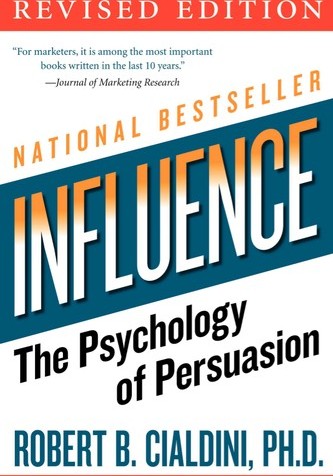
The book came out in 1984 as Influence: The Psychology of Persuasion, later joined by an academic edition, Influence: Science and Practice. It has sold more than 5 million copies.
The edition now in print is Influence, New and Expanded: The Psychology of Persuasion, which Barnes & Noble lists as a 2021 revision with new research, insights and examples, along with applications to online settings.
FDEs need this book because of a familiar reality on client sites: you cannot give orders to the head of operations, the data team lead or the VP who holds the budget.
Cialdini argues that in modern organizations, persuasion shapes other people’s behavior far more than formal authority does. That is an FDE’s daily situation.
What the book teaches, and in what order to read it
The core of the book is six principles: reciprocity, liking, social proof, commitment and consistency, authority, and scarcity. Influence At Work, Cialdini’s company, now presents seven, having later added a seventh principle, unity.
This piece goes deep on three ideas, but social proof deserves a brief mention because it is so easy to apply. Influence At Work describes it simply: when uncertain, people look at what others do.
So when a team lead on the client side is still hesitating, show them colleagues who are genuinely using the system, and never invent a reference customer who does not exist.
Start with the article Cialdini wrote for Harvard Business Review in 2001, “Harnessing the Science of Persuasion.” It is short and pairs each principle with a rule you can use straight away. For liking, for instance, the rule is to find real similarities and offer genuine praise.
Then read the book to understand the mechanisms behind them, and finish with the 2013 HBR interview between Cialdini and Sarah Cliffe, “The Uses (and Abuses) of Influence,” which discusses how leaders can apply the six principles authentically.
Read in this order, you get the tools first, then the theory, and end with the ethics. For anyone who works face to face with clients, the ethics is the most important part.
First idea: give first what you want to receive
The HBR article puts it briefly: people repay in kind. Influence At Work spells it out: people feel obliged to return the behavior, gift or help they have received first. The accompanying rule is to give exactly what you want to get back.
For an FDE, the “gift” is rarely a gift in the literal sense. Say you need read access to the client’s log tables before week two, but their data team is swamped and nobody has prioritized the request.
Instead of sending another reminder email, you spend an afternoon with them untangling a broken pipeline, even though the work falls outside the contract’s scope. A few days later, when you raise access again, you are asking someone you have just helped. You are no longer a stranger from the vendor.
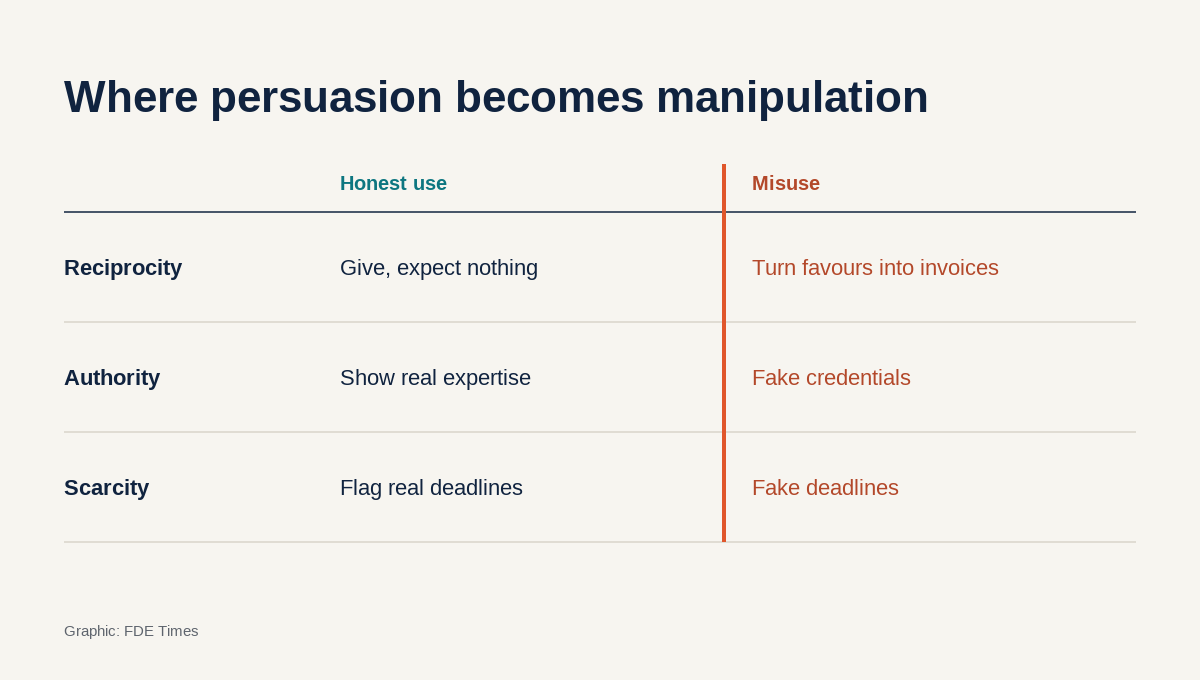
The common mistake is turning help into an invoice: “I just fixed your pipeline, now open up access for me.”
Phrasing it that way turns giving first into a conditional trade, and it slides toward the manipulation column in the figure above.
Let the help stand on its own, then make your request plainly.
Second idea: the client must write the commitment
Cialdini advises making other people’s commitments active, public and voluntary. When preparing to pilot an agent for a customer service department, do not write the success criterion into your own slide. Send the sponsor a one-sentence draft, ask them to edit it as they see fit, and let them send it to their team themselves.
That draft now belongs to the sponsor. When the pilot reaches its review, you measure the results against their words, not against your promise.
The process also gives you a concrete line for your CV: secured a written success criterion with an executive sponsor. In interviews, this is the story to have ready if you are asked how you persuaded someone who did not report to you.
Third idea: use only real signals
On authority, the HBR article tells of a team with genuine expertise that nobody knew about. The fix was to make that expertise more visible, without inventing credentials. FDEs often make the same mistake: you have put a similar system into production before but never mention it at the kickoff.
On scarcity, Cialdini accepts only honest use, meaning telling people an opportunity is about to close when that is true. If your engineering team really will move to another client after a certain date, say so clearly. Inventing a false deadline to pressure the client into signing is where you cross into manipulation.
Cialdini says bluntly that tricking or trapping people into agreement is ethically wrong and, in practical terms, a poor move. The Influence At Work site adds that dishonesty may bring short-term results, but once it is discovered, the relationship breaks down with it.
An FDE engagement usually runs for months and involves people you will meet again at the next renewal. That is why the most valuable lesson in Influence is how to keep people trusting you after they have said “yes.”
Was this article useful?
Thanks for the feedback!
6 sources
- Influence, New and Expanded: The Psychology of Persuasion
- Influence: Science and Practice (Wikipedia)
- Harnessing the Science of Persuasion (Robert B. Cialdini, HBR Oct 2001, AAPL repost) · 2021-02-20
- Dr. Robert Cialdini's Seven Principles of Persuasion | IAW
- The Principles of Persuasion Aren't Just for Business · 2016-05-23
- The Uses (and Abuses) of Influence · 2013-07-01