Prediction Machines and the question every FDE should ask clients
Three economists argue that AI makes prediction cheap, and that the hard part is putting a price on the consequences of every wrong guess.
In brief
- The book's central claim is that AI makes prediction cheap, so an FDE should look for the client decisions that rest on an expensive prediction.
- Judgment means working out the consequences of each outcome. It takes real effort, and it is where AI projects tend to stall.
- When judgment is not too hard, cheaper prediction makes good judgment more valuable, so FDEs should build the skills that complement prediction.
In 2022 Harvard Business Review Press published an updated edition of a 304-page book whose argument fits on a single line: the rise of AI is, at bottom, a fall in the cost of prediction.
The book is Prediction Machines, Updated and Expanded: The Simple Economics of Artificial Intelligence, by the economists Ajay Agrawal, Joshua Gans and Avi Goldfarb. According to the publisher, The Economist once named it one of the five best books for understanding AI.
It was written for managers, yet forward deployed engineers may get more out of it. An FDE often stands between a demo that works and a leadership team that wants to know what it will change for their business. The book supplies a shared language for that conversation, one that never needs to mention model architecture.
One economic idea can replace ten slides
The publisher’s blurb captures the spirit of the book: AI’s impact is profound, but the economic framework for understanding it is surprisingly simple.
The academic foundation sits in a chapter the three authors wrote for a volume published by NBER and the University of Chicago Press. That chapter treats recent advances in AI as improvements in prediction technology.
For an FDE, this framing changes how a discovery session begins. When a client says it wants to “build a chatbot” or “bring in agents”, turn the question around: which prediction in your workflow today is expensive, slow or based on gut feel? The answer is usually a specific decision, and that decision is what the client’s leadership actually cares about.
The most expensive part of a decision is judgment
The second idea is where the book earns its price. The authors call the work of determining the payoff of each outcome “judgment”, and they separate it cleanly from prediction.
Judgment is costly because, for every situation that might occur, someone has to think through what the consequences would be. At an event hosted by the MIT IDE, Goldfarb gave an operational definition: judgment is everything that affects a decision other than prediction and data.
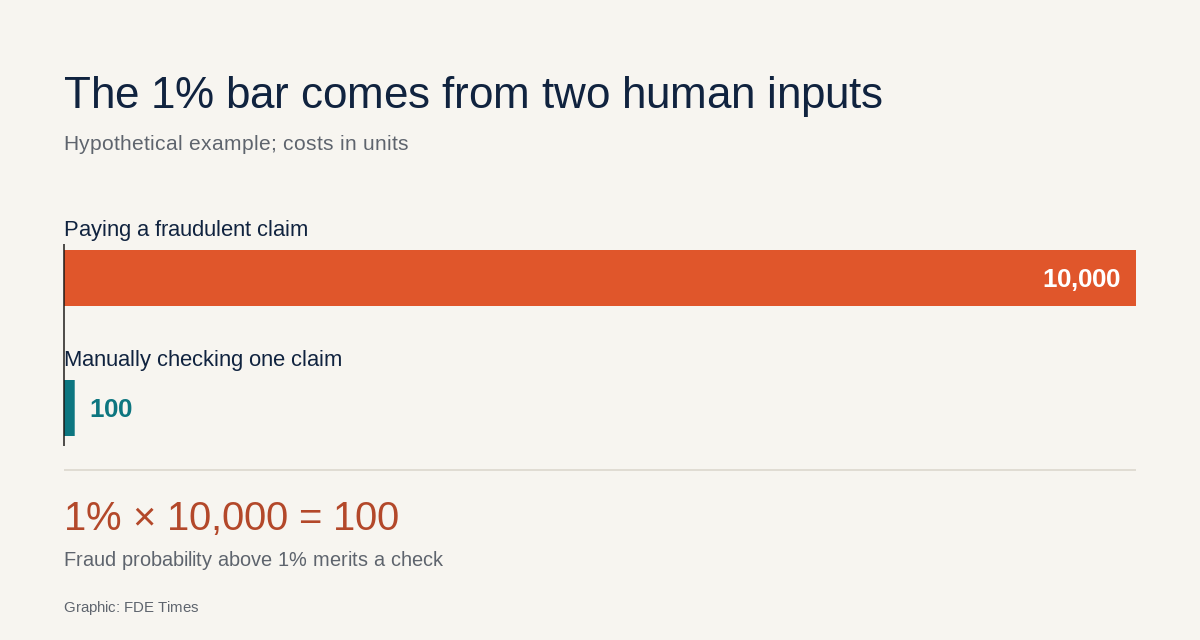
A hypothetical example makes this concrete. An insurer wants a model to score claims for fraud. The model produces only a probability. It does not know that paying out on a fraudulent claim costs about 10,000 units, while sending a claim for manual review costs 100.
People set those two numbers. From them it follows that any claim with a fraud probability above 1% is worth reviewing, because 1% × 10,000 = 100.
If the claims department will not commit to those numbers, no level of model accuracy turns into action. The first job at a client is to sit down with the process owner and fill in the payoff table for the four right and wrong cases.
Why cheap prediction makes people more valuable
The third idea runs against the “AI replaces people” reflex. In the authors’ model, prediction and judgment are complements, provided judgment is not too difficult. In those cases, the cheaper prediction becomes, the more good judgment is worth. The NBER chapter also draws out implications for automation, contracts and the boundaries of the firm.
During scoping, this works as a filter. Decisions with a clear, stable payoff table are candidates for automation. Decisions where every case forces someone to rethink the consequences should keep a human in the loop, and the system only needs to deliver the prediction to the right person at the right moment.
Goldfarb also offers career advice: the most valuable skills will be those that complement prediction. For an FDE, that means turning a client’s vague language into numbers for consequences, designing thresholds and making clear who is accountable for the final decision.
On a CV, describe projects in terms of “which decision improved, and which costs the threshold was based on” rather than as a list of models used.
Read the 2022 edition, then open the NBER chapter
The updated edition adds two new sections. One examines where prediction fits within decision-making; the other looks at how foundational technologies such as quantum computing will affect business choices. The first is the core material for FDEs; the quantum section can be skimmed.
A sensible order for an engineer: start with the 2022 HBR edition to learn the language for talking to executives.
Then open the chapter Prediction, Judgment, and Complexity on the NBER site to see the model behind it. The summary of Goldfarb’s talk at the MIT IDE is a short primer for anyone with only ten minutes.
The book will not teach anyone to write evals or put agents into production. It suits FDEs who are technically strong but falter when a meeting moves from model accuracy to money. For engineers moving from software engineering into FDE work, it is a quick way to start speaking the client’s language.
The next time a client executive asks what AI is worth, skip the model’s scores. Ask them a harder question instead: when prediction is almost free, how much does each wrong guess cost?
Was this article useful?
Thanks for the feedback!
4 sources
- Prediction Machines, Updated and Expanded: The Simple Economics of Artificial Intelligence (HBR Store) · 2022-11-15
- Prediction Machines, Updated and Expanded (Apple Books) · 2022-11-15
- Prediction, Judgment, and Complexity: A Theory of Decision-Making and Artificial Intelligence (NBER) · 2019-05
- How AI can lead to better predictions (MIT Initiative on the Digital Economy) · 2017-04-17