FDEs need only two of UW's four public speaking courses
Introduction supplies a framework for building a talk, Speaking to Inform is the core course, and the inspirational speeches can safely be skipped.

In brief
- The specialization has four courses, about 60 hours in total. For FDEs, Speaking to Inform is the core course.
- Take Introduction first for a framework and help with nerves, then study Inform closely. Leave Persuade for later; Inspire can be skipped.
- Talks are peer-graded and the feedback is sometimes thin, so ask a colleague to watch as well.
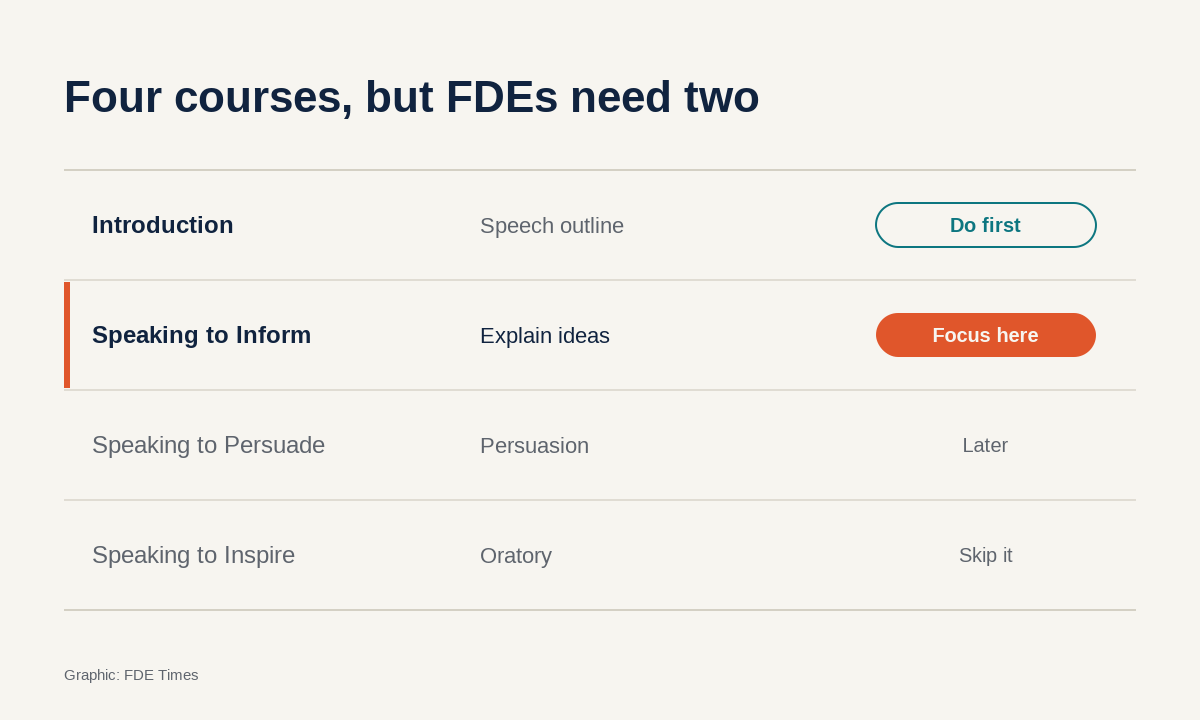
The University of Washington’s Dynamic Public Speaking specialization on Coursera has four courses, about 60 hours in total. An FDE about to present pilot results to a client’s leadership needs only two of them right away: Introduction, for a framework to build a talk, and then Speaking to Inform, the one to study most closely.
Coursera introduces the specialization with the line that speaking well is your most durable professional skill. The time commitment is less clear. The top of the page says roughly 4 weeks at 10 hours a week, while the FAQ estimates 4-6 months for the whole specialization. An engineer in the middle of a deployment will struggle to find that much time, so choices have to be made.
The way to choose is by the people you will be standing in front of. In the meeting room, the FDE is usually the person who understands the system best. But the client’s executives decide based only on what they hear in a few minutes. What follows covers what to study, in what order, and what to drop.
The instructor is a debate coach
All four courses are taught by Dr. Matt McGarrity, a Teaching Professor in the University of Washington’s Department of Communication, who earned his PhD at Indiana University in 2005. He also founded and directs the university’s Center for Speech & Debate, which trains students in speaking.
The four courses are: Introduction to Public Speaking; Speaking to Inform, on explaining complex ideas with slides; Speaking to Persuade, on persuasion; and Speaking to Inspire, on ceremonial and motivational speeches.
The specialization teaches two sets of skills. The first is delivery: voice, movement and gesture. The second is writing the talk: storytelling, argument, framing a problem and using evidence.
It is pitched at beginners. If you are already used to presenting in technical demos, much of it will move slower than you need.
Speaking to Inform is the course FDEs need most
The course sets a clear goal: by the end, you can explain complex ideas vividly and clearly, build clean slides and speak from notes. Those are precisely the tasks of a briefing for a client’s leadership. The syllabus runs week by week: targeting the audience, designing the talk, clarifying ideas with examples and slides, then delivery.
Take a hypothetical case. You have just finished a pilot of an agent that handles support tickets, and the client’s head of operations has to decide whether to expand it.
Engineering habit would have you prepare a dozen or more slides on the architecture, the eval pipeline and latency. The course asks you to put yourself in the listener’s seat before making a single slide.
From that executive’s seat, only three things matter: what the pilot achieved, what risks remain, and what they need to decide today. That makes three slides, one idea each. The architecture goes into an appendix, to be opened when someone asks.
Three ideas worth keeping
The first is to start with the audience, as in the case above. Before every briefing, write one sentence answering the question: what does the decision-maker need to hear? Cut any slide that does not serve that sentence.
The second comes from a 2024 University of Washington article, in which McGarrity argues that listeners follow a talk because of its structure, and that a speaker is writing for the ear, not the eye.
A reader can go back over a paragraph; a listener cannot. So announce “there are three things” in advance, take them one at a time, and restate the structure at each transition.
The third is to keep slides simple. “Keep slides simple” is the title of a lesson in the week on slides. With lean slides you have to speak from notes and look at your audience instead of reading text off the screen. The Inform course trains that skill directly.
What order to take them in, and what to skip
Start with Introduction. It offers a framework for preparing and delivering a talk, teaches vocal practice and adds practice in VR. Of its five weeks, week 4 is devoted to overcoming the fear of public speaking and sharpening delivery. Once Introduction is done, move straight on to Inform and spend most of your time there.
Persuade can wait until the job requires you to ask for more budget or propose a new scope. Inspire covers ceremonial speeches and motivational talks, far removed from a technical briefing. If time is short, skip it.
The grading deserves attention. You record videos of your talks for other learners to grade, some assignments are graded by AI, and learners report that peer feedback is sometimes weak. Ask a colleague as well, ideally someone outside engineering, to watch the video and tell you what they remember.
When you put this skill on your CV, do not stop at the certificate line. A 5-minute briefing video you recorded yourself, with a few lines on what you cut to suit the audience, is far more concrete evidence. Link it from your portfolio and use it when an FDE recruiter asks about your experience working with clients.
Picking the right two courses lets you concentrate on the parts that directly serve a briefing. The rest comes from practicing again and again on your own real presentations, until you can explain a system to people who have no need to know how it works.
Was this article useful?
Thanks for the feedback!
5 sources
- Dynamic Public Speaking Specialization (University of Washington, Coursera)
- Introduction to Public Speaking (University of Washington, Coursera)
- Speaking to inform: Discussing complex ideas with clear explanations and dynamic slides (Coursera)
- Matt McGarrity, UW Department of Communication
- The truth about public speaking (UW College of Arts & Sciences) · 2024-03-05