The Bedrock agent course is gone. Its agents still run at AWS clients
Read it as a map of a legacy system: three of its ideas still hold, once translated into AgentCore.
In brief
- DeepLearning.AI has retired the course, and AWS has stopped accepting new sign-ups for Bedrock Agents, now called Agents Classic
- Clients already on Agents Classic can keep running it, so FDEs still need to understand the architecture the course teaches
- New projects should be built on AgentCore and the Strands Agents SDK, with Observability, Identity, Policy and Evaluations learned on top
The DeepLearning.AI page for Serverless Agentic Workflows with Amazon Bedrock, updated on June 4, 2026, now opens with one short sentence: the course has been retired. AWS documentation also says that Amazon Bedrock Agents, the service at the heart of the course, no longer accepts new sign-ups and has been renamed Agents Classic.
At first glance that closes the matter. But AWS also states plainly that existing Bedrock Agents users can carry on using it.
For FDEs, that is the detail that matters. Systems built on Bedrock Agents may well still be in production, so when you are sent to an AWS client that deployed agents some time ago, you may meet exactly the set of concepts this course teaches.
The course is therefore best revisited as a map of a legacy system, with a translation table to the current platform. What follows separates what to keep from what to discard.
A short course, taught by AWS
The instructor is Mike Chambers of AWS. The course is pitched at intermediate level, runs about 1 hour 34 minutes, and contains 8 videos and 5 code examples. The only prerequisite is basic Python, and it is aimed at people who want to build agentic applications for work or for personal projects.
Its goal is stated directly: take a “responsible” agentic application to production using serverless technology. The underlying problem is an agentic workflow that handles tasks which are hard to predict in advance because they depend on user input, such as calling APIs.
A hands-on write-up by Classmethod, published on December 8, 2024, lays out the concrete path; according to the post, the course is free. Learners build an agent on Bedrock Agents, connect AWS Lambda functions, use a Knowledge Base to answer FAQs (in other words, AWS-managed RAG), attach Guardrails, and then add calculation logic with Code Interpreter.
What has gone out of date?
The course’s way of building agents rests on the fully managed Bedrock Agents model: each agent needs at least one action group, along with a knowledge base and trace.
For new users, AWS points to Amazon Bedrock AgentCore, where agents are defined in code with the Strands Agents SDK. According to AWS documentation, AgentCore works with any framework and any model, and consists of several modular services, each of which can be used on its own.
If the client is just starting out, do not build the agent step by step as the course does. You will run straight into a sign-up door that is closed to new users.
The course also leaves out areas that real production work needs. AgentCore ships with Observability, Identity, Policy and Evaluations. AWS describes Policy in particular as a deterministic control layer that keeps agents within business boundaries and rules without slowing them down. This is the part you will have to learn on your own.
Three ideas still worth keeping
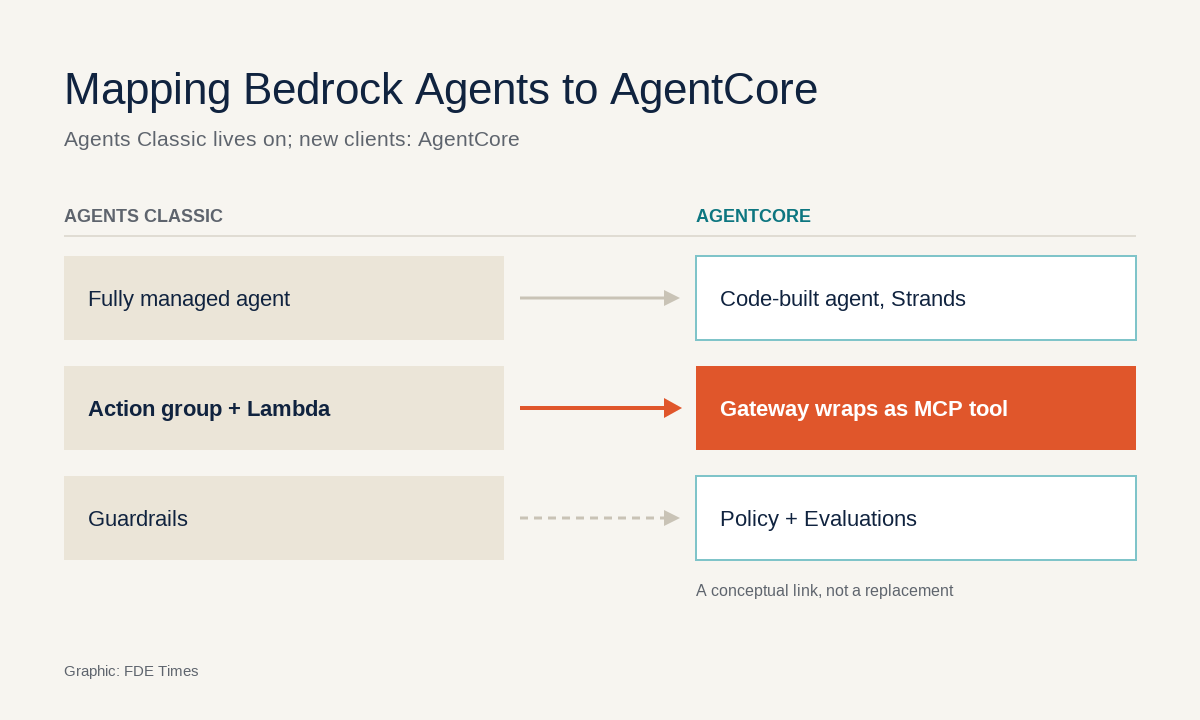
The first: a tool is a contract between the agent and the client’s systems. In the course, that contract is an action group pointing to a Lambda function. On AgentCore, Gateway turns APIs, Lambda functions and existing services into MCP-compatible tools, so the course’s material on connecting an agent to a CRM still teaches the right idea.
Take a hypothetical retail client running a customer-service agent on Agents Classic, with an action group that looks up orders through Lambda. When it moves to AgentCore, Gateway can wrap that Lambda function as an MCP tool. The heavy lifting lies in two steps before the old path is switched off.
The first step is to lock down the schema. For example, a look_up_order tool takes a required string order_id and an email to verify the order’s owner, and returns exactly three fields: status, estimated_delivery_date and total_amount. Any field the old agent accepted implicitly, such as a phone number, must be either written down or deliberately removed.
The second step is regression testing. Take real questions the old agent received, run them in parallel through both the old action group and the new tool, and check whether the tool called, the parameters passed and the results returned all match. Only when they match should you switch off the old action group.
The second idea: do not let the model do arithmetic. The course hands calculation to Code Interpreter. When an agent quotes a price, calculates a refund or adds up inventory, the number should go through code that actually runs and can be checked, because the client will ask where that number came from.
The third idea: “responsible” is an engineering layer with real configuration. The course puts Guardrails directly on the road to production, and on AgentCore, Policy and Evaluations serve the same purpose of keeping the agent within bounds.
This is a link between ideas only; it does not mean Policy replaces Guardrails. When a client asks whether the agent could give answers that break the rules, you need to be able to show a configuration and an evaluation suite rather than a promise.
Who should learn this, and in what order?
If you are about to take on a client already running Bedrock Agents, get to grips with action groups, knowledge bases, traces and guardrails before you open their AWS account. Then read the AgentCore documentation, starting with Gateway because it connects directly to the Lambda work you already understand, followed by Policy, Observability, Identity and Evaluations. Leave the Strands Agents SDK until last, when you are ready to write agents in code.
If the client is entirely new to AWS, go straight to AgentCore and Strands. In that case the course is useful only as background on why older systems look the way they do.
On the career side, when a job posting mentions Amazon Bedrock, ask in the interview whether their clients are on Agents Classic or AgentCore. The answer tells you whether the work will be maintenance, migration or a fresh build.
On a CV, a line such as “migrated Bedrock Agents action groups to MCP tools via AgentCore Gateway, with regression tests” is far more persuasive than a certificate from a retired course.
The course has closed, while agents built on Bedrock Agents are still allowed to keep running. When they need to move house, the person who gets the call will be the one who understands both generations.
Was this article useful?
Thanks for the feedback!
6 sources
- Serverless Agentic Workflows with Amazon Bedrock - DeepLearning.AI · 2026-06-04
- Serverless Agentic Workflows with Amazon Bedrock (learn.deeplearning.ai)
- Dr. Werner のキーノートで紹介された Serverless Agentic Workflows with Amazon Bedrock をやってみた #AWSreInvent · 2024-12-08
- Automate tasks in your application using AI agents - Amazon Bedrock User Guide
- What is Amazon Bedrock AgentCore? - Amazon Bedrock AgentCore Developer Guide
- Amazon Bedrock AgentCore FAQs