The Navy SEAL rule that keeps FDE incident meetings from blame
Extreme Ownership, by two former SEALs, gives forward deployed engineers a way to run a failing client engagement without the meeting turning into a hunt for culprits.
In brief
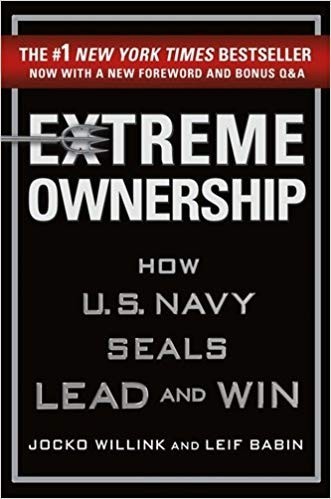
- Extreme Ownership by Jocko Willink and Leif Babin, published in hardcover in 2015, uses SEAL combat in Ramadi to teach leadership.
- For FDEs, the book's main value is the reflex not to blame, because blame drags an incident meeting toward who was wrong instead of what needs doing.
- Ownership does not mean working alone: priorities must be clear enough for the client side to execute when you are not there.
“There are no bad teams, only bad leaders.” Jocko Willink and Leif Babin repeated the line in a 2016 Business Insider interview, republished on Yahoo Finance. It sounds like a slogan, yet it captures almost the whole spirit of the book the two had published a year earlier.
The book is Extreme Ownership: How U.S. Navy SEALs Lead and Win. St. Martin’s Press released the 320-page hardcover on October 20, 2015; the Apple Books ebook followed on November 21, 2017.
The authors served together in SEAL Task Unit Bruiser, which the bookseller describes as the most highly decorated special operations unit of the Iraq War and one that helped secure victory in Ramadi. They later co-founded Echelon Front, a leadership consultancy, with Willink as CEO and Babin as President.
For a forward deployed engineer, this is a book about the hardest moment in the job: when a client project goes off course and there are plenty of people around to blame.
The product team, the client’s data team, the infrastructure vendor: any of them could be the reason. The skill the book trains is running a troubled engagement without letting it slide into a search for the culprit.
Blame stops the meeting
The book recounts leading Task Unit Bruiser in Ramadi and applies the lessons to business and life, with one clear thesis: leadership at every level is the most important factor in whether a team succeeds or fails. As Echelon Front puts it, when something goes wrong, you own it, with no excuses and no one else to blame.
A 2018 post on the Conductor blog brought the idea into a software company and boiled the response to failure down to three steps: take ownership, find out what happened, then build the solution.
A hypothetical example shows the difference. In the third week of a deployment, the client’s ticket-classification agent loses accuracy because their data team changed the ticket format without warning.
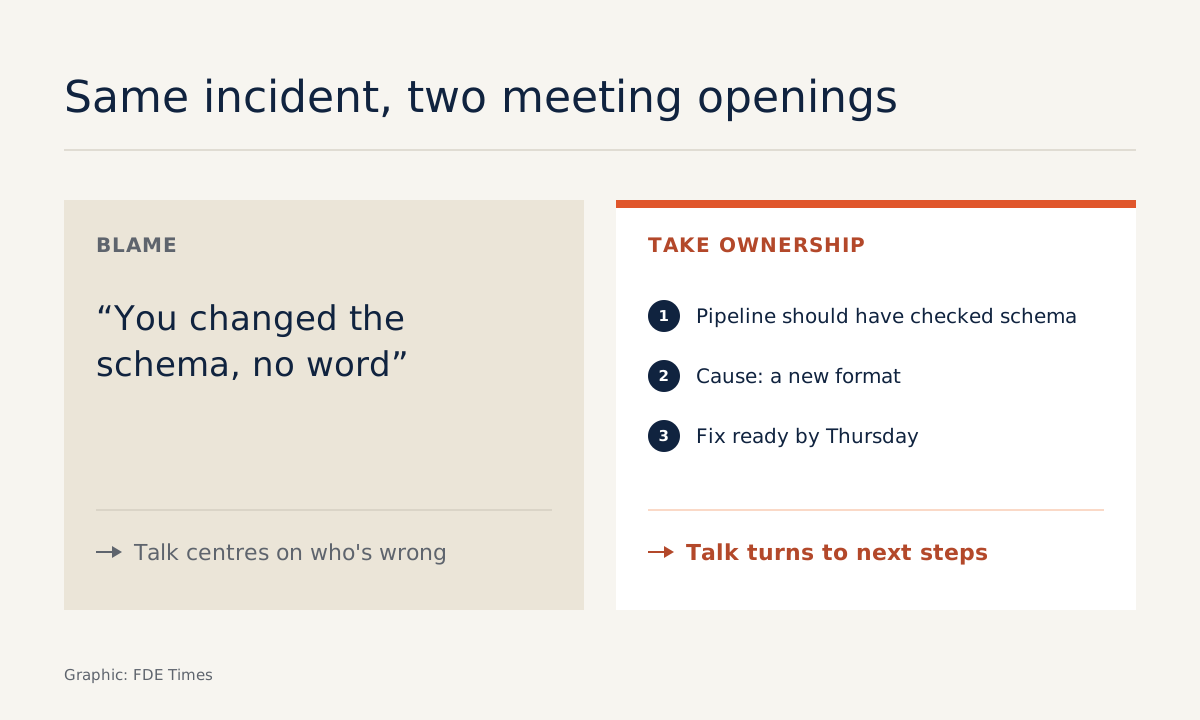
Open the meeting with “your side changed the schema without telling us,” and the meeting will revolve around who was wrong. Nobody leaves the room with a concrete task.
Now say instead: “Our deployment pipeline should have validated the schema before data came in. The cause is the new format in field X. The fix will be ready Thursday, with a check so this doesn’t happen again.” The facts are the same, but the meeting moves on to the work.
Echelon Front suggests a question to turn on yourself before looking at anyone else: “How is this my fault?” Examine your own role first, then work out how to stop the failure recurring. For good engineers this is often the hardest part, because technically you are often right.
Does ownership mean doing it alone?
No. Conductor’s definition explains why: Extreme Ownership means owning everything in your world, including the things you do not directly control. You cannot give orders to the client’s data team, but you can take the initiative to bring them into the fix.
In the example above, owning the solution means you personally invite the client’s data team to agree on a process for giving notice before format changes, and you tell your product team that the product lacks input validation. You take responsibility for the coordination without taking other people’s work onto yourself.
Echelon Front also stresses clarifying and simplifying priorities: if the team does not understand or remember what you said, the fault is not theirs. So if the client team did not know to give notice before changing a schema, quite likely nobody told them clearly, and the person who should have was you.
Doing the client’s work is the easiest trap
The most common mistake is reading “take full responsibility” as quietly doing the work yourself. The client’s data team is slow, so you write the conversion script; the client lead cannot approve in time, so you decide. The incident passes, but the client team learns nothing and still depends on you.
Echelon Front describes the desired outcome in the opposite direction: when the leader takes ownership, the team stops making excuses and gets on with execution. A client team cannot execute anything if you have already done it all.
A simple test: after each act of ownership, ask whether the client team could do this if you were not there. Every FDE eventually leaves the client; if the answer is no, you have only treated the symptom.
Who should read it, and how to get value from it?
The book suits two groups of readers best. The first is FDEs who are starting to run engagements themselves, when you answer for the outcome at the client and not only for the code you wrote. The second is software engineers who want to move into FDE work, because the biggest leap is precisely from owning code to owning outcomes.
Read it with one caveat: these are battlefield stories, and turning them into lessons for a client’s company is your job. Once you have read the core principles, reopen your most recent incident and ask which parts fell within your remit before reading on.
The book also helps in a job search. If an interviewer asks about a project that went wrong, tell it in the three-step sequence above and add what you changed so the failure would not recur.
On a CV, a line describing a deployment you rescued, stating clearly which part you were responsible for, tells a recruiter more than a list of technologies.
Next time a deployment goes wrong, start with the book’s most uncomfortable question: how is this your fault?
Was this article useful?
Thanks for the feedback!
6 sources
- Extreme Ownership – Leadership Now
- Extreme Ownership – Apple Books · 2017-11-21
- About – Echelon Front
- What Are Extreme Ownership Leadership Strategies? – Echelon Front
- Former Navy SEAL commanders explain why 'there are no bad teams, only bad leaders' · 2016-10-02
- Effective Leadership Through Extreme Ownership – Conductor · 2018-05-11