The GenAI interview book isn't for FDEs. Three chapters still are
Drill the seven-step framework and the chatbot and RAG chapters; agents and production evaluation you will have to learn somewhere else.
In brief
- The book, from ByteByteGo and written by Ali Aminian and Hao Sheng, targets ML engineers and data scientists. It was not written for FDEs.
- FDEs should read chapter 1 (the seven-step framework, offline and online evaluation), chapter 4 (chatbots) and chapter 6 (RAG) first. Leave the image and video chapters for later.
- There is no dedicated chapter on agents. Production evaluation, observability and inference cost also need to be learned from other sources.
In its opening chapter, Generative AI System Design Interview states plainly that it is written for ML engineers and data scientists preparing for ML system design interviews. The letters FDE appear nowhere.
Yet OpenAI’s job posting for a Forward Deployed Engineer in New York measures success by three things: whether the client actually puts the system into production, measurable impact on the workflow, and an eval-driven feedback loop.
The book does lay groundwork for that loop: the introduction teaches two ways to evaluate, offline and online. But it was built for interview practice, so FDEs should read it selectively.
If you are preparing for the system design round of an FDE interview, or are about to build an AI assistant on a client’s real data, settle three things before opening it: which chapters to drill until they stick, which to skim, and where the book leaves gaps you will have to fill yourself.
Who wrote it, and what is in it?
ByteByteGo launched the book in an Alex Xu newsletter on November 18, 2024. Alex Xu said he had worked with Ali Aminian and Hao Sheng, the book’s two authors. According to the publisher, it contains a seven-step framework for answering GenAI system design questions, 10 questions with detailed solutions and more than 280 diagrams.
There are 11 chapters. After the introduction come text generation (Gmail Smart Compose in chapter 2), machine translation (Google Translate in chapter 3) and a ChatGPT-style personal assistant chatbot in chapter 4. Then image captioning, Retrieval-Augmented Generation in chapter 6, image generation, personalized headshots and text-to-video.
The list leans heavily toward images and video. If your job is mostly bringing language models into client workflows, the text chapters, above all chatbots and RAG, are the ones closest to daily work.
Chapter 1 is the most valuable in the book
The introduction’s seven-step framework runs in this order: clarify requirements, frame the problem as an ML task, prepare the data, develop the model, evaluate, design the overall system, then deploy and monitor. At the evaluation step, the book splits the work into two kinds: offline and online.
In an interview room, the framework stops you from jumping straight to model choice. On a client site, it works as a discovery checklist: each step is a set of questions to ask before writing the first line of code.
For FDEs, the evaluation step deserves the most time. OpenAI’s posting for an FDE in Financial Services asks candidates to run eval loops that measure model and system quality against benchmarks specific to each financial workflow. The Healthcare posting in San Francisco goes further, asking for eval definitions, human review processes, escalation paths and launch criteria.
Running the seven steps on a RAG case
Take a hypothetical case: a bank’s compliance team wants an assistant that answers questions from its internal rulebook. Clarifying requirements tells you who is asking, what they ask and what a wrong answer costs. Framing it as an ML task shows that this is a RAG problem, exactly the subject of chapter 6, with no need yet for fine-tuning.
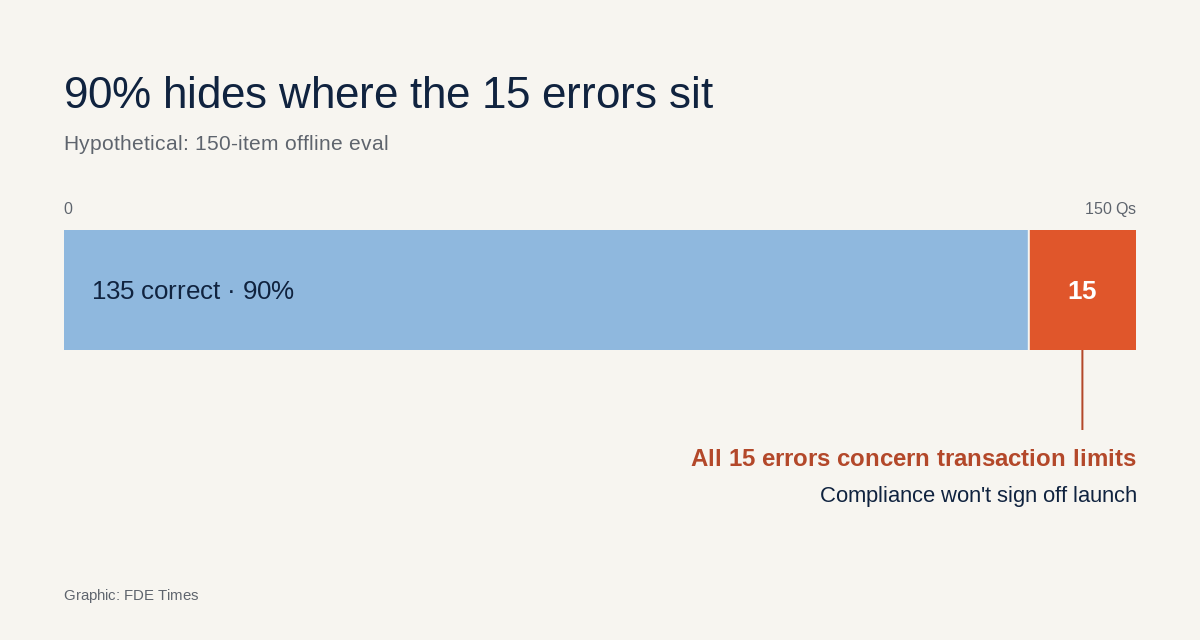
At the evaluation step, say the offline eval set has 150 questions written by compliance staff themselves and the system answers 135 correctly. That 90% figure means something only once you know where the 15 wrong answers fall. If all 15 concern transaction limits, compliance will not sign off on launch, however good the average looks.
Online evaluation comes after the system is live: the share of answers users accept, and the number of questions escalated to a human reviewer. When presenting this case in an interview, state the launch criteria and the escalation path at the evaluation step. OpenAI’s Healthcare FDE posting names exactly those two things.
Three common mistakes at the evaluation step
The most common is reporting 90% and stopping there. The interviewer, like the compliance team, will immediately ask what kind of questions the 15 failures were. Make a habit of always pairing the average with a breakdown of errors.
The second is talking only about offline evaluation. The book’s framework includes online evaluation too, and that is the part that tells you whether the system is actually used after launch. The third is letting engineers write the question set. In the bank case, the value of the 150 questions lies in the fact that people who do the work wrote them.
What order to read in, and where to stop
Read chapter 1 first for the seven-step framework, then chapter 4 on chatbots and chapter 6 on RAG. The bank case shows why: an internal assistant on a client’s documents combines both kinds of system.
Chapters 2 and 3 are worth skimming if you want to see how the book handles text generation. Leave the image and video chapters for later, unless your client works in media.
What the book leaves out matters as much as what it covers. A review on the interview-prep site PracHub notes that the public table of contents has no dedicated chapter on agentic workflows. The review also recommends further study of production evaluation, observability and inference cost.
A sensible way to fill the gap is to apply the seven-step framework to a tool-calling agent yourself, and answer one extra question: how each tool call is logged and measured.
On experience, OpenAI’s New York FDE posting asks for at least 5 years of technical or deployment experience, including direct work with customers.
A CV line such as “built a 150-question eval set with the business team and set launch criteria” shows a recruiter both things they want: an eval mindset and experience working with clients.
The book teaches you to design a system on a whiteboard. What FDEs must learn on their own is how to prove that system still holds up on a client’s real data, in front of the client’s real users.
Was this article useful?
Thanks for the feedback!
6 sources
- Our New Book, Generative AI System Design Interview, Is Now Available · 2024-11-18
- Introduction and Overview | Generative AI System Design Interview (ByteByteGo)
- Forward Deployed Engineer (FDE) - NYC | OpenAI
- Forward Deployed Engineer (FDE), Financial Services - NYC | OpenAI
- Forward Deployed Engineer (FDE), Healthcare - SF | OpenAI
- Generative AI System Design Interview Book Review 2026: Is It Still Enough? · 8/3/2026