Government software fails in the gap FDEs are paid to fill
HealthCare.gov had 36 contractors and still crashed; in Recoding America, Jennifer Pahlka blames culture and waterfall process, not money or technology.
In brief
- Pahlka argues that government software fails because of culture and process, not a lack of money or technology.
- The root cause is policy split from delivery: users see the software only at acceptance, and contracts measure success by checklist.
- For FDEs, the book teaches how to bring users in early and to define done as the point when users can actually use the product.
In October 2013 HealthCare.gov opened and collapsed almost immediately. The huge project had been handed to 36 contractors. On the argument that runs through Jennifer Pahlka’s work, failures like this are rarely about a shortage of money or technology. They happen because nobody stands between the people writing the requirements and the people who will actually use the product.
Pahlka devotes all of Recoding America to explaining that gap. In her view, the problem is culture and process.
If you are an FDE, that gap is where you work. The client may be a bank, a hospital or a government ministry, but the failure Pahlka describes will be familiar: requirements written at a distance, software delivered at the end of the project, and then nobody able to use it.
An author who has sat on both sides
Pahlka founded Code for America, co-founded the US Digital Service and served as US Deputy Chief Technology Officer. The book was published by Metropolitan Books, an imprint of Macmillan, on 13 June 2023. The hardback runs to 336 pages, and a 2025 edition added a foreword by William Hurd.
This is not a technical book. It teaches no architecture and no framework. What it trains is a skill technical documentation does not: seeing why an organisation with ample resources still cannot ship software people can use. Three ideas are worth keeping.
Idea one: software meets its users too late
Pahlka argues that the whole machinery of government runs on a waterfall model. In an interview with Santi Ruiz on Statecraft, she said that under this model the software does not touch users until the very end, at the stage called user acceptance testing.
The root cause, she says, is that policy is separated from delivery. The people who decide what needs doing do not talk to the people building it, and the builders never meet the users. Perla Ni’s review of the book in the Stanford Social Innovation Review calls this a paralysing gap, created by outsourcing, between policymakers and the people who use the services.
At a client site, the fix is simple: do not make real users wait until acceptance week. In the first week, find one person who will use the system every day and show them anything that runs, however rough.
Idea two: ticking every box is not done
Government contracts often list requirements as a checklist without demanding that the software be usable. Pahlka is clear that even if every box has been ticked, the job is not done if people cannot use it.
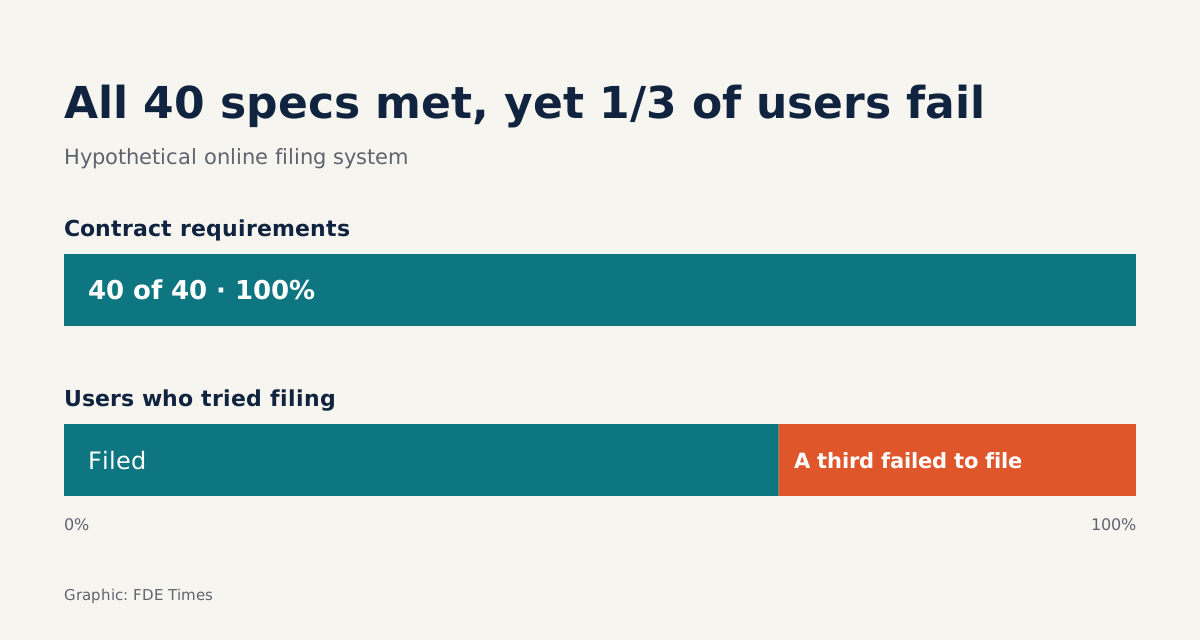
Picture an online application system with 40 requirements, and a contractor that meets all 40. At the acceptance session, one in three test users cannot finish an application because they cannot find the step for uploading documents. On paper the project scores 100%. For a third of the people who need the service, it is a complete failure.
So FDEs should rewrite the definition of done at the start of an engagement. Instead of “the system supports document upload”, write “applicants can upload their documents without calling support”, then measure that sentence with real people.
Idea three: culture beats rules
The biggest barrier is not procurement law. In a conversation with ITIF, Pahlka argued that the real barrier is fear of being held accountable, and she summed it up in one line: culture trumps policy.
Her proposal is to fund in phases: discovery, pilot, and only then scale. She also wants delivery teams brought in while policy is being made, and wants government to own and be able to fix its own code rather than depend entirely on outside contractors.
Another of her observations is worth remembering: legacy systems are rarely replaced; they are simply patched with layer upon layer.
Pahlka also distinguishes product management from project management. Product management, in her view, is the art of deciding what to build in the first place. Good FDEs do exactly this: before writing a line of code, they reframe the question of what the client really needs.
Who should read it, and how
The book suits FDEs who work, or are about to work, in the public sector, banking, insurance or healthcare: places with long contracts and heavy process. Software engineers hoping to move into FDE work should read it too, because it gives you the language to explain why the role exists.
A sensible order: start with Perla Ni’s review in SSIR, because its HealthCare.gov example shows what failure at scale looks like. Then read the book, then the Statecraft interview to hear Pahlka herself on policy delivery.
For your career: when a job ad mentions “public sector”, ask in the interview whether the team gets to meet end users, and who owns the code after handover. On your CV, record the time from project start to the first time a real user used the product, rather than only listing features shipped.
The book is about America, but the gap it describes exists at every large client. The FDE role was created to close it.
Was this article useful?
Thanks for the feedback!
4 sources
- Recoding America (Macmillan Academic Trade)
- Citizen Digital: How the US Government Can Do Better in the Digital Age with Jennifer Pahlka (ITIF) · 2023-06-16
- How to Actually Implement a Policy (Statecraft, Santi Ruiz interviews Jen Pahlka) · 2024-05-01
- Recoding America review by Perla Ni (Stanford Social Innovation Review) · 2023