In Tokyo, FDE pay nearly triples, but the real gate comes first
Three of five Tokyo FDE listings rule applicants out over Japanese, residency or a US security clearance before pay is even discussed.

In brief
- Channel Talk's Tokyo FDE listing gives ¥7M–¥20M a year, total compensation including bonus. Two listings on Japanese job platforms give ¥8M–¥12M and ¥8M–¥15M.
- Japanese is the most common hard requirement: Channel Talk wants smooth work in an all-Japanese environment, Abbeal wants Native or N1.
- Some listings block on other grounds: Channel Talk and Abbeal do not accept applicants from abroad, and Palantir's Tokyo listing requires a US Top Secret clearance.
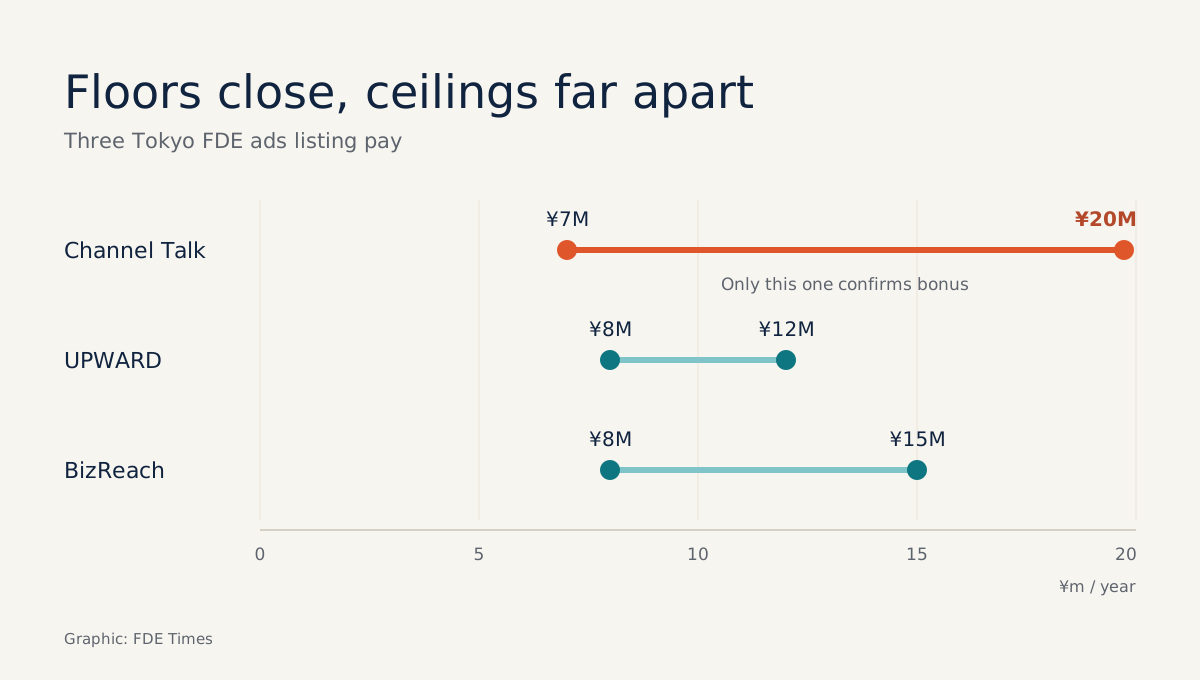
A Forward Deployed Engineer listing from Channel Talk in Tokyo gives pay of ¥7M to ¥20M a year. The ceiling is nearly three times the floor. The figure includes bonus, so it is total compensation rather than base salary.
The decisive part, though, sits a few lines further down. Candidates must communicate effectively in an entirely Japanese-speaking workplace without major difficulty, and must already live in Japan, because the company does not accept applications from abroad.
If you are an engineer in Hanoi, Bangalore or Berlin, ¥20M is not the first question you need to answer.
The five Tokyo FDE listings in the table below make the point plainly: three state outright a hard requirement that rules applicants out before pay comes into it. The other two, from UPWARD and on BizReach, state no such condition on the page, and that is where you have to ask the employer yourself.
Japanese is the most common barrier, but not the only one. Knowing in advance where you will get stuck can save you weeks of applying to places that are certain to reject you.
What does a wide salary range actually tell you?
Channel Talk’s range is the widest in the group. Listings on Japan’s domestic job platforms, where most of the mid-range data sits, are much narrower.
UPWARD, a Japanese SaaS company, is hiring an FDE for the Japanese market at ¥8M–¥12M a year. A BizReach listing for a consulting-leaning FDE role gives ¥8M–¥15M.
Separate the floor from the ceiling. The floors are close together: ¥7M at Channel Talk, ¥8M at both UPWARD and the BizReach listing. The ceilings are far apart: ¥12M, ¥15M and ¥20M.
Three listings are not enough to draw conclusions about the whole market, but they suggest that FDE starting pay is fairly similar, while the top of the range depends on how much each company is willing to pay for its best people.
There is a trap in comparing these figures. Of the three listings that publish pay, only Channel Talk’s is known for certain to include bonus.
Imagine two offers that both say ¥10M: if one is total compensation and the other excludes bonus, they are not equal at all.
Before comparing, ask the employer directly whether the figure includes bonus.
How do Business Level+ and N1 differ?
Channel Talk names no certificate. It describes the Japanese level by what you can do: Business Level+, meaning working in an all-Japanese environment without significant hesitation. That wording does not ask which exam you passed; it asks whether you can keep up with a meeting, a chat thread or a specification written entirely in Japanese.
Abbeal sets the highest bar. Its AI FDE consulting role in Tokyo requires a native speaker or JLPT N1, and accepts N2 only if the profile is truly outstanding.
The listing does not explain why. A reasonable reading is that in a consulting role, Japanese is the tool for working with clients, not just for talking within the team.
Abbeal also does not publish pay, leaving it to the first call. The order is worth noticing. By the time salary comes up, you have already passed the Japanese filter, so Japanese is not something to bargain with but the condition for getting a seat at the table.
When the barrier is not Japanese
Palantir’s Tokyo FDE listing states no Japanese requirement. The role is posted under Washington, D.C., but the actual place of work is Tokyo, because it serves projects with the US government. The only hard requirement stated is an active Top Secret clearance, along with eligibility for and willingness to obtain SCI.
For most engineers who are not US citizens, this is harder to meet than N1. Japanese can be learned; a clearance is not something a candidate can get by sitting an exam. So a Tokyo FDE listing that does not require Japanese is not necessarily easier to get into. Sometimes the barrier has simply moved.
UPWARD is a murkier case. The job page states no Japanese requirement, but the role serves the Japanese market and the listing itself is written in Japanese. A page that does not mention language does not mean you are exempt. This is a question to ask in the first conversation, rather than assuming the answer that suits you.
| Listing | Pay | Japanese requirement | Applicants abroad | Actual hard requirement |
|---|---|---|---|---|
| Channel Talk | ¥7M–¥20M, including bonus | Business Level+, all-Japanese environment | Not accepted, must live in Japan | Japanese and residency |
| Abbeal (AI consulting) | Not disclosed, discussed on first call | Native or N1, N2 if the profile is outstanding | No visa or relocation support | Top-level Japanese and residency |
| UPWARD | ¥8M–¥12M | Not stated on page | Not stated on page | Ask; listing is in Japanese |
| BizReach (consulting FDE) | ¥8M–¥15M | Not stated on page | Not stated on page | Ask |
| Palantir Tokyo | Not stated | Not required | Not stated on page | US Top Secret clearance, SCI eligibility |
Residency is the line to read first
So when you open a Tokyo FDE listing, residency is worth reading before even Japanese. Neither Channel Talk nor Abbeal offers visa or relocation support for applicants abroad. If you do not already live in Japan, these two listings are closed, however good your Japanese.
Only then comes the Japanese level, and it should be read as a job description. “An entirely Japanese-speaking environment” means no one will interpret for you in client meetings. Only once you clear these conditions is the question of where you fall in the ¥7M–¥20M range really worth discussing.
If you want to work as an FDE in Tokyo
The most practical advice is to prove your Japanese through work you have done, not just exam scores. On your CV, do not write only “JLPT N2”.
Write N2 alongside something concrete, such as “led requirements-gathering sessions with Japanese clients and wrote specifications in Japanese”. That line directly answers what Channel Talk wants to know: whether you can work without hesitation.
Practice should also follow the work. Rehearsing a customer discovery session in Japanese, from asking about the current process and finding the bottlenecks to agreeing success criteria, will show you how far you are from Business Level+. Learning more general vocabulary will not measure that.
If you are outside Japan, rule out from the start any listing that says it does not accept applications from abroad, and focus your effort on those that offer visa support. With companies that keep pay private, like Abbeal, have your target figure ready before the first call, because that is when the range is put on the table.
The best investment for an FDE aiming at Tokyo, then, is probably not in salary negotiation. It lies in hours spent practising client conversations in Japanese, long before anyone mentions ¥20M.
Was this article useful?
Thanks for the feedback!
6 sources
- Forward Deployed Engineer (Channel Talk) – Japan Dev · 2026-09-29
- Forward Deployed Engineer (AI), Native/N1 Japanese, Consulting — Tokyo – Japan Dev
- UPWARD株式会社 の求人|フォワードデプロイ・エンジニア(FDE)|【公式】ハープキャリア
- 転職サイト ビズリーチ (job 7955175)
- Forward Deployed Software Engineer - Japan Forward Deployed – Palantir (Lever)
- Deployment Strategist - Japan Forward Deployed – Palantir (Lever)