FDE salaries in India: why five data sources disagree by a factor of several
Take a ₹20 lakh offer. Against one source it beats the top 25% of earners. Against another it falls short of the floor for mid-level engineers.
In brief
- Salary.com and Glassdoor cluster around ₹13–17 lakh. Levels.fyi puts the 75th percentile at about ₹42.2 lakh, and Scaler's table puts mid-level pay at ₹30–65 lakh.
- The sources measure different things: self-reported total compensation, estimates for top product companies, or pay borrowed from ML engineers.
- The title is new and the samples are thin, so an average says very little about your own offer.
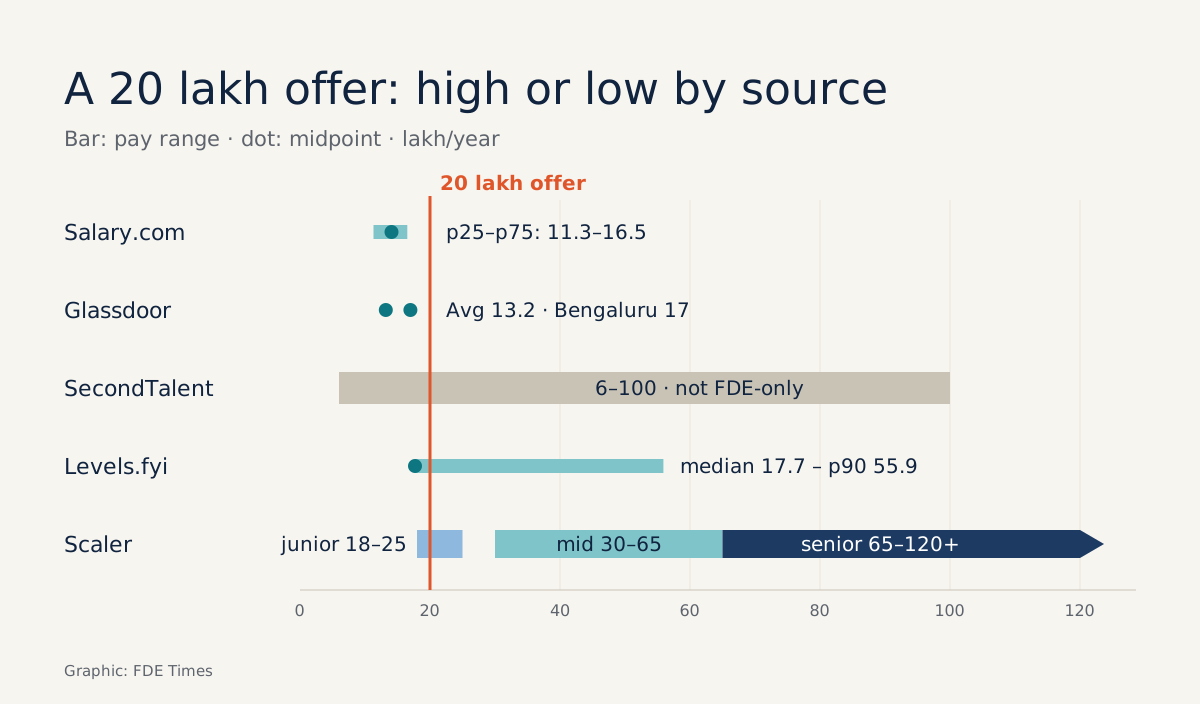
Salary.com puts the median pay of a Forward Deployed Engineer in India at around ₹14.07 lakh a year. The table in Scaler’s 2026 guide puts mid-level pay alone at ₹30–65 lakh. Scaler’s floor is more than twice Salary.com’s midpoint, and its ceiling is more than four times it.
If you are about to negotiate pay, thinking about moving from software engineering to FDE work, or hiring for an FDE team, that gap bears directly on your decision. There is no reason to think any source is making numbers up. More likely, each one measures something different, across a different group of people, at a different time.
Reading these figures correctly is itself an FDE skill. You ask of a salary table the same questions you ask of a customer’s data: who was counted, what was counted, when, and how many.
Where do the low figures come from?
Salary.com gives a very narrow band: the 25th percentile is ₹11,29,889 and the 75th percentile is ₹16,53,596. The site does not publish a sample size for this title. It says only, in general terms, that its database covers more than 25,000 job titles at more than 8,000 organisations.
The page was last updated on 22 April 2025, earlier than any other source in the group.
Glassdoor lands in the same range. Prepzee, a training provider, cites Glassdoor for a median total pay of about ₹13 lakh a year across India. Build Fast with AI cites a Glassdoor figure for Bengaluru of ₹16,99,778 a year.
A band this narrow can be a sign of averaging across many kinds of company, and averaging removes exactly the tail a negotiator needs to see. Prepzee itself advises treating these bands as indicators, not benchmarks.
The high figures measure something else
Levels.fyi counts total compensation. On its page for FDEs in India, the median is about ₹17.7 lakh, the 25th percentile ₹16,15,766 and the 75th percentile ₹42,23,893. All of it rests on 12 salaries reported by users.
The Levels.fyi median almost matches Glassdoor’s Bengaluru figure, while its 75th percentile is more than twice the median. So the gap sits in the upper tail, not with the person in the middle. But with 12 data points, a few high reports are enough to create that tail, so do not treat it as a pattern.
Scaler goes higher still, and labels its figures plainly: the India numbers are market estimates for top product companies in 2026. Notably, Scaler lists its benchmark sources as Levels.fyi, Glassdoor and ownyourcareer.
So Scaler shares some sources with the low-figure group, yet arrives at much higher numbers. The most plausible explanation is that Scaler keeps only the top corner of the market, in line with the “top product companies” label it gives itself.
Scaler is not consistent even within one page: the table gives mid-level pay as ₹30–65 lakh, while the FAQ says ₹30–55 lakh. When a source disagrees with itself by ₹10 lakh at the ceiling, read it as a rough estimate.
Build Fast with AI, citing data from OYC Labs, gives a band of ₹18–28 LPA for people with 0–2 years of experience, well above Salary.com. The same article admits that the aggregate figures contradict each other.
Second Talent takes a different route. Because few Indian employers use the FDE title, it borrows the pay bands of ML/AI engineers: ₹6–14 LPA for juniors, ₹28–65 LPA for seniors. Its reasoning is that FDEs are hired from the same pool of senior AI, platform and full-stack candidates as ML engineers. It is not a separate FDE sample.
| Source | What it measures | Headline figure | Caveat |
|---|---|---|---|
| Salary.com | Median and middle band, all India | ~₹14.07 lakh; ₹11.3–16.5 lakh | Updated April 2025, no sample size published for the title |
| Glassdoor (cited by Prepzee, Build Fast with AI) | National median; Bengaluru average | ~₹13 lakh; Bengaluru ~₹17 lakh | Second-hand figures, not the original data |
| Levels.fyi | Self-reported total compensation | Median ~₹17.7 lakh; P75 ~₹42.2 lakh | Only 12 data points |
| Scaler | Estimate for top product companies | Mid-level ₹30–65 lakh (FAQ: ₹30–55 lakh) | Partly based on Levels.fyi and Glassdoor, so not independent |
| Second Talent | Pay for ML/AI engineers | Junior ₹6–14 LPA; senior ₹28–65 LPA | Not a separate FDE sample |
The gap comes from three places. Some sources measure total compensation while others give only an average. Some cover the whole market while others cover only top companies or borrow figures from another role. And some rest on a handful of data points. It is not that one source is right and the others wrong.
One title, several pay markets
Build Fast with AI identifies the root cause: the same FDE title exists in the AI delivery arms of IT services firms and at global AI labs hiring remotely in India. The article explains the contradictory data by exactly this difference between types of employer.
Scaler also concedes that FDE-specific pay data for India is limited because the title is still taking shape, so its bands are drawn from comparable roles. The consequence follows easily: someone doing exactly the work of an FDE under a different title will not show up on an FDE salary page, and the reverse is also true.
Putting a ₹20 lakh offer on the table
Imagine you have three years of experience, live in Bengaluru, and receive an FDE offer with total compensation of ₹20 lakh. Against Salary.com, that beats the 75th percentile (₹16.5 lakh). Against Glassdoor in Bengaluru, you are about ₹3 lakh above average.
Prepzee records self-reported packages for FDEs with 1–3 years’ experience in Hyderabad and Bengaluru ranging from ₹15 to ₹27 lakh, so ₹20 lakh sits within the range, slightly towards the lower end. Switch to Levels.fyi and ₹20 lakh is just above the ₹17.7 lakh median and less than half the 75th percentile.
For Build Fast with AI, the figure falls within the ₹18–28 LPA band for newcomers with 0–2 years. On Scaler’s table, it is below the ₹30 lakh floor for mid-level pay. One offer, many readings, from “very good” to “below market”.
The right question, then, is which group the offering company belongs to, and which source has a sample closest to that group. The problem is that no source says clearly which types of employer its sample includes, so every choice of benchmark here is an informed guess, not a conclusion.
Scaler’s band is a fair benchmark only when the employer really is a top product company, since that is the label Scaler gives itself. It says nothing directly about AI labs.
For the AI arm of an IT services firm, market-wide averages such as Salary.com or Glassdoor may be closer, but check them against accounts from people working at that particular company.
For a global AI lab hiring remotely, none of these sources measures that group on its own. The upper tail of Levels.fyi is the nearest hint, but 12 data points are too thin to be your only argument.
Read salary figures like customer data
Before using any figure, ask four questions. Is this base salary or total compensation? Which companies are in the sample? How many people are in it? When was the data last updated?
Applied to the table above, no source answers all four. Salary.com falls short on sample size and freshness, Levels.fyi on sample size, and Scaler and Second Talent on not measuring FDEs specifically. So do not take a single number into the negotiating room; take a range, along with your reason for choosing that source for that kind of company.
This way of reading is not limited to India. In any market where the FDE title is still new, you are likely to meet the same three sources of distortion: different measures, different groups of companies and samples that are too thin.
Because Second Talent prices FDEs on ML engineer bands, the strongest case for being paid on that band is evidence on your CV for both halves: the system you built and the results the customer achieved with it.
An average answers only the question of what the market pays. The question you need to answer before sitting down to negotiate is which market this company belongs to, and no salary table can answer that for you.
Was this article useful?
Thanks for the feedback!
7 sources
- How Much Does a Forward Deployed Engineer Make in India? Salary Range, Hourly Rate and More
- Levels.fyi – Forward Deployed Engineer Salary · 2026-11-03
- Forward Deployed Engineer Salary India 2026 (Bands) · 2026-07-29
- How to Land a High-Paying Forward Deployed Engineer Job in India · 2026-10-05
- Forward Deployed Engineer Salary, Role & Responsibilities: The 2026 Guide · 2026-10-05
- Forward Deployed Engineer Salary India: ₹50K-₹8.3L/mo - Sep, 2026 · 2026-09-14
- Forward Deployed Engineer Salary in India 2026: Experience, Companies & Skills · 2026-08-25