FDE salaries in Toronto: why job postings under Ontario law beat salary estimates
In Toronto, an FDE salary figure can be a number the employer must publish under Ontario law, a third-party estimate or a US-market figure. Bring the wrong kind to a negotiation and you pay for it yourself.

In brief
- In Ontario, employers with 25 or more employees must state pay in job postings, with ranges no wider than CAD 50,000; roles paying around CAD 200,000 or more are exempt.
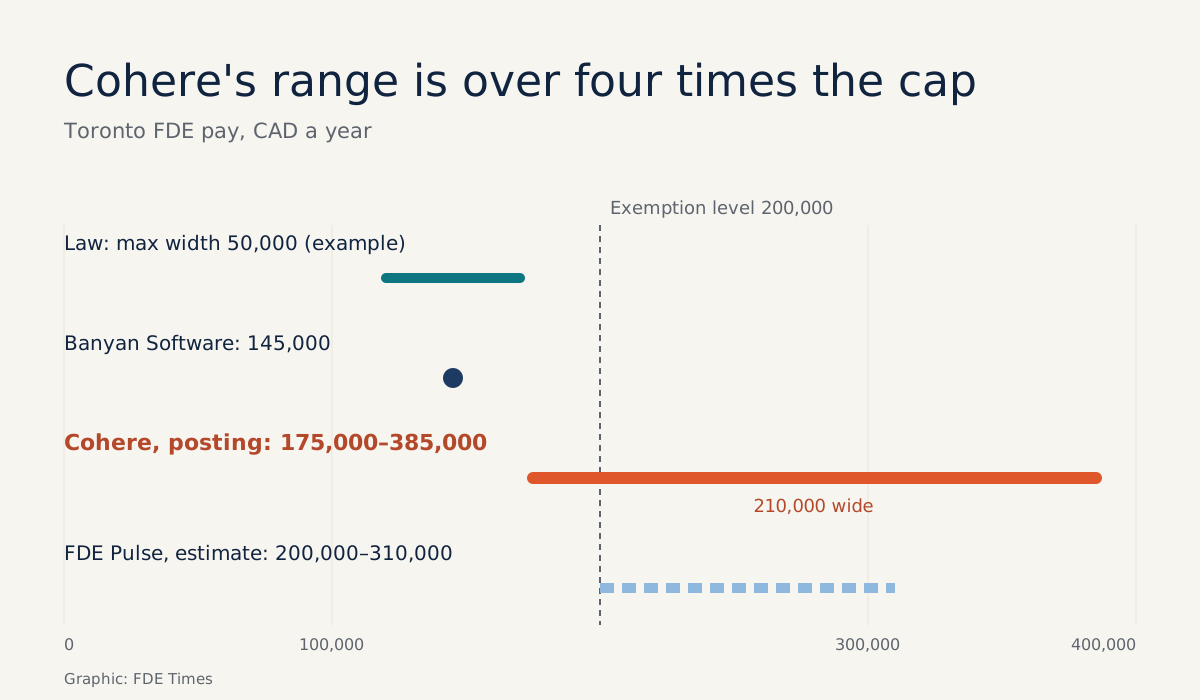
- Banyan Software lists a single figure, CAD 145,000 or USD 170,000, excluding annual bonus; Cohere's posting lists CAD 175,000–385,000, more than four times the width limit.
- FDE Pulse's C$200,000–310,000 estimate for Cohere and ClavePrep's US figures are for orientation only, not anchors for negotiating in Toronto.
Banyan Software is hiring a Forward Deployed Engineer in Toronto, Ontario. The body of the posting puts the expected base salary at CAD 145,000 or USD 170,000, not including annual bonus.
That is a single figure, not a range, and it carries three traps for the careless reader: two currencies, a bonus that sits outside the number, and a line saying pay depends on location and experience.
Also for Toronto, the tracking site FDE Pulse estimates pay for Cohere’s roles at roughly C$200,000–310,000. ClavePrep’s 2026 FDE salary guide, meanwhile, gives headline figures calculated for the US market. These three numbers belong to three different categories, and bringing the wrong one to a negotiation can cost you real money.
Since 1 January 2026, the most reliable source of FDE salary data in Toronto has been job postings that carry an employer’s name, because Ontario law requires postings to state pay and caps how wide a range can be. To use that source well, though, you need to know which part of the market the law covers and which parts it leaves out.
Ontario law turns job postings into data
According to BNN Bloomberg, from the start of 2026 employers in Ontario with 25 or more employees must include an annual salary range or hourly rate in publicly advertised job postings. The law firm Fogler Rubinoff and Legal 500 both confirm the 25-employee threshold. Stating pay is now a legal obligation, no longer something left to the employer’s discretion.
The more important rule is the width cap. Fogler Rubinoff, BNN Bloomberg and Legal 500 all describe the same rule: the bottom and top of a range may be no more than CAD 50,000 a year apart. BNN Bloomberg is blunt about the purpose: to stop employers getting around the law with very wide ranges.
Take a hypothetical posting listing CAD 120,000–170,000. The range is already at the maximum width, so the midpoint is CAD 145,000 and each end sits just CAD 25,000 from it. If your experience matches the job description, aiming for the upper half is reasonable; asking for more than the top end means you are, in effect, applying for a different job.
Why do better-paid roles say less?
The first gap is company size. Because of the 25-employee threshold, if you are targeting a very small startup, its postings are not legally required to state pay.
The second gap is at the high end. Fogler Rubinoff writes that the disclosure obligation does not apply when the pay, or the top of the range, exceeds CAD 200,000 a year. Bennett Jones phrases it slightly differently: the obligation does not apply to roles paying CAD 200,000 or more. Right at the edge of the threshold, then, do not treat either reading as certain.
Cohere’s posting for an FDE in Sovereign AI, open to candidates in Toronto, shows what this gap looks like. It lists a Canadian salary range of CAD 175,000–385,000 a year: a spread of CAD 210,000, more than four times the CAD 50,000 cap.
Because the top end is well above CAD 200,000, the range falls outside the zone the law tightens, and its CAD 280,000 midpoint tells you almost nothing about where you would land.
So when an FDE posting shows no figure at all, do not assume the company is deliberately hiding it. The team may have fewer than 25 people, the role may be outside Ontario, the posting may predate 2026, or the pay may already exceed the exemption threshold.
An employer-published figure still needs three questions
Back to Banyan’s posting. This is the best kind of data you can get, because the company itself stands behind the CAD 145,000. Even so, it is not yet the amount you will actually be paid.
The first question is currency: the posting gives both CAD and USD, so you need to know which one the contract pays in. The second is the adjustment factors: the posting says pay also depends on market conditions, location, skills and experience, so 145,000 is an expected figure, not a fixed band.
The third is bonus. The figure excludes annual bonus, so comparing it with an offer that includes bonus is comparing two different things. One more small detail: the header of the posting on LegalTech Roles shows “CAD1K - CAD2K Annual”, which contradicts the body. Always take the figure from the body of the posting, not the summary box.
These three questions work for any FDE posting, in any country with a pay-transparency law. Asking them on the first call with the recruiter saves far more effort than discovering the answers when the offer arrives.
Third-party estimates are for orientation only
The C$200,000–310,000 that FDE Pulse gives for Cohere’s Toronto roles is a figure converted into CAD, on an undated page. It is an inferred number, not a range the company posted under Ontario law. It suggests large AI companies may pay a high ceiling, but it is not a number to take into a negotiation.
With ClavePrep, the problem is different. The guide’s headline figures reflect only US roles at AI companies that have raised Series C or later, and say nothing about Toronto.
ClavePrep builds its numbers from public aggregators, without stating a methodology, and then applies a rough 20–40% discount for early-stage startups or non-AI companies. A discount that wide, on top of the difference between markets, makes these figures much weaker than a posting with a named employer behind it.
The table below ranks the figures by how useful they are in Toronto:
| Source | Figure | Who stands behind it | How to use it in Toronto |
|---|---|---|---|
| Posting from an employer with 25+ employees, below the CAD 200,000 threshold | Mandatory range, at most CAD 50,000 wide | The employer, legally bound | Primary negotiation anchor |
| Banyan Software | CAD 145,000 or USD 170,000, excluding bonus | The employer | Reliable, but ask about currency, location and bonus |
| Cohere, FDE Sovereign AI | CAD 175,000–385,000 | The employer, but outside the CAD 50,000 cap | Confirms the role exists; ask more to narrow it down |
| FDE Pulse (Cohere) | Estimate of C$200,000–310,000 | Third party, undated | Only a hint that the ceiling may be high |
| ClavePrep | US data, 20–40% discount for early-stage or non-AI companies | Third party, no stated methodology | Do not use as an anchor for Toronto |
Build your own salary dataset
The most reliable approach is to build a spreadsheet from the postings themselves. For each FDE posting in Ontario, record the salary range, its width, the currency, and whether bonus is separate or included. Every row is tied to a role and a named employer, so in a negotiation this sheet carries more weight than an average of unclear scope.
The sheet also helps you prepare your application. When reading job descriptions, look at which requirements come with the highest ranges, such as experience deploying on real customer data or working directly with customers. Skills that recur there are worth writing up in your CV as concrete, measured results.
And when you meet a posting with no pay, or a range wider than CAD 50,000 like Cohere’s, do not guess. It is a sign you are in territory Ontario’s law does not reach, and there the only trustworthy number is the one you ask for yourself.
Was this article useful?
Thanks for the feedback!
8 sources
- Forward Deployed Engineer | LegalTech Roles
- New Year, New Rules: Changes to Job Posting Requirements in 2026 · 2025-11-11
- Ontario's new job posting and hiring transparency rules in force as of January 1, 2026 · 2026-01-12
- New Regulations Regarding the Hiring Process: Key Dates and Information for Ontario Employers · 2024-12-12
- New pay transparency laws are now in effect in Ontario · 2026-01-05
- FDE Pulse – Cohere
- Forward Deployed Engineer Salary & Career Path: What the Data Says in 2026 · 2026-06-30
- Forward Deployed Engineer, Sovereign AI (Cohere) – ResumeHog · 2026-09-01