Do FDEs get let go when a client project ends? What to ask before you sign
Every client project ends. What matters is what the company does with you in the weeks when there is no client.

In brief
- TCS caps bench time at 35 working days a year, alongside a target of 225 billable days. According to press reports, staff who exceed the cap may face disciplinary action, a PIP or termination.
- Vietnamese law does not treat the end of a project as grounds for restructuring. But if performance criteria are tied to billable days, that gap can still become a reason for dismissal.
- Ask about the gap between projects before you sign, and do not let the value of your work be known to only one person on the client side.
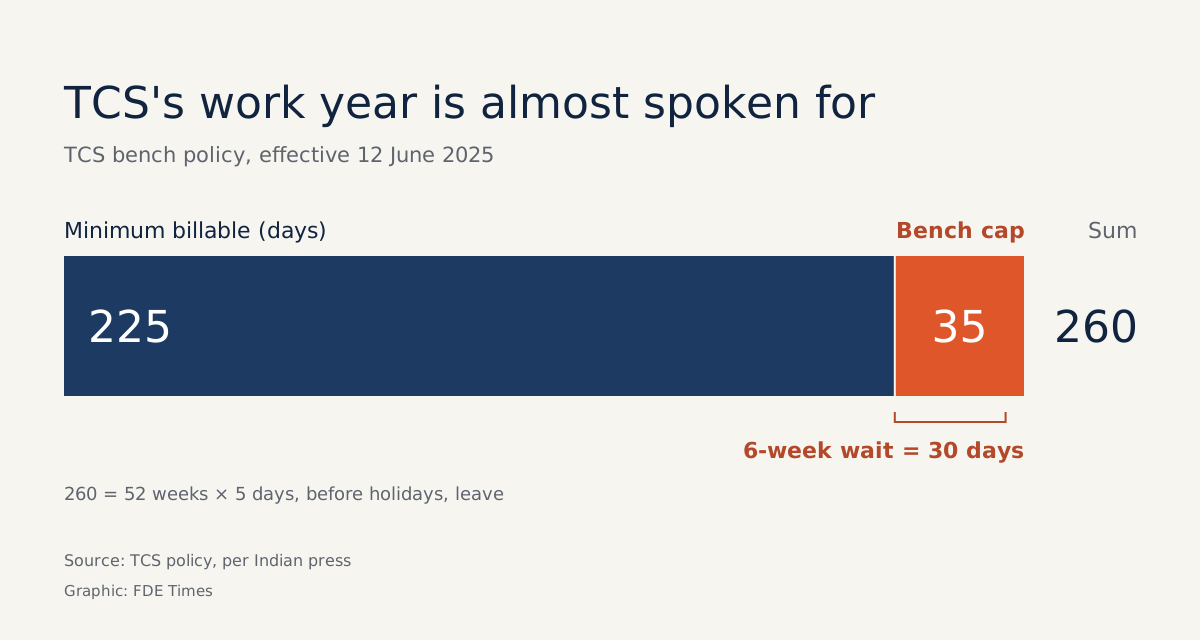
From 12 June 2025, TCS set a hard limit on the gap between two projects: each employee may spend at most 35 working days a year on the “bench”. Indian media reported that anyone who exceeds the limit without a project may face disciplinary action, be placed on a performance improvement plan (PIP), or even have their contract terminated.
People holding an FDE offer share the same worry. An anonymous post on Blind said that FDEs placed at clients were let go as soon as the engagement ended, while another poster compared the model with consulting, where bench time is already built in. That is opinion, not data.
The project will certainly end, so do not ask whether it will. The questions to ask are what the company does with you in the gap that follows, what the law where you sign allows it to do, and how far you have built your own standing on the client side.
At TCS, the bench has a countdown clock
TCS’s policy does not stop at the 35-day cap. It comes with a target that each employee must log at least 225 working days billed to clients each year.
Add the two numbers yourself: 225 plus 35 is 260. TCS does not publish this figure, but a year of 52 weeks at five days a week also comes to exactly 260. On that arithmetic, the working year is almost fully allocated, even before public holidays and annual leave are subtracted.
Picture an engineer who leaves a project in September and has to wait six weeks for a new one. Six weeks is 30 working days, so the bench allowance is nearly used up, and for the rest of the year that person has almost no room to wait again.
Time on the bench is not time off, either. Under the new policy, people without a billable project can no longer work remotely and must take mandatory upskilling courses. Those waiting for a project are therefore more tightly constrained than those who have one.
The union has made more troubling allegations. The IT union NITES filed a formal complaint with India’s Ministry of Labour, saying that employees who could not be assigned to projects were repeatedly receiving emails pressuring them to resign, and asked the regulator to investigate.
These are only the union’s allegations, but they show how the bench can be used to push people out without a formal round of layoffs.
Experts consulted by The Week said that letting go of benched staff is a last resort and that a large company such as TCS can allow time for reskilling, but that the risk of cuts later on is real.
The FDE title does not tell you how you are measured
This policy applies to TCS’s IT services staff, not to any standard of the FDE profession. It is simply the clearest example of how the logic of selling days of work operates once it is written into rules.
Chris Degnan, who has publicly criticised the FDE role, called FDEs “a glorified professional services person”, placing the role close to professional services. You do not have to agree with him. The criticism is worth hearing because it points straight at the profession’s most vulnerable spot.
The difference lies in the metric. If the company assesses you by billable days, you are working in a model that sells days of work, whatever your title says. In that case TCS’s logic can apply to you too, perhaps not written down as plainly, but working the same way.
So read the job description closely and listen carefully in interviews. If you hear words such as “utilization”, “billable target” or “staffing pool”, you are probably being hired into a staffing system.
If the interviewer talks a lot about feeding lessons from clients back into the product, that is a different model, and the gap between two projects means something different there.
How far does the law protect you?
Labour law differs from country to country. Take Vietnam as an example: an employer may unilaterally terminate a contract when the employee regularly fails to complete their work against the assessment criteria that have been set. The end of a project, on its own, is not a ground for restructuring recognised by the law.
If the company wants to make people redundant on grounds of restructuring, it must show economic difficulty or technological or organisational change, and give at least 30 days’ notice. Those who lose their jobs receive severance of one month’s salary for each year worked, with a minimum of two months. So one year’s service still earns two months’ salary, and four years earns four months.
The weak point is the word “criteria”. If the assessment criteria the company issues include a number of billable days, then overrunning the bench allowance can be recast as “failing to complete the work”.
The company could then take that route instead of having to prove grounds for restructuring. This is an inference from the structure of the law rather than a case that has happened, but it is exactly the clause you most need to read carefully.
| Mechanism | What is known | What to ask before you sign |
|---|---|---|
| Bench cap | TCS: at most 35 working days a year | Is there a limit on time waiting for a project, and what happens if you exceed it? |
| Billable target | TCS: at least 225 days a year | Are you assessed by billable days or by results at the client? |
| Conditions while waiting | No remote work, mandatory training | When you have no project, what do you do and where? |
| Valid grounds for termination | Vietnam: regularly failing to complete work against the criteria | Where are the assessment criteria written, and do they mention utilization? |
| Restructuring | Vietnam: requires economic, technological or organisational grounds, 30 days’ notice, severance of at least two months’ salary | What does the law where you sign say about grounds, notice periods and severance? |
If you sign a contract in another country, the last two rows of the table still apply: find out which grounds for termination the law there allows, how much notice is required, and how severance is calculated.
When a clause is too vague, a session with an employment lawyer usually costs far less than the consequences of signing the wrong thing.
Have you let the project depend on one person?
The contract only tells you what happens after the project ends. Whether it ends early or late depends, as common sense suggests, largely on whether the client side sees its value. If support rests on a single person, when that person leaves you almost have to rebuild the relationship from scratch.
Imagine you are deploying a document-processing agent for a bank. Your champion is the head of operations, and only he understands how many working hours the system has saved.
If he changes jobs mid-quarter, his replacement sees only a running cost, not the value, and your engagement can easily become the first thing to be cut.
The safeguard lies in the daily work itself. From the first month, take your results to at least two or three people at different levels on the client side.
Record the project’s value in numbers that someone newly handed the account would understand at once. That way the project depends less on one person, and if it still ends, you have evidence to take to the next client.
What to bring to the interview
The most valuable question is not on any list of sample questions: “The last time an engagement ended, what did the FDE in charge do the following month?” If you get a concrete answer, such as moving to another client, returning to the product team or building internal tools, that is a good sign.
If the interviewer hesitates, that is an answer too.
On your CV, show that you have been through several engagements and carried something from one project to the next, such as a library, a process or an eval suite.
Recruiters read that as evidence that you create value beyond billable days. When you need a new job, it is also what keeps you from being seen as someone worth something only while placed at a client.
Every client project ends one day. Choose a place that already has a clear answer for that gap before you need it.
Was this article useful?
Thanks for the feedback!
8 sources
- TCS gives employees 35 days to get on a project, ends remote work · 2025-06-17
- Why IT Union Complained Against TCS' 35-Day Bench Rule · 2025-07-17
- TCS new policy triggers layoff concerns, IT union demands Labour Ministry probe · 2025-07-17
- What does limiting bench time to 35 business days by TCS mean for the Indian IT services segment · 2025-06-17
- Forward Deployed Engineers (FDE) layoffs
- Chris Degnan Critiques Forward-Deployed Engineer Role · 2026-05-27
- Notes About The Unilateral Termination Of The Labor Contract In Vietnam · 2021-10-29
- Guide To Restructuring A Cross-Border Workforce 2024 – Vietnam Chapter · 2024-01-19