Frontend FDE job ads turn out to want backend engineers too
Working on site with customers, interface engineers must also own scoping, deployment and the lessons that feed back into the product.
In brief
- Foxglove puts Frontend in the job title but also asks for Node.js or Python backend skills and 3+ years in robotics or autonomous systems.
- Lovable is hiring the first members of a new FDE team, working across frontend and backend, with an 8+ year bar, turning customer needs into platform features.
- To move from frontend to FDE, have a backend you deployed yourself, a domain specialism and CV lines that state scope and success metrics.
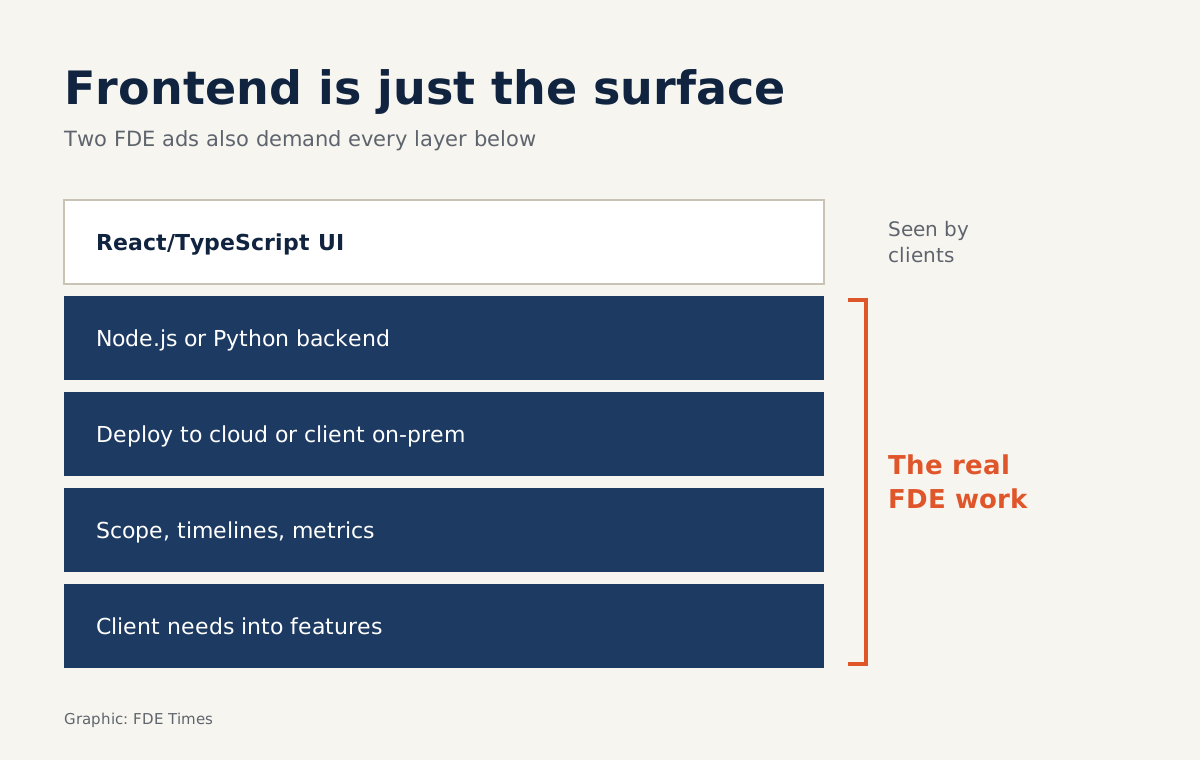
Foxglove puts the word “Frontend” right in the title of its Forward Deployed role. Then, in the same job ad, the company asks for at least 3 years of experience in robotics or autonomous systems, plus backend work in Node.js or Python.
Lovable does not attach “frontend” to its FDE title, but the job description stretches from frontend to backend and sets a bar of 8 years building production software. Two companies, two naming conventions, one message: the person building interfaces on site with a customer cannot only build interfaces.
For a frontend engineer eyeing FDE as a career move, this detail deserves a close read. “Frontend” in a job ad sounds like an easy niche to enter. In practice, the role makes you accountable to the customer from the first scoping page to the rollout on their servers.
Why hire along the interface track?
The most plausible answer is that the interface is where customers see value. A dashboard that shows their own data correctly, a workflow that matches how their team actually works: that is what gets a pilot renewed.
But for that dashboard to run in the customer’s environment, someone has to connect it to data sources, handle authentication, deploy it and keep it running.
Foxglove says this plainly: candidates need strength in React/TypeScript on the frontend and backend experience with Node.js or Python. The full-stack expectation is intact; the emphasis simply sits on the side users see.
Lovable goes a step further. It asks its FDEs to design, write, test, deploy and operate solutions across both Lovable’s frontend and backend. That describes an engineer with end-to-end ownership, not someone who receives a mockup and builds screens.
Lovable: the first hire writes the rules
The biggest difference at Lovable is that the role has no template yet. The ad states that whoever is hired will be among the first to build the company’s FDE team. There is no internal playbook and no senior FDE colleague to ask how an engagement should run.
The reason Lovable needs such a team lies in its growth. According to the company, users have built more than 60 million projects on Lovable since its launch in November 2024, with customers ranging from individuals to major brands.
Once large customers arrive, their needs rarely fit inside a self-serve product.
Lovable also heads off a common misreading: this is a hands-on software engineering role, not pre-sales or support. And the goal is set out precisely: recognise what should become part of the Lovable platform, then build it yourself.
That detail is the heart of the role. An FDE at Lovable does not just solve one customer’s problem but must judge when that problem recurs often enough to become a shared feature. That may explain the 8-year bar: product judgement is harder to teach than React.
Foxglove: writing code on someone else’s infrastructure
Foxglove paints a different picture. Its FDEs work directly with strategic customers to integrate and extend the Foxglove platform inside their environments. Code is written alongside the customer’s engineers and deployed on the customer’s own cloud or on-prem infrastructure.
Doing frontend work on someone else’s infrastructure is a skill in its own right. You do not have your familiar CI, you cannot install tools at will, and every environment failure happens in front of the customer’s engineering team. The ability to debug a build that works on your machine but breaks on their servers is worth more than any component library.
Foxglove also demands domain expertise: 5+ years of JavaScript/TypeScript and 3+ years in robotics or autonomous systems. The two numbers side by side show the company is not looking for a strong frontend engineer to teach robotics later. It needs someone who speaks the robotics team’s language from the first meeting.
The role also sits inside the commercial motion. Foxglove’s FDEs share customer accounts with Sales and Customer Success, and must write the scope of work, timelines and success metrics from proof-of-concept to production rollout. The person writing the code is also the person writing the promises to the customer.
Two job ads, one profile
Put the two descriptions in one table, and the differences are context; the similarities are what you need to practise.
| Aspect | Lovable | Foxglove |
|---|---|---|
| Role status | New FDE team, you are among the first hires | Clearly named role: Frontend Engineer, Forward Deployed |
| Experience bar | 8+ years of production software | 5+ years of JS/TS and 3+ years in robotics or autonomous systems |
| Technical scope | Lovable’s frontend and backend, from design to operation | React/TypeScript, Node.js or Python backend, deployment on customer cloud or on-prem |
| Expected output | Customer needs turned into platform features | Scope, timelines and metrics from PoC to production |
| Who you work with | Customers, then bringing their needs into the platform | Customer engineers, Sales and Customer Success |
Read down the columns: Lovable needs someone to carry lessons from customers back into the product, while Foxglove needs someone to carry the product deep into the customer. Read across the rows: neither pays for screen-building alone.
One dashboard, from PoC to production
Consider a hypothetical scenario with the kind of customer Foxglove describes. A robotics team wants a custom dashboard for data from its autonomous vehicle fleet. A pure frontend engineer would ask for a mockup; an FDE would first ask where the data lives, who opens this dashboard every morning, and what they use instead today.
From there, the PoC scope page might say two weeks, one data source and two metrics: the operations team opens the new dashboard instead of the old script, and the time to find an incident falls compared with the current approach. These numbers are practice examples, but the structure matches the requirement to write scope, timeline and success metrics.
The hard part comes at production. The PoC running on your machine has to be deployed onto the customer’s on-prem infrastructure, its backend connected to their authentication system, and kept running after you have moved to another account.
If three customers in a row ask for the same kind of dashboard, at a company like Lovable that is the signal to turn it into a platform feature. Only one link in the whole chain is truly “frontend”; the rest is discovery, scoping, deployment and product feedback.
What to practise if you work in frontend
Your advantage is real: people who are good at interfaces understand how users work, and that is the first thing customers see. The first priority is to have a Node.js or Python backend that you wrote, deployed and operate yourself.
The second priority is a domain. Foxglove shows that interface-track FDEs can be industry specialists: robotics today, perhaps another field at another company. If you have spent a few years in one industry, put it at the top of your CV instead of hiding it behind a list of frameworks.
The third priority is evidence that you can handle the commercial side. A CV line such as “built a React dashboard” is far weaker than one stating the scope, timeline, success metrics and results after rollout.
When reading job ads, phrases such as Sales, Customer Success or customer environment tell you what the interview will ask about beyond code.
Lovable’s 8-year bar and Foxglove’s 3 years of robotics are not rejections of less experienced engineers. They are the clearest description of the destination: an engineer customers trust with both their screens and their servers.
Was this article useful?
Thanks for the feedback!