Salesforce owns MuleSoft, yet its FDE Lead posting only prefers it
Integration is the heart of the job; what MuleSoft developers lack is real code, LLMs and client leadership, and no certificate fills that gap.
In brief
- Salesforce says FDEs decide how agents connect to enterprise data, which puts integration at the centre of the job.
- The FDE Lead posting requires strong API-led design but lists MuleSoft Anypoint only as a plus; it also requires expert-level coding and LLM and agent skills.
- Partners such as Deloitte are putting FDEs into delivery teams, a practical route in for developers in the Salesforce ecosystem.
Salesforce owns MuleSoft. Yet in its posting for a Forward Deployed Engineering Lead (Data Science & Integration), hands-on experience with the MuleSoft Anypoint Platform, including advanced DataWeave and deployment on Runtime Fabric, sits under “preferred” rather than “required”.
At first this looks backwards. In fact it is the detail most worth reading closely in the whole posting, because it hints at which part of an integration developer’s skill set Salesforce values.
If you write Apex, build MuleSoft flows or map data in DataWeave and wonder whether you could move into FDE work, this posting gives a fairly clear answer. You already have the core skill. What is missing is specific and learnable, but no certification will fill the gap for you.
Integration is the main job, not a side task
In Salesforce’s own description, the FDE is the person who decides how an agent connects to enterprise data. MuleSoft developers should read that sentence twice: at Salesforce, the FDE’s work revolves around exactly what you do every day.
Demand comes from Agentforce, which Salesforce calls the fastest-growing product in the company’s history. An agent that answers customers is only useful if it can read orders in the ERP, ticket history and contracts in legacy systems. Each of those connections is an integration problem.
The way the teams are organised says the same. Salesforce groups FDEs into small pods of two FDEs and one Deployment Strategist. With two engineers for an entire customer, there is no room for someone who knows prompts but not how data moves through systems.
Why is MuleSoft only a plus?
Compare two lines in the posting and it becomes obvious. The required line asks for proven expertise with enterprise integration platforms and API-led connectivity design. Only the preferred line names MuleSoft. The sensible reading is that Salesforce puts the way of thinking ahead of the tool.
Take a concrete case. A customer wants an agent to answer “where is my order?”. Order data lives in SAP, delivery status in the carrier’s system, and customer details in Salesforce.
Someone who works API-led is used to splitting this into layers. The bottom layer wraps each source system. The middle layer joins orders with delivery status. The top layer returns exactly what the agent needs, compact and stable. The agent then calls one clearly defined API instead of guessing how to talk to SAP.
The skill here is deciding where the boundaries between layers fall, not typing DataWeave. If the customer switches to another integration platform tomorrow, the layering still holds. The posting’s generic wording, “enterprise integration platforms” rather than a product name, can be read in that light.
Three gaps no certification can fill
The remaining requirements are where Salesforce developers need to prepare most, because the posting makes them mandatory. It asks for expert-level proficiency in at least one programming language such as Python, Java or SQL. That goes beyond low-code integration work, so you need evidence of real code, not just drag-and-drop flows.
The second gap is AI. The role requires LLM integration, prompt engineering and agent frameworks such as LangChain or LlamaIndex. A typical MuleSoft developer has never had to think about what a model will do when an API returns incomplete data.
The third gap is the hardest to see. The hire will be the FDE technical lead on important customer engagements, and direct customer-facing experience is a plus. Add the requirement of more than 8 years of end-to-end delivery and this is clearly not a role for learning on the job.
| Requirement in the posting | What Salesforce/MuleSoft developers usually have | How to close the gap |
|---|---|---|
| API-led design, integration platforms | Yes, it is daily work | Spell out layering decisions in your CV, not just tool names |
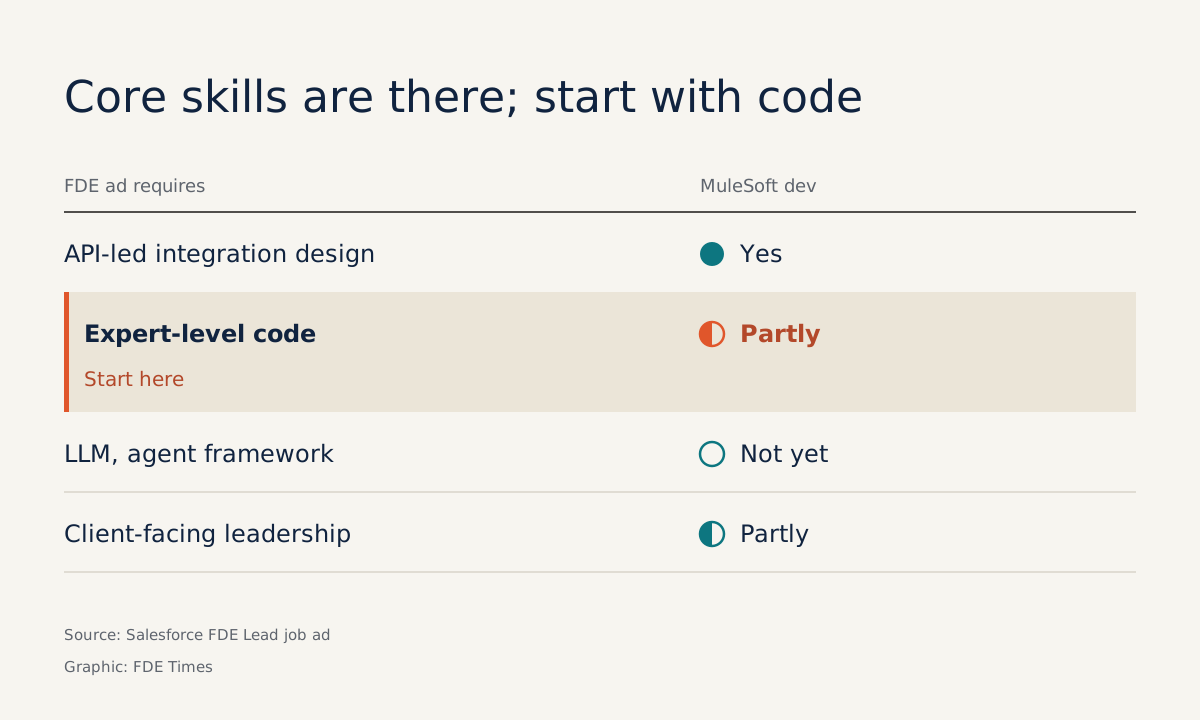
| Expert-level code (Python, Java, SQL) | Partly, often hidden by low-code | A Python project with tests, SQL on real data |
| LLMs, prompting, agent frameworks | Usually not yet | A small agent calling an API you designed, with notes on its failures |
| Technical leadership in front of customers | Varies; often sits with BA or PM roles | Take on demos, workshops and incident handling with customers |
| 8+ years of end-to-end delivery | Depends on seniority | Aim for a regular FDE role first if you lack the years |
Read across the rows and the biggest gap is not AI. An agent framework is something you can try yourself in a small project. Proving that you write serious code after years on a low-code platform usually takes more evidence, so start with the code.
The way in need not be the front door
If you do not yet have 8 years, Salesforce itself is not the only door. Salesforce has set up an FDE Partner Network and says firms in it are behind a third of successful Agentforce projects, according to the company’s own figures.
Deloitte became the first GSI to deliver a Salesforce FDE engagement, by embedding FDEs directly in its delivery teams. For developers at consultancies or SIs, this is the shortest path: move from the integration team to the FDE team within the same firm, on the same ecosystem.
The model is spreading elsewhere too. ITPro reported that Salesforce will embed dedicated engineers in customer teams in the UK. As demand expands market by market, people who understand Salesforce and can code will have an advantage anywhere.
Before applying, consider the pace of a lead role. The posting asks for willingness to travel up to 50-75% of the time to customer sites, including secure facilities.
The listing page states that the posting was taken down on 3 September 2026, so treat it as a description of requirements, not an open opportunity.
Why this is a career step up
One Salesforce FDE leader argues that FDEs are in a position of great influence, not only over customers but over the future of Agentforce. For integration developers used to sitting at the end of the chain, taking requirements and wiring systems together, that is a big change: what you see at customers flows back to shape the product.
The next steps are therefore fairly clear. Rewrite your CV so that each integration project shows a design decision, not just a list of tools. Publish a Python project with tests as evidence of your coding. Then build an agent that calls an API you designed yourself, so you have a real story to tell in interviews.
MuleSoft developers are still often seen as the people who look after the plumbing. In the age of agents, that plumbing decides whether an agent can do its job, and the people who understand it best have good reason to apply for FDE roles.
Was this article useful?
Thanks for the feedback!
5 sources
- Forward Deployed Engineering Lead - Data Science & Integration (Built In)
- Salesforce launches Forward Deployed Engineer Partner Network · 2026-04-15
- FDEs are back to build Agentforce (Salesforce blog) · 2025-11-15
- Deloitte becomes first GSI to deliver Salesforce FDE engagement · 2026-08-12
- Salesforce doubles down on forward deployed engineers in UK Agentforce push · 2026-09-16