FDE take-homes now grade how well you understand the customer
At Cognition the exercise needs almost no code; at OpenAI, every design decision has to trace back to a specific customer need.

In brief
- Cognition's FDE take-home runs inside Devin and needs almost no code; at OpenAI, the submission includes a running app and a video walkthrough.
- The reason is AI: when submissions look alike, the reasoning behind decisions is what separates strong candidates from people who are good at prompting.
- Graders want to see how you decompose a problem, empathise with the end user, reason from data and scope sensibly.
According to a guide from Aced (formerly Exponent), the take-home for an FDE role at Cognition takes place inside Devin, and coding makes up very little of it. The exercise is not meant to show how fast you can write an algorithm. It tests whether you understand how customers use the product.
Cognition is not alone. OpenAI’s take-home case study, also according to Aced, runs for about a week. You submit working code, a running app and a video walkthrough; slides are optional. The advice to candidates is that in the video, every design decision should be tied to a specific customer need.
If you are preparing for FDE interviews only by grinding more LeetCode or polishing a repo for the take-home, you may well be leaving blank the very part that decides the offer.
The round that decides the offer often has no code
An analysis on techinterview.org says the round that carries the most weight for an FDE offer often contains no code at all. The familiar example is Palantir’s decomposition round. Candidates are given a vague, real-world challenge, break it into smaller parts and propose a solution, with almost no coding.
The grading criteria are stated plainly: structured decomposition, empathy for the end user, data-driven reasoning and the ability to scope. None of the four says anything about syntax. They describe exactly what an FDE does in the first week at a customer site, when nobody yet knows what the final system will look like.
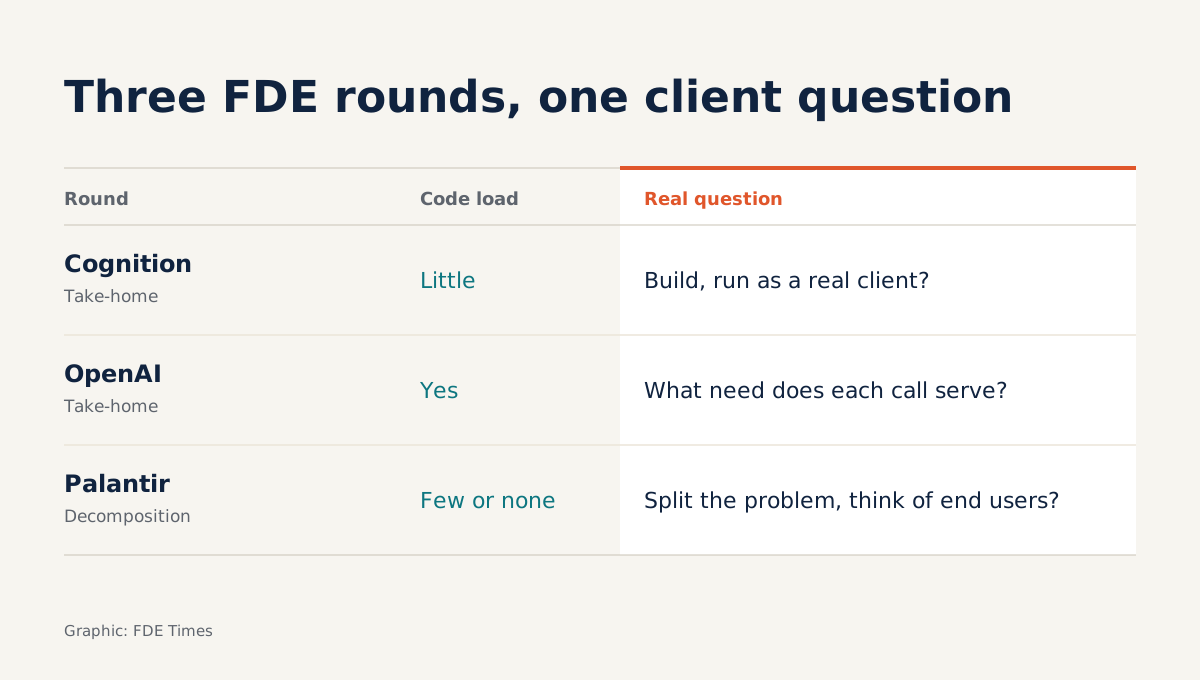
Take-homes are moving in the same direction as the decomposition round. Put the three formats in one table and they ask almost the same question, only in different ways.
| Round | Format | Amount of code | The real question |
|---|---|---|---|
| Cognition take-home | Hands-on exercise in Devin | Very little | Can you set up the product and run a workflow like a real customer? |
| OpenAI take-home | About a week: code, a running app, a video walkthrough | Yes, graded together with how you frame the problem around the customer | Which customer need does each of your decisions serve? |
| Palantir decomposition | Break down a vague real-world problem | Little or none | How do you split the problem, choose the scope and think about the end user? |
The last column is the point. Three companies use three different formats, but all want to know how you think when you stand between the customer and the product.
Why code is no longer enough of a signal
Karat, a company that provides technical interviewing services, argues that coding tests and take-homes now give a less reliable hiring signal than before. Karat also says live interviews involving both humans and AI give the strongest signal. That claim deserves some caution, since it is precisely the format Karat sells.
Looking at technical hiring broadly, not just FDE roles, techinterview.org reaches the same diagnosis. When AI can produce a polished take-home, the submission no longer reveals who made it, and the take-home loses its one purpose: separating strong candidates from people who are good at prompting.
That is why many teams keep the take-home but add a live walkthrough in which candidates defend their decisions.
One part is hard to hand to AI: knowing why something needs to be done a certain way, and for which customer. A model can generate a complete app, but it does not know at which step the customer’s operator will give up. OpenAI’s video walkthrough and Cognition’s hands-on exercise in Devin both pull the focus back to exactly that.
Same app, two ways to tell it
Imagine the brief asks for a support-ticket triage tool for a logistics company. Candidate A submits a clean architecture with full tests, then spends the video walkthrough on frameworks, prompts and latency. Everything works, and everything is correct.
Candidate B submits an almost identical app but opens differently. B says the night-shift staff need to know which tickets must be handled before the morning shift starts, and every decision after that flows from this need.
B uses only four labels instead of twelve, because when the classifier gets it wrong the person on shift has to fix it by hand, and fewer labels are quicker to fix. B keeps an “uncertain” label so ambiguous tickets do not slip into the low-priority queue. B also deliberately drops the dashboard, because the main user does not need it during a shift.
Score the two submissions against the four criteria of the decomposition round and B earns points on all four: structured decomposition, understanding of the night-shift worker, reasoning about mislabelled data and deliberate scoping. A mainly demonstrates build quality, and in this example that is the part a candidate who uses AI well can also produce.
That does not mean B’s code can be sloppy. Aced notes that at OpenAI, interviewers check whether the design starts from customer needs and use cases alongside build quality, not instead of it. The best submission has both.
The first thing to do when you receive the brief is to open a decision log before you open your editor. Each line has four fields: the decision, the customer need it serves, what you are trading off, and the question you need to ask the customer.
When it is time to record the video, you simply walk through this file in order, and the live defence that follows will rarely catch you off guard.
Record the friction as a customer would
According to Aced’s guide, the goal of Cognition’s take-home is to show that you can set up Devin and run a real workflow. This comes from candidates’ accounts, not an official description from the company, but it still indicates that graders are looking at how you set up and run the workflow.
The skill is identical to day one at a customer site. You install, connect to existing systems, run a real workflow and note where you get stuck. Newcomers often skip the note-taking, yet that list of friction points is what shows you see the product through the customer’s eyes.
So when you do an exercise like this, submit the list of friction points along with how you would explain each one to the customer. After the interview, that document is also worth adding to your portfolio.
Your CV should speak the language of the decomposition round
A CV that only lists technologies tells the reader what you can build, but not who you build it for. A better line states what you chose, because which user needed what, and what the result was. Wherever you apply, put the user into at least one bullet point for every project.
Job postings also tell you where to focus your effort. If one emphasises working directly with customers or handling ambiguous problems, give decomposition and walkthrough practice as much preparation time as algorithms.
In FDE take-homes today, what makes the difference is being able to say who will use the product on Monday morning, and why they need it exactly that way.
Was this article useful?
Thanks for the feedback!
5 sources
- Cognition Forward Deployed Engineer Interview Guide | Sample Questions (2026) - Aced (formerly Exponent)
- OpenAI Forward Deployed Engineer (FDE) Interview Guide | Sample Questions (2026) - Aced (formerly Exponent)
- What the forward deployed engineer interview really tests · 2026-08-05
- Technical Assessments in the Age of AI: Which Formats Still Work? · 2026-08-13
- Why live coding rounds are beating take-homes in 2026 · 2026-07-24