Your pass rate is a product decision, and setting it is the FDE's job
When "correct" becomes a matter of judgement, the person closest to the customer should be the one who turns it into a test that runs.
In brief
- Agents are non-deterministic, so "correct" has to be defined. Anthropic argues the people closest to product requirements and users are best placed to do that. On a deployment, that means the FDE.
- Anthropic warns that teams without evals end up fixing bugs reactively in production. Hamel Husain finds that failed LLM products share one root cause: they never built a robust evaluation system.
- A pass rate is a product decision. The FDE negotiates it with the customer, then turns it into a metric (pass@k or pass^k) and an eval suite that runs.
“Your pass rate is a product decision.” The line is Hamel Husain’s, quoted by Simon Willison on his blog, and it sounds odd to any engineer used to writing unit tests. A unit test passes 100% of the time. There is nothing to negotiate.
Yet that line explains why evals have become a core skill for FDEs working on AI. AI systems do not produce the same output every run, so “correct” is no longer a purely technical question. Someone has to decide how correct is correct enough, and that decision has to be written down as something that runs.
Anthropic is explicit about who should do it: the people closest to the product requirements and the users are best placed to define success.
On an AI deployment, that person is not a researcher at headquarters. It is the engineer sitting in the customer’s office: an FDE in exactly the sense Andrew Ng uses in The Batch, an engineer embedded in the customer’s organisation.
Who pays when there are no evals?
Anthropic defines an eval in a few words: give an AI system an input, then apply grading logic to its output. It is simple enough that many teams skip it, and Anthropic also names the reason. The cost of evals is visible upfront, while the value accumulates gradually and is easy to overlook.
The result, again according to Anthropic, is that teams get stuck fixing bugs reactively and only find problems once the system is in production. Hamel Husain has observed that failed LLM products usually share one root cause: they never built a robust evaluation system.
For an FDE, none of this is abstract. When an agent gives a customer’s employee a wrong answer, you take the call, not the model team. The FDE bears the cost of missing evals, and also gains the most from the compounding effect Anthropic describes.
Hamel calls it a flywheel: an eval system creates a loop that lets you iterate very quickly. Each time the customer reports a bug, you turn it into a new case, and next time you do not have to wait for anyone to report it.
Three levels of evaluation, and which one belongs to the FDE
Hamel splits evaluation into three levels: Level 1 is unit tests, Level 2 is model and human evaluation (including debugging), and Level 3 is A/B testing. At first glance this is a map for the whole organisation. Look closer, though, and each level needs something the FDE is best placed to supply.
| Level | Question it answers | What the FDE brings |
|---|---|---|
| Level 1: Unit tests | Does the output break any hard rule? | Business rules heard directly from users on site |
| Level 2: Model & human eval | Is the output “good” in the customer’s sense? | Relationships with domain experts to calibrate the LLM-as-judge |
| Level 3: A/B testing | Which version produces better business results? | Access to the real workflow to measure |
Level 2 is where FDE skills show most clearly. Using an LLM to grade outputs is tempting because it is cheap and fast, but Hamel warns that you must align the model with human judgement, because “correct” is subjective.
The humans here are not you. They are the accountant, the customer service agent or the maintenance engineer who uses the system every day, and only the FDE sits close enough to ask them: “What score would you give this, and why?”
Hamel adds another principle: remove all friction from looking at data. Reading real traces, one by one, is core work, not a side task. An FDE who opens the traces every morning sees failures before the customer does; an FDE who only watches a dashboard sees them after the customer is already annoyed.
pass@k or pass^k: the question customers don’t know they have to answer
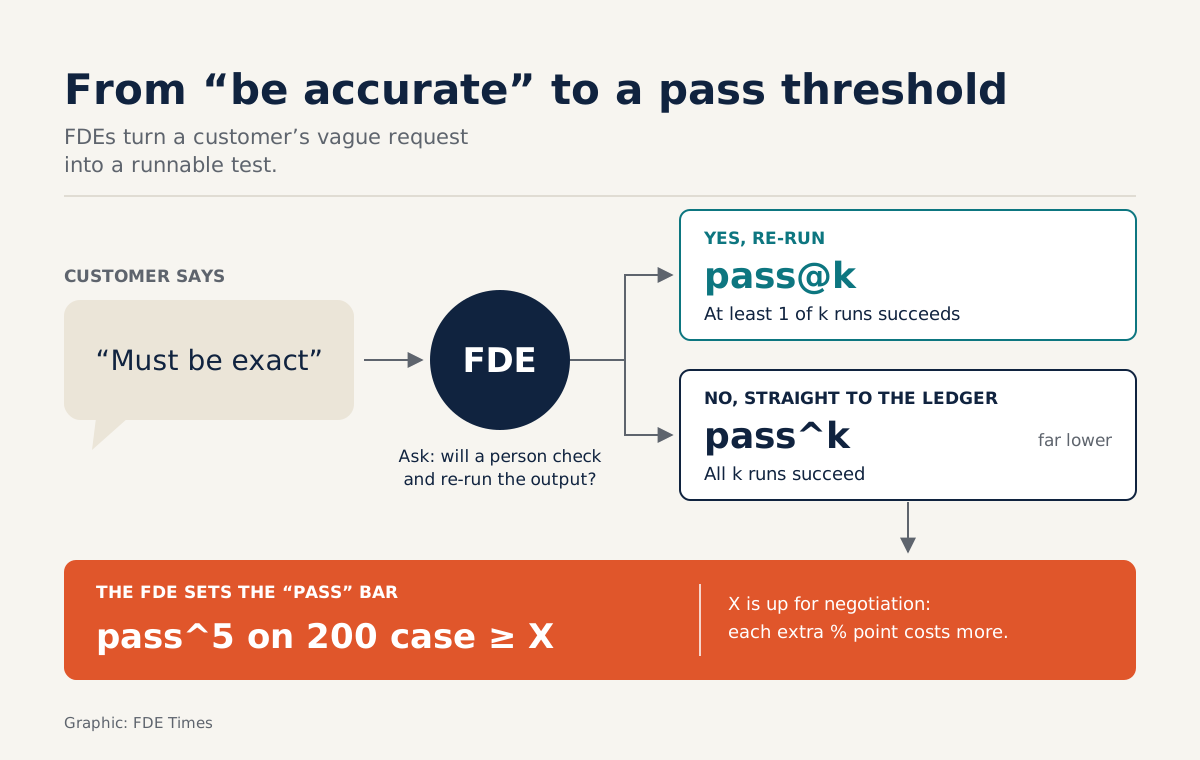
Back to Hamel’s line: the pass rate is a product decision. Making that decision starts with choosing the right measure, and Anthropic distinguishes two that give very different results for agents. pass@k measures the probability that at least one of k runs succeeds; pass^k measures the probability that all k runs succeed.
For the same agent, the two numbers can be far apart, because agents are non-deterministic.
Imagine you are deploying an agent that reads invoices for an accounting department. If their process lets someone review the result and run it again, pass@k is a reasonable measure. If the output goes straight into the books with nobody checking, pass^k is the number they actually need, and it will be much lower.
Customers rarely ask this question themselves. They just say “it has to be accurate”. The FDE is the one who translates “it has to be accurate” into “pass^5 on this set of 200 cases must be above threshold X”, and then negotiates X.
Negotiation here is literal. Customers tend to want 100%, and a non-deterministic system rarely delivers that. Assume each extra percentage point will cost more than the last, and say so to the customer from the start.
The only person holding both pieces of information, the system’s limits and the business’s real tolerance for error, is the engineer sitting between the two. Leave that decision to sales or to the model team, and one side will overpromise while the other measures something nobody needs.
What if Evals Engineer becomes a separate job?
Andrew Ng speculates that AI engineering may split into narrower roles, such as AI FDE, LLMOps Engineer or Evals Engineer. He may be right. But even if someone specialises in building eval infrastructure, the hardest part cannot be handed off: defining success.
Grading infrastructure can be centralised. An understanding of which errors users at each customer consider serious cannot.
That is why, for a developer in Vietnam or anywhere else looking to move into an FDE role, evals are the skill most worth investing in right now: they are technical, and they prove you understand the business. Practising does not require a large project.
Take any AI workflow you have worked on, build a small eval suite from real traces, ask someone who knows the domain to grade it by hand, then measure how far your LLM-as-judge diverges from them. Complete that loop once and you have a concrete story to tell in an interview.
On your CV, do not write “experienced in prompt engineering”. Write how many cases your eval suite had, how you graded them, and what pass rate you agreed with users.
In job descriptions, look for words such as evaluation, trace, observability or “define success metrics with customers”. They signal that the company understands what an FDE does, rather than just wanting someone to install software.
Models will change, frameworks will change, and the prompt you write today may be thrown away next quarter. What remains is the eval suite you built with the customer, and the answer to a question only you are close enough to ask: how correct is correct enough?
Was this article useful?
Thanks for the feedback!