AI labs are now buying the FDE's knack for writing evals
Prime Intellect and Labelbox are hiring forward deployed engineers to turn customers' real workflows into RL environments and automated verifiers.
In brief
- Prime Intellect and Labelbox are both hiring FDEs whose main job is building RL environments, eval harnesses and verifiers.
- Epoch AI sees enterprise workflows as a major growth area for RL environments, and Wing VC says enterprises usually get this work through forward-deployed engineering.
- Wing VC also warns that environment companies without research depth risk getting stuck as on-site contract teams.
Labelbox is hiring for a role called “Forward Deployed Engineer, RL Environments”. According to the posting, the main job is building isolated, reproducible execution environments in which AI agents work during training.
On its own, that looks like one more job title. Read alongside a Prime Intellect posting and recent market analysis, it points to a clearer shift.
The FDE’s familiar skill is sitting next to the customer, understanding their real work and turning it into something measurable. That same skill is now being packaged as a product and sold to AI labs.
For an engineer who works as an FDE, or wants to, two questions follow. If writing evals for customers is what the market wants to buy, how deeply should you learn it? And should you worry that deployment work is turning into data contracting?
The job postings describe a different product
Prime Intellect calls the role a forward-deployed research engineer. One of the core responsibilities is designing and building RL environments, eval harnesses and verifiers tailored to each customer. The method is still classic FDE: working inside strategic customers’ teams to understand their agent architectures, failure modes and product goals.
The line most worth reading closely sits in the skills section. Prime Intellect wants someone with strong intuition for eval design, meaning the ability to look at a customer’s agent and quickly work out what needs measuring. The company lists evals among the role’s core competencies; they are not treated as an extra chore once deployment is done.
Labelbox is heading the same way from the data-vendor side. Its Alignerr unit works directly with leading AI labs to produce RL environments and evaluation benchmarks, and its customers also include Fortune 500 companies.
Within a single company, the line between data vendor and FDE is blurring.
Why labs need people close to the real work
Labelbox gives its own reason in the posting: the quality of RL environments is one of the biggest bottlenecks in training agentic AI today. Bad environments teach agents bad habits. Good environments require someone who understands the work the agent will have to do in the real world.
Epoch AI, in a Q&A on RL environments, calls enterprise workflows a major growth area, citing examples such as Salesforce, reporting and spreadsheets.
Epoch also argues that product companies are natural partners for building environments around their own software. When a partner supplies the workflow and an FDE builds the environment, the customer’s real work flows straight into the training loop.
Demand from the labs is substantial. TechCrunch reported that Anthropic’s leadership had discussed spending more than $1 billion on RL environments over the coming year. According to Epoch, contracts typically run to six or seven figures per quarter.
TechCrunch also reported that Surge, a long-established data-labeling company, has set up a dedicated internal organization for RL environments. Data vendors are pouring into exactly this segment.
How a CRM workflow becomes an environment
A hypothetical example shows what the work involves. A CRM customer wants an agent to read notes after sales calls, update the stage of each opportunity and create the next follow-up task. An FDE working the traditional way would wire up the API, write prompts, test on a few dozen notes and hand over.
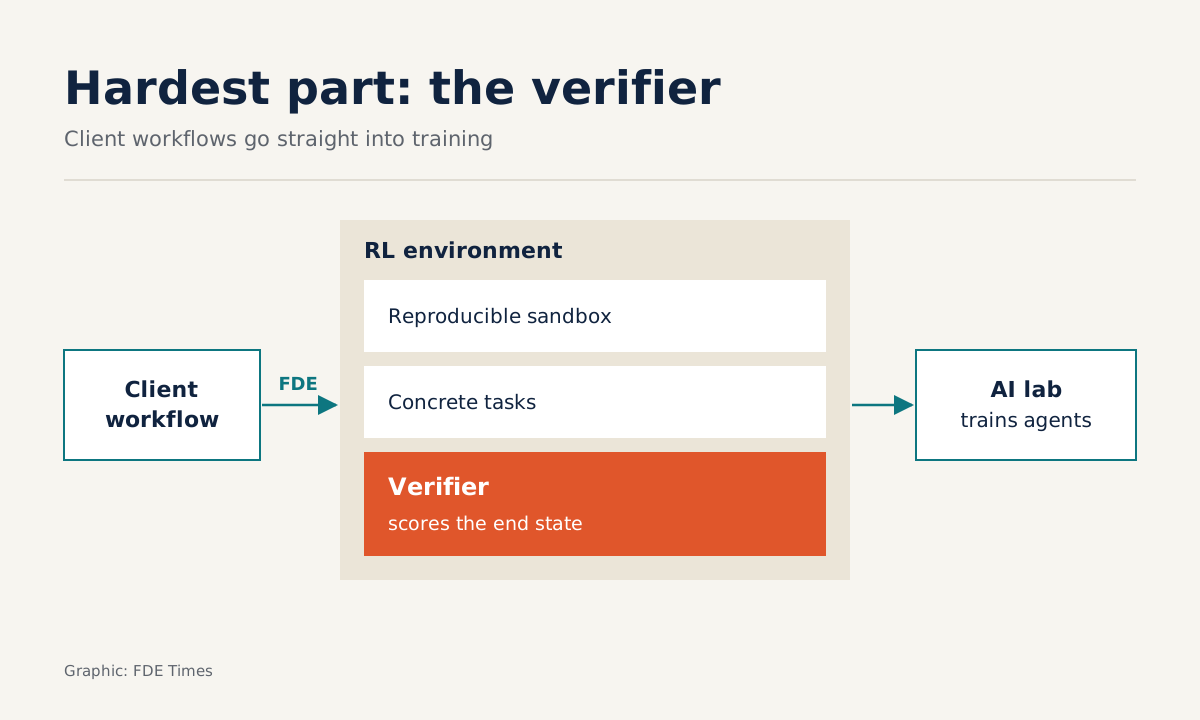
Turning that workflow into an RL environment takes three extra steps. The first is building an isolated copy of the CRM, preloaded with fixed data, so that the thousandth run is identical to the first.
The second is writing the task as concrete cases. If a note says “customer agreed to sign a trial contract”, for instance, the stage must move to negotiation and there must be exactly one follow-up task assigned to the account owner.
The third, and hardest, is writing the verifier. The verifier grades the final state of the CRM and ignores the agent’s reply. An agent can report fluently that the update is done, yet if the record is still in the old stage, or two duplicate follow-up tasks were created, the score is 0.
The failure modes you observe while sitting with the customer, such as duplicate records or the wrong owner, become the test cases.
The example explains why Prime Intellect puts eval intuition first. Docker and RL algorithms are the easy part. The hard part is deciding what doing a job correctly means, when only people inside the customer’s line of work fully understand that job.
| Aspect | FDE deploying a product | FDE building RL environments |
|---|---|---|
| Main output | A system running in the customer’s production | Reproducible sandbox, eval harness, verifier |
| Agent failures are used to | Fix before handover | Become test cases and training signal |
| Who uses the result | The customer’s operations team | The customer, and the AI lab training the agent |
| Most-requested skill | Integration, communication, shipping to production | Eval design, choosing what to measure, automated grading |
| Career risk | Being seen as an integration team that takes orders | Getting stuck as a contract team without research depth |
Enterprises buy people first, environments second
Wing VC, in its analysis of the RL environment market, observes that most enterprises do not buy environments directly. The work usually reaches them through forward-deployed engineering. In other words, FDEs are the distribution channel. Without someone sitting next to the customer, no real workflow makes it into an environment.
Wing also issues the opposite warning. Environment startups that lack research depth, or have not yet earned the labs’ trust, risk stalling as mere forward-deployed teams.
This path can fail: with people on site but no ability to design good training signals, a company ends up selling hours rather than a product.
Put Wing’s two observations together and the worry raised at the start has a fairly clear answer. Deployment work is not turning into data selling. It is growing a new branch, where the value lies in converting an understanding of the customer’s work into a trustworthy measurement. A good measurement is worth something. Plain hours are worth little.
What to prepare if you want this track
When reading job postings, look for phrases such as RL environments, evaluation harness, verifier, reproducible sandbox or failure modes. Postings with these phrases are hiring people to design measurements, even if the title still says FDE or applied research. If a posting mentions only integration and handover, it belongs to the traditional deployment track.
The skill to practice is the chain from the CRM example: turning a vague workflow into concrete tasks, building a reproducible environment, then writing a grader based on final state. On your CV, do not just write “built evals”. Say what you measured, which failure modes you caught, and what decision the eval led to.
One habit is worth building from the start: before turning a customer’s workflow into an environment, ask exactly what the contract allows it to be used for.
When a company’s real work can become training material for someone else’s model, the FDE should be the first to ask who owns that workflow, before legal has to ask on their behalf.
The previous generation of FDEs was judged on whether systems reached production. The next may also be judged on a harder question: can you prove the agent did the job correctly?
Was this article useful?
Thanks for the feedback!
5 sources
- Applied Research - Forward-Deployed @ Prime Intellect | Menlo Ventures Job Board
- Forward Deployed Engineer, RL Environments at Labelbox | JobMinglr
- An FAQ on Reinforcement Learning Environments (Epoch AI) · 2026-01-12
- Who Will Win the RL Environment Market—and Why · 2026-01
- Silicon Valley bets big on 'environments' to train AI agents · 2025-09-16