Is your 30th customer any faster than your third?
Hours logged and project counts cannot answer that question; only time-to-value, tracked cohort by cohort, shows whether an FDE team is compounding or drifting into services.
In brief
- Hours measure effort going in and project counts measure output. Neither tells you whether the customer has received any value.
- Time-to-value has to be tracked as a trend: each customer should be faster than the last, or nothing is compounding.
- FDE pay should be tied to outcomes after the contract is signed, not designed like a sales quota.
“If the 30th deployment takes as long as the third, nothing is compounding.” Waydev wrote that line in an analysis of the FDE model published in August 2026. It is the quickest test of whether a forward deployed team is building a product or simply selling hours.
Waydev also issues a less comfortable warning. An FDE model can look healthy on revenue and customer satisfaction while it has quietly become a services business. According to Waydev, the rot shows up only in the engineering data, and most organizations do not look there.
This matters to individual engineers because the metric a team chooses decides which parts of the job get credit. A team that counts hours rewards whoever spends the longest on site. A team that counts projects rewards whoever takes on the most work. Only a team that measures time to first value rewards the engineer who makes each customer faster than the one before.
Hours and project counts measure the wrong thing
Software delivery has already faced this question. The Accelerate/DORA approach was designed to measure what actually happens, rather than inputs such as hours worked. Lines of code were ruled out too, because they are output, not outcome.
Applied to FDE work, hours are the input and projects are the output. A team can report a 100% booked calendar and 12 live projects while no customer has yet seen a result in production. Both numbers say the team is busy; neither says anyone has benefited.
Time-to-value goes straight to the outcome: how long it takes a customer to see what they paid for. More important, as Waydev argues, the number has to shrink with each customer cohort. A flat line means lessons from the field are not making their way back into the product.
The clock starts at signature
Waydev and a16z both put the start point at the contract and the end point at a real result. Rocketlane specifies only the end point, the first measurable result, while DORA, on the software delivery side, starts the clock at commit. The table below sets the four approaches side by side by start point, end point and what each one catches.
| Measure | Start | End | Unit | What it catches |
|---|---|---|---|---|
| Waydev | Contract signed | First value | Time, by customer cohort | Whether the team is compounding |
| Rocketlane | Not specified | First measurable result | Days, target under 90 | A hard deadline for the first result |
| a16z | Contract signed | First production use | Engineer-months | The true cost of one deployment |
| DORA (for comparison) | Commit to version control | Running in production | Elapsed time | How fast changes reach users |
Rocketlane, in an FDE playbook written for professional services leaders, sets a KPI for Deployment Engineers of under 90 days to first measurable result. a16z offers a diagnostic question: how many engineer-months does it take from contract signature to first production use?
According to a16z, enterprises want AI vendors whose deployments are predictable and whose time-to-value is fast.
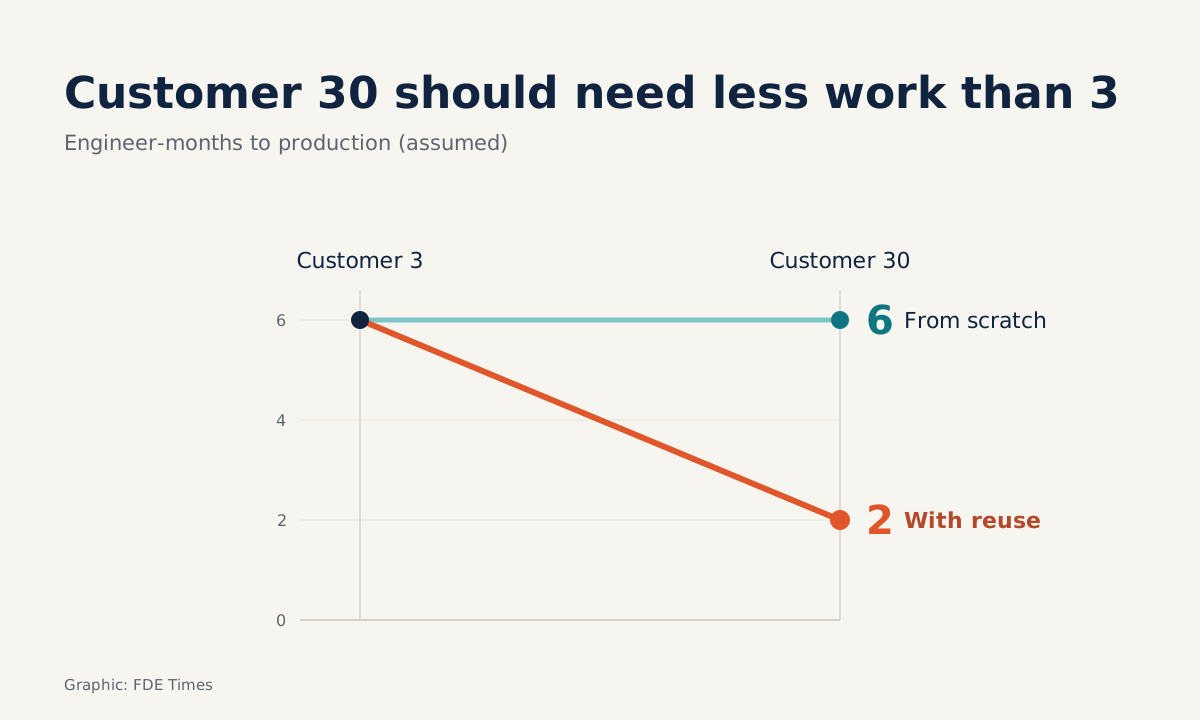
The a16z measure is the most useful because it combines time and headcount. Take a hypothetical case: for the third customer, two FDEs spend three months, or 6 engineer-months.
If the figure is still 6 by the 30th customer, everything is being rebuilt from scratch. If it has fallen to 2, connectors, eval templates or the onboarding process are genuinely being reused.
A timesheet report cannot tell those two scenarios apart. In both, two engineers are fully booked.
A clock that starts at signature changes how teams work
Once the clock runs from signature, the first thing to go is the weeks spent writing proposals. A practitioner’s FDE playbook published on dev.to argues that a demo running on real data after 2 weeks beats a proposal deck that took 6 weeks.
The same author frames FDE economics in terms of time to value in production: 5 months instead of 15.
The 5- and 15-month figures reflect one person’s experience, not an industry benchmark. The direction is still clear: bring real data in early, so the customer reacts to something that runs rather than to a document.
Rocketlane adds a habit that stops the metric being measured once and forgotten. For every live engagement, it recommends tracking incremental value delivered in each 30-day window, set against time spent on site.
A project in its fifth month whose last three windows added nothing needs to be reviewed, however happy the customer is.
Does faster mean sloppier?
This is the most common objection: reward speed and engineers will push half-finished work into production. DORA’s research on software delivery offers an answer, having shown repeatedly that speed and stability are not trade-offs.
DORA defines lead time for changes as the time it takes a change to go from commit in version control to running in production. It can be read as software delivery’s counterpart to time-to-value.
Even so, DORA’s conclusions come from software delivery teams and have not been tested specifically on FDE teams. Treat this as a well-grounded analogy rather than proof.
Quality is protected by where the clock stops. Rocketlane says “measurable result” and a16z says “production use”, so a demo does not count.
If first value is defined as a metric the customer has agreed in advance, such as the number of files processed automatically each day, cutting corners will not stop the clock any sooner.
Pay has to follow the same clock
A metric carries weight only when it touches compensation. Rocketlane advises against designing FDE variable pay like a pre-sales quota. That approach, it says, optimizes for winning deals rather than delivering outcomes, so bonuses should be tied to post-signature outcome metrics.
Put that alongside Waydev’s warning and the picture is consistent. A team paid on contracts signed will show good revenue. A team paid on hours will show good utilization. Only a team paid on falling time-to-value has a reason to carry what it learns at customers back into the product.
Make your team’s metric your own advantage
There is no need to wait for a manager to change the KPIs. On your current project, record three dates: the contract signature, the first demo on real data and the customer’s first production use. After two or three customers you will have your own data series showing whether you are getting faster.
That series is the strongest line you can put on a CV. A sentence such as “cut time from signature to first production use from 10 weeks to 4 by packaging a shared connector” shows a hiring manager both deployment skill and product thinking. “Worked on 8 projects” says only that you were there.
When reading job ads or interviewing, ask how the team measures its FDEs. If the answer is billable hours or utilization, you are applying to a services team. If they can say how long their latest customer took to reach production compared with their first, the team is building something that compounds.
The most valuable question to put to your own team is a simple one: is the 30th customer faster than the third? A team that can answer with data is building a product. A team that cannot is selling time.
Was this article useful?
Thanks for the feedback!
6 sources
- Forward Deployed Engineers Are Everywhere. Can You Prove They're Working? · 2026-08-13
- The FDE Blueprint: A complete guide for PS leaders in 2026 · 2026-05-21
- The Palantirization of everything · 2026-01-16
- the forward deployed engineer playbook · 2026-06-21
- Accelerate and DORA Metrics - Software Delivery Performance Measurement · 2021-04-14
- DORA's software delivery performance metrics · 2026-01-05