FDE job ads want excellent writing. Prove it with a document
The most convincing evidence is a piece of writing that a stranger on the client's side can read and put to use straight away.
In brief
- Tungsten Automation's FDE posting reduces writing to one generic line, yet its responsibilities call for custom technical documentation written for clients.
- According to Aced's guide, OpenAI's recruiter screen grades how well you summarize complex work for non-technical listeners; FDE Academy cites the line that a 70% solution with good documentation beats a 100% solution without it.
- The evidence to bring is writing other people can use, such as an incident report or a decision record, rather than an adjective on a CV.
The Forward Deployed Engineer posting that Tungsten Automation published in July 2026 folds writing into a single line alongside speaking and presenting, with one word attached: “excellent”. The responsibilities section of the same ad is far more specific. The FDE must run train-the-trainer sessions, write custom technical documentation for clients and share best practices.
It is only one job ad, but it shows a gap worth watching for in any FDE posting. The requirements list offers an adjective; the job description describes an entire deliverable. The ad says nothing about how a candidate should demonstrate that adjective, so the burden of proof falls on you.
Interview Kickstart, in its readiness map for FDE skills, states plainly that portfolios, CVs and interview answers must all carry concrete evidence of how you have used a skill. Nobody can grade the line “strong communication skills” on a CV. A real document can be graded.
One requirement doing three jobs
The same Tungsten ad asks FDEs to translate complex technical concepts for both hands-on engineering teams and C-level executives. Put that next to the line about writing, speaking and presenting, and “communication” here covers at least three tasks: explaining to engineers, standing in front of leadership, and writing documentation that stays behind.
Only the third leaves an artifact a hiring team can read before meeting you. The other two surface only in the interview. To learn how you will be tested, look at the interview process; the job ad will not tell you.
Which round listens to you explain?
According to the OpenAI FDE interview preparation guide from Aced (formerly Exponent), the recruiter screen checks your motivation for forward deployed work and your hands-on experience building products with LLMs. Communication is one of the criteria graded in this round: how clearly you summarize a complex piece of work for a non-technical listener.
That is a spoken exercise, but the hard part is identical to writing: deciding which points to keep, which to drop and in what order to tell them. A summary written down before the call becomes the skeleton of your answer.
FDE Academy, in a piece on why candidates fail FDE interviews, cites a blunt observation. People who can code but cannot explain their own thinking to an outsider will struggle a great deal. The same piece quotes a line from another source: a 70% solution with good documentation beats a 100% solution with none.
It sounds backwards, but it makes sense once you think about the reader. With the documented 70%, they know which parts work, which are missing, why you cut them and what comes next. With an unexplained 100%, they have to guess, and at a client site guessing means calling you back.
Handover is done when a stranger can pick it up
PostHog’s FDE handbook sets a clearer standard than any adjective. A deliverable counts as done only when a stranger on the client’s team can pick it up and use it immediately, without anyone walking them through it. At handover, the FDE must write down what was built and why.
The handbook also gives a short-form example: a one-paragraph status note each week in the shared channel with the client, sketching the week ahead so nobody is surprised on Monday morning. Interview Kickstart describes the same habit at the level of decisions: record the decision, the reasoning behind it and its expected impact on the client.
This is what Tungsten calls custom technical documentation, but PostHog adds a clear test for whether the documentation has met the bar. The strongest evidence, then, is writing that looks exactly like the work you would do once hired.
What a good incident report looks like
Rootly’s postmortem template is a good framework to start with. It has six sections: summary, what happened, impact, contributing factors, what went well and follow-up actions. Rootly deliberately leaves out a separate root-cause section, preferring to record contributing conditions so that every incident is not forced into a single cause.
A technical writing study guide for FDEs on Fatskills advises blameless postmortems that put the root cause in the opening paragraph. The two pieces of advice can be reconciled: the first sentence of the summary states the main cause in plain language, while the contributing factors section lists every condition that combined to produce the incident.
Take a hypothetical case. A nightly data sync job runs twice after a server changes time zone, duplicating records in a client’s reports. A note reading “fixed duplicate bug” proves nothing about your ability to write.
Under the Rootly framework, the first sentence of the summary says the job ran twice because its schedule drifted after the time zone change. The timeline records timestamps and the hypotheses you ruled out. The impact section says which reports were wrong, who used them and for how long.
The contributing factors section names both the schedule and the job’s lack of protection against duplicate writes. The follow-up section spells out who does what so the fault does not return. A manager on the client side can still follow it, and a client engineer could handle a recurrence alone: PostHog’s stranger test, passed.
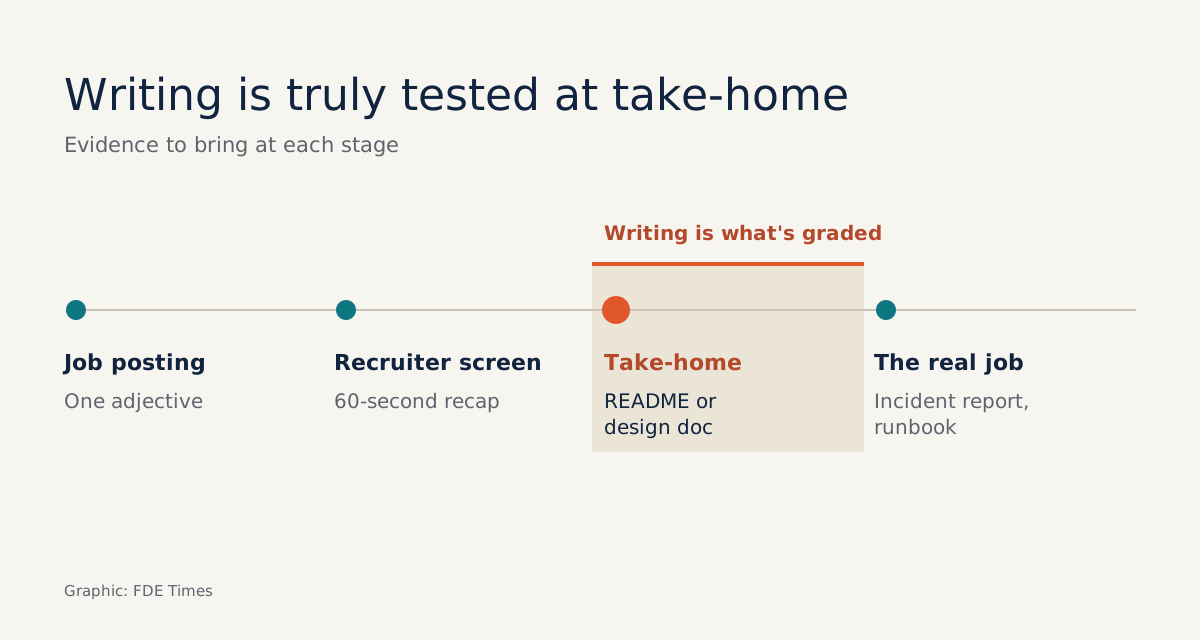
The table below sets out the same skill in the order you will meet it along the application path, with what to prepare at each stage.
| Stage | How writing skill shows up | Evidence to bring |
|---|---|---|
| Job posting | One generic requirement, lumped in with speaking and presenting | Read the responsibilities to see whether they mention documentation or training the client’s team |
| Recruiter screen | Summarizing complex work for a non-technical listener | A rehearsed 60-second summary of your latest project |
| Problem-solving rounds | Documentation accompanying the solution is graded | State clearly what works, what was left unfinished, why, and the next step |
| The actual job | Handover documents a stranger can use immediately | Incident reports, decision records and status notes in your portfolio |
How to put the evidence in your application
Start with the CV. Delete “excellent communication skills” and replace it with a line that has a concrete result, for example that you wrote the handover documentation for a system another team took over, with a link to a redacted copy if possible.
In your portfolio, each project should have at least one decision record following the three parts Interview Kickstart lists: the decision, the reasoning and the expected impact. Add an incident report using the six-section framework above, and whoever reads your application will be able to picture what you leave behind for a client.
In interview take-home exercises, set aside time for documentation from the start. If time runs out when most of the work is done, do not cram in the rest; write down clearly what works, what is unfinished and how you would complete it, in the spirit of the 70%-beats-100% line.
When reading a job ad, scan the responsibilities before the requirements. If the posting mentions custom documentation, train-the-trainer sessions or best practices, as Tungsten’s does, writing is daily work, and you should prepare an interview story built around a document you wrote that other people have used.
Someone hiring an FDE has no way to test an adjective. A one-page incident report shows them what you will leave behind after you leave a client, which is what they want to know before taking you on.
Was this article useful?
Thanks for the feedback!
7 sources
- OpenAI Forward Deployed Engineer (FDE) Interview Guide | Sample Questions (2026) - Aced (formerly Exponent)
- Forward Deployed Engineer @ Tungsten Automation | TA Associates Job Board · 2026-07-07
- Working with customers - Handbook (PostHog)
- Common Reasons Candidates Fail Forward Deployed Engineer Interviews (FDE Academy) · 2026-08-03
- 10 Forward Deployed Engineer Skills to Master: An Evidence-Based Readiness Map · 2026-08-25
- Incident retrospective (postmortem) template (Rootly) · 2026-11-04
- Forward Deployed Engineer 101: Technical Writing for the Field (Runbooks, Incident Reports, User Guides) | Study Guide