Two healthcare FDE jobs, two opposite ideas of who can apply
Hospital-side roles want people who understand HL7 and FHIR, while Optum asks for eight-plus years of engineering and seven-plus of consulting.

In brief
- Under the same healthcare FDE title, Optum asks for 8+ years of engineering and 7+ years of consulting, while Qualified Health says you don't need to be a developer
- At Qualified Health the core work is integration specs on Epic with HL7 v2 and FHIR R4, with up to 30% travel; Commure's FDEs sit alongside doctors
- Medplum argues no prior healthcare experience is needed, only a willingness to learn the standards, regulations and clinical realities
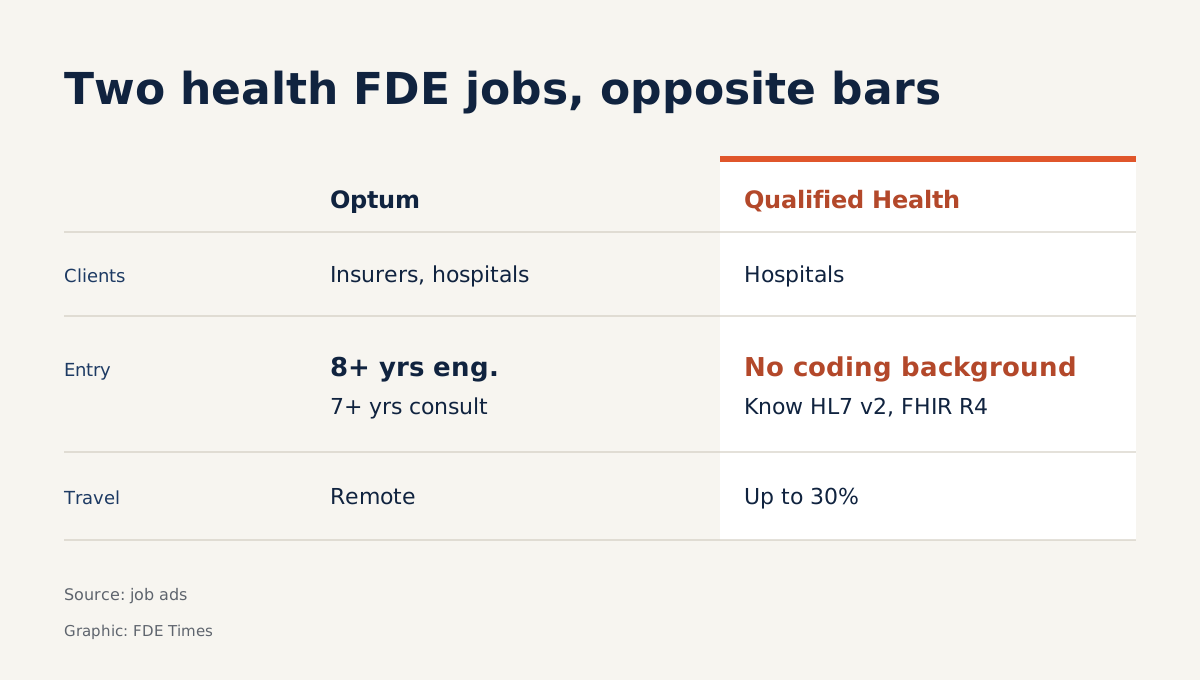
Qualified Health’s job ad for an Epic-focused Forward Deployed Engineer contains a rare line: familiarity with the concepts of HL7 v2 and FHIR R4 is enough, and “you don’t need to be a developer”. Optum, part of UnitedHealth Group, asks FDE candidates for at least eight years as a software engineer and at least seven years in consulting.
The two ads share a title and an industry, yet they describe very different jobs. The most useful way to read them is to look at the customer each role serves, because healthcare has two kinds of customer with two kinds of need.
For an engineer with a few years’ experience looking for a way into FDE work, healthcare deserves a close look. On the hospital side, most of the barriers the job ads list are knowledge of data standards and clinical reality, and both can be learned.
Payers and providers need different things
In healthcare, payers are the insurers; providers are hospitals, clinics and health systems. Cedar, a company that handles patient billing, explains why so many problems persist: insurers have little incentive to improve their processes, while providers lack the technology to reach patients at scale.
Cedar’s view is that FDEs must get things done despite that complexity. For engineers, the gap between the two sides is where the jobs come from: neither side can close it alone, so someone has to sit between the product and the customer’s real workflows.
Optum’s ad places the FDE at the intersection of consulting, engineering and client delivery, serving both payers and providers. The areas it names are claims, revenue cycle, clinical workflows and member experience. Claims and member experience are the language of insurers; revenue cycle and clinical workflows are the language of hospitals.
Optum also asks for hands-on experience deploying distributed systems and cloud-native solutions, on top of years of consulting. With requirements like that, it is hardly a starting point for an engineer a few years into a career.
In hospitals, the work lives inside Epic
The provider side is narrower but deeper. Qualified Health’s FDE is the main technical point of contact for one or two health systems, working on site or remotely but closely embedded with the client’s team. The core task is designing end-to-end integration specs for each use case, including configuring Epic Bridges interfaces and FHIR R4 endpoints.
Hippocratic AI, in an October 1, 2026 posting for a mid/senior role, lists EHR integration (Epic, Cerner, Athena), FHIR, HL7 and healthcare data standards as preferred rather than required skills. That leaves the door open to engineers who have never worked with an EHR.
A hypothetical case shows what such a spec demands. Say a hospital wants an AI tool to read patient information before an appointment and write a summary back into the record.
For that use case, the spec has to answer: which data flows through an HL7 v2-style interface, which data is pulled through a FHIR R4 endpoint, where in the EHR the result is written, and who on the hospital side configures which part.
None of those questions requires you to write an algorithm. They require you to understand how healthcare data moves through an existing system, and that can be learned before you apply.
The work happens in the clinic
If integration is the technical side, being on site is the craft. The head of Commure’s FDE team calls the job “a contact sport”: you have to be right there to understand the problem quickly.
The story at NEMS shows how literal that is. The NEMS CIO recalls Commure’s FDEs turning up after 7 p.m. appointments, sitting with doctors and even with patients.
For an FDE working with hospitals, customer discovery can mean sitting in the exam room, watching a doctor work while the patient talks. The travel figure in a job ad tells you how much of that to expect: up to 30% at Qualified Health, 25% to 40% at Hippocratic AI.
Three job ads side by side
| Company | Scope of work | Entry requirements | Presence |
|---|---|---|---|
| Optum | Claims, revenue cycle, clinical workflows and member experience for both payers and providers | 8+ years of engineering, 7+ years of consulting | Remote |
| Qualified Health | Integration specs on Epic Bridges and FHIR R4 for 1–2 health systems | Familiarity with HL7 v2 and FHIR R4 concepts; no need to be a developer | On site or closely embedded remotely, up to 30% travel |
| Hippocratic AI | Mid/senior role | EHR integration (Epic, Cerner, Athena), FHIR and HL7 preferred | Remote, 25–40% travel |
Three ads are too small a sample to call a pattern, but they suggest a way to read the market. The role tied to health systems at Qualified Health leans on data standards and presence, which fits what Commure describes at NEMS. Optum leans on years of experience, perhaps because its scope spans many workflows and both kinds of customer.
Why engineers should consider this field
Medplum, which builds a healthcare data platform, argues that buyers in this industry have long expected engineers to come on site and work alongside them, almost since the industry began. If Medplum is right, demand for FDEs in healthcare predates the current wave of FDE hiring.
Medplum also says engineers need no prior healthcare experience. What they need is a willingness to learn the industry’s standards, regulations and clinical realities.
That should not be read as “join first, then learn the standards from scratch”. Qualified Health’s “you don’t need to be a developer” refers to coding skill; the ad still asks for domain knowledge, in the form of familiarity with HL7 v2 and FHIR R4 concepts. Needing no healthcare experience, in Medplum’s terms, is different from needing to know nothing about data standards.
So if you plan to target this field, invest in exactly what the job ads name, and do it before you apply. Learn the concepts of HL7 v2 and FHIR R4 well enough to explain to someone else how the two standards differ.
Then write your own integration spec for an invented use case and add it to your portfolio, because that is precisely the deliverable Qualified Health describes.
On your CV, don’t just write “worked on integrations”. Spell out that you specified the data flow between two systems, worked directly with end users and put something into production. Integration experience from another industry still transfers if you describe it as a spec.
When reading a job ad, three details reveal the real role: whether the customer is a payer or a provider, which EHR is named, and how much travel is involved. An ad that says “primary point of contact for one to two health systems” is warning you that you will work closely with the client every day. Make sure that is what you want.
On the hospital side, the door to FDE work is open to anyone willing to learn the data standards. The rest is being willing to stay after a 7 p.m. appointment, long enough to understand what the doctor really needs from the data.
Was this article useful?
Thanks for the feedback!
6 sources
- Forward Deployed Engineer (FDE) - Remote (Optum, Built In NYC)
- Forward Deployed Engineer, Epic Specialist (Qualified Health)
- Forward Deployed Engineer (Mid/Senior) - Remote w/Travel (Hippocratic AI) · 2026-10-01
- Keyboard Liberation at NEMS: The Role of Ambient AI and Forward-Deployed Engineers · 2025-06-24
- FDE: What nine years in healthcare taught us (Cedar) · 2025-10-16
- Forward Deployed Engineering in healthcare (Medplum) · 2026-07-01