Holding an FDE offer? Count the coding hours before you sign
Under the same Forward Deployed Engineer title, coding can fill anywhere from 30% to 90% of the week, and some roles involve no software development at all.
In brief
- The split of 25% coding, 50% integration and 25% meetings is one writer's reading of a single Google Cloud job ad, not survey data.
- An analysis of 1,000 FDE job ads found builder roles code 70-90% of the time, while Sales Engineer+ roles code only 30-40% and carry sales targets.
- Some roles called FDE involve no software development at all, so ask about coding before you sign.
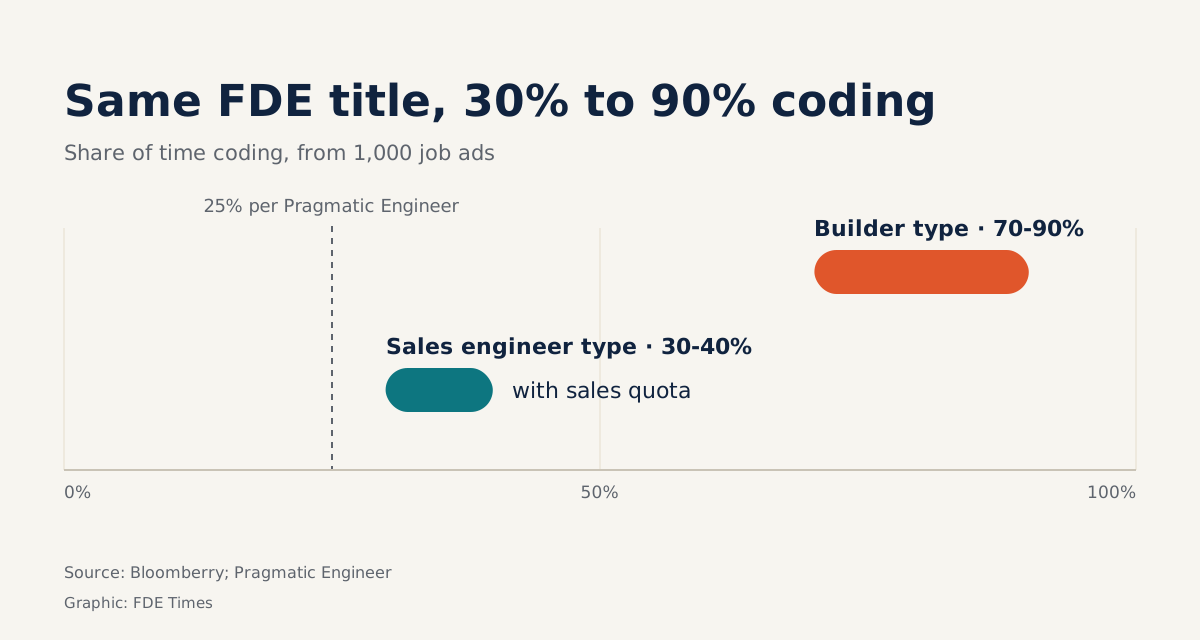
Bloomberry analyzed 1,000 Forward Deployed Engineer job ads and found at least two very different jobs sharing one title. The first type codes 70-90% of the time. The second, which it calls “Sales Engineer+”, codes only 30-40% and carries a sales target.
That gap is far wider than the figure usually quoted for FDE work: roughly 25% code-related, 50% integration and wiring systems together, 25% meetings and hands-on customer support.
The split appeared in The Pragmatic Engineer, but it is one writer’s interpretation of a Google Cloud job ad, not a survey or official data.
If you are holding an FDE offer, do not borrow the industry average. The real coding hours of this particular role decide whether you are still an engineer two years from now, and you have to count them yourself before you sign.
25/50/25 is just one reading
Treated as an illustration, the split is still useful. Applied to a 40-hour week, it gives about 10 hours of code-related work, 20 hours of integration and 10 hours with customers. For someone who spends the whole week writing features in a familiar codebase, that is a very different rhythm.
But those 20 hours of integration may or may not be real engineering. In a Pragmatic Engineer piece on whether the FDE role is losing its appeal, one developer warned that at some companies FDEs do almost nothing that counts as software engineering, beyond integrating software the product team has already built.
So the question about integration has to be specific: will you write code that connects systems, or just configure what someone else wrote? Job ads call both “integration”.
The week is not evenly divided
There is another reason to distrust any average: an FDE’s coding hours come in clumps rather than spreading evenly. A Palantir FDE told The Pragmatic Engineer that in some weeks he spent most of his time writing and reviewing the team’s code, like an ordinary software engineer.
An FDE at Wonderful described to Insight Partners full days spent writing code and fixing bugs, alternating with days spent entirely at the customer’s site. Even onsite time varies: Palantir expects FDEs to spend about 25% of their time with customers, while at Commure the figure can reach 50%.
In practice, the question “roughly what percentage will I be coding?” tends to get a neat answer that means nothing. Ask an FDE on the team about their own last four weeks instead: which weeks were spent coding, which at the customer, and where that code ended up.
Less travel is not always a good sign
Bloomberry’s data contains a detail that is easy to read backwards. The builder type, coding 70-90%, travels 30-50% of the time. The Sales Engineer+ type, coding 30-40%, travels less than 20% and carries a sales target.
Many engineers will find an offer with little travel more comfortable. If light travel comes with a quota, though, it suggests you are being hired to support sales rather than to build systems that run at the customer.
When reading a job ad, look for three signals together: the coding share, the onsite time, and any mention of quota, commission or revenue. One signal on its own says little; all three together say a lot.
When the FDE title hides another job
The worst risk is not 30% or 25%. It is zero. In the same piece on whether the FDE role is losing its appeal, The Pragmatic Engineer quoted an engineer whose company wanted to use him more as an engagement lead and gave him no software development work.
At the other end, First Round Review reports that “legal engineers” at Ironclad merge code into production and do code review with the CTO every week. What makes this example valuable is that the coding is verifiable: there are commits, there is production, there is a reviewer.
That is the standard to use. A company that treats FDEs as engineers can show where FDE code goes through review and how it reaches production. The table below turns the signals from these sources into questions to put directly to the employer.
| Question to ask | Builder-role signal | Warning sign |
|---|---|---|
| How much of a team FDE’s last four weeks went to coding? | Most of the time, close to the builder type’s 70-90% | Around 30-40%, or nobody can give a figure |
| Is there a sales target or commission? | No quota mentioned in the offer | A quota, combined with less than 20% onsite time |
| Is FDE code merged to production and reviewed? | Yes, regularly every week, as at Ironclad | Only configuring and integrating what the product team built |
| Which repo will you commit to in your first week? | A specific repo, with a reviewer | Only documents, demos and a meeting calendar |
| Why was this position opened? | There is technical work at a customer that nobody has managed to do | They need another person to coordinate engagements |
The last question comes from First Round Review itself. The publication advises hiring managers to ask what prompted the opening, who is doing that work now, and what happens if nobody is hired. Turn it around and ask them: the answer shows whether the company needs an engineer or a customer relationship manager.
Scarcity gives you the right to ask
Christian & Timbers, an executive search firm, says it has mapped more than 17,000 FDEs in the US and identified about 2,000 who meet the standard it calls “elite”.
The study says “Not 2,000 available, 2,000 total”, and TechCrunch reads that as the number of engineers with the required expertise, not the whole FDE population.
The firm also forecasts that demand for FDEs overall will rise by about 2,100% by the end of 2026. That is its own projection, so it is best read as a signal of where the market is heading.
However cautiously you read them, the two figures point the same way: the people in demand are those with deep technical expertise, not anyone with an FDE title.
A role that stops you coding will pull you out of that group, and today’s scarcity gives you enough leverage to demand clear answers before you sign.
Keep your CV an engineer’s CV
Whatever offer you take, write your CV to the same verifiable standard. Each line should say what code you merged into production, who reviewed it, which customer the system runs at and which part you own.
To anyone reading a CV, a line like that separates a builder from a coordinator at once. If after six months in the new role you cannot write a single such line, it is time to reconsider your choice.
With an offer in hand, you are in the strongest position to ask. A company that genuinely treats FDEs as engineers will show you four weeks of a team member’s work and the repo you will commit to in week one; if it dodges both, you have your answer.
Was this article useful?
Thanks for the feedback!
8 sources
- The Pulse: Forward deployed engineering heats up again · 2026-05-24
- What are Forward Deployed Engineers, and why are they so in demand? · 2025-08-12
- Is the FDE role becoming less desirable? · 2026-03-26
- Hiring Elite FDE Talent | Christian & Timbers · 2026-09-10
- Forward deployed engineers are the AI industry's latest talent obsession · 2026-07-30
- What I learned analyzing 1K forward deployed engineer jobs · 2026-01-25
- A day in the life: How four companies run FDE motions · 2026-07-27
- So you want to hire a forward deployed engineer · 2026-02-24