A factory FDE can own the data, but not knowledge of the line
Forward deployed engineers in manufacturing end up doing the data engineering themselves, while the plant's own engineers still hold what matters about the production line.
In brief
- Instrumental requires FDEs who have actually worked on a factory floor, while Re:Build hires people with 3–5 years in software and places its FDE alongside the plant's production, engineering and quality teams.
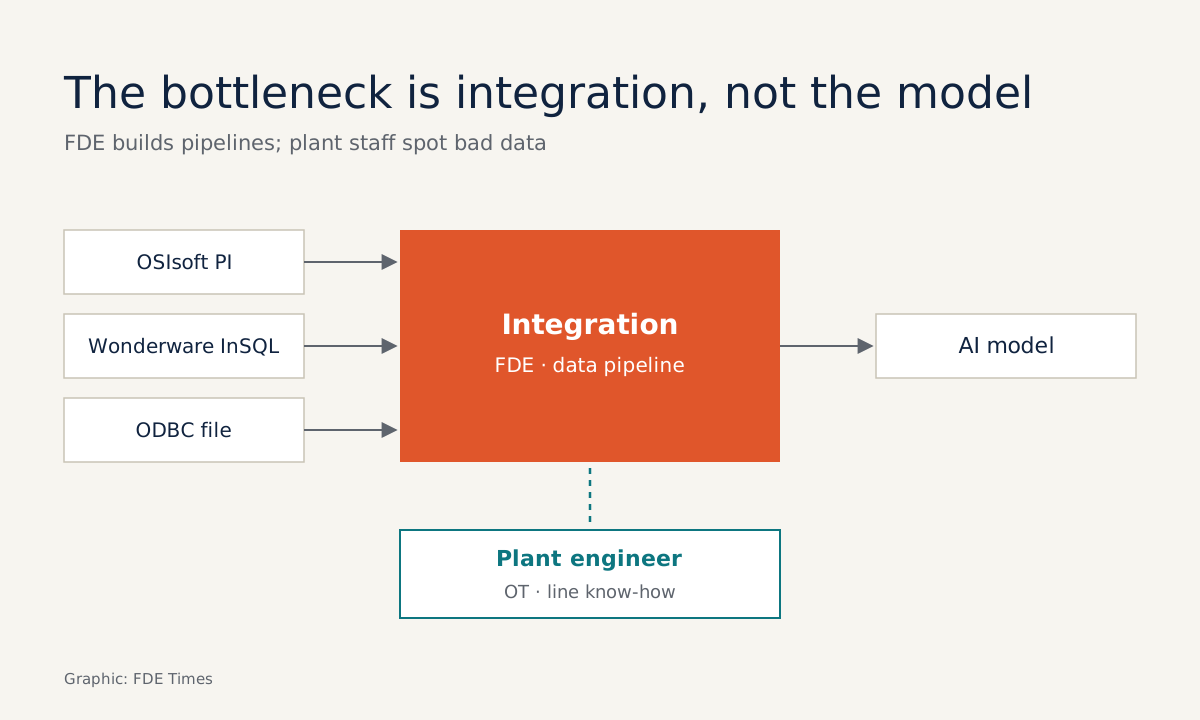
- The bottleneck in industrial AI is the integration layer with OT: historian data arrives in every format, and drifting sensors must be handled inside the pipeline.
- An FDE can carry the data engineering, but still needs the plant's engineers for domain knowledge; one source recommends creating a dedicated role to translate between OT and IT.
Instrumental’s posting for a Forward Deployed Manufacturing Engineer contains one unusually blunt line. Candidates must have actually worked on a factory or contract manufacturing floor: “not next to it, on it.”
This year Re:Build Manufacturing also advertised for an FDE embedded at a plant, with very different requirements: 3–5 years of experience in software development, support or deployment, plus AWS.
Both companies are putting FDEs into factories, but they answer differently a question that every engineer heading into industry will face. The answer shapes what you should practice and where you should apply.
It comes in two halves. The FDE can carry the data engineering, and in practice has no choice. But knowledge of the production line stays with the plant’s people, and the FDE’s real job is to stand between the two sides and translate.
The first 90 days start with questions
The classic FDE model comes from Palantir. According to a16z, the engineers Palantir internally calls “Deltas” and “Echoes” sit inside the customer’s organization and own what they build. They do not hand over and leave.
One Palantir engineer has described the opening of an energy-sector project. On arrival, the team’s first task was to decide which problem to solve within 90 days. To do that, they interviewed the customer and read as much as they could about energy markets.
The detail shows that engineers do not arrive with domain knowledge in hand; they learn it on the job. Yet learning enough to pick the right problem is one thing. Understanding deeply enough to replace people who have run a line for years is something else entirely.
Re:Build’s job description draws that boundary fairly clearly. Its FDE works directly with the plant’s production, engineering and quality teams to resolve problems on site quickly. Domain knowledge stays with those teams; the FDE is the connector.
An analysis of AI in manufacturing by fde.academy adds that plant engineers tend to be cautious. Integration with OT systems demands care and usually has to be done with them. Some work, in other words, an FDE is not allowed to do alone, however capable.
The heaviest work sits in the integration layer
If domain knowledge can lean on the plant, the data cannot. An analysis by Industrial Monitor Direct of industrial AI deployments concludes that the bottleneck keeps appearing in the integration layer between the AI system and the plant’s operational technology. The model is rarely where things get stuck.
The reason lies in the data itself. A single plant may hold data in OSIsoft PI (now part of AVEVA), in Wonderware InSQL and in ODBC exports in formats of their own. Pulling them into one usable place is a data engineer’s workload.
Then there are the sensors. fde.academy stresses that drifting or failing sensors must be handled in the data pipeline; handling them in the model layer alone is not enough. That is data engineering work, and according to fde.academy, the person who takes it on is the FDE.
One drifting sensor shows where the line falls
Take a hypothetical example. You build a model that warns of product defects on a line, pulling furnace temperature from PI and quality inspection results from an ODBC file exported each shift. A few weeks later the model starts flagging defects in bursts, though the actual scrap rate has not changed.
Looking only at the model layer, the usual reflex is to retrain. Do that and the model learns the wrong numbers as normal, and real defects slip through.
The right fix is to add a step to the pipeline that compares that sensor against a reference sensor, flags it when the deviation exceeds a threshold, and holds the data back instead of pushing it straight into the model.
Writing that check is the FDE’s job. But knowing that the sensor is drifting and the furnace is not really running hot, or that the sensor was recalibrated last week, is the plant engineer’s knowledge. Without either person, the check is either never written or written with the wrong threshold.
The person between OT and IT
a16z argues that Palantir’s model depends on people with an extremely rare combination of business and technical ability: the capacity to understand the customer’s problem while still building the system themselves.
In a factory the bar is a notch higher, because domain knowledge here means understanding each sensor and each shift. If the business-plus-engineering combination is already rare, expecting a newly arrived FDE to stand in for someone who has run the machines for years is a gamble that is hard to build a hiring plan around.
The Industrial Monitor Direct piece points to a more practical route. It recommends creating a dedicated role for translating between OT and IT, rather than splitting the work across several teams.
Whoever holds that role need not know the line as well as the plant engineers, but must ask the right questions and speak both sides’ language, which is exactly where Re:Build places its FDE.
Palantir’s deployment teams build on a small set of reusable components, and spend their time choosing and validating the right ones for each customer.
They do not rewrite from scratch each time. The time saved by not rebuilding goes into the integration layer, where projects most often stall.
So the real difference between the two postings is where domain knowledge sits. Re:Build is content to leave it with the plant’s teams. Instrumental wants some of it already in the head of an FDE who has stood on the floor.
Which path to take
If you are a software engineer with 2–8 years of experience who has never set foot in a factory, Re:Build-style roles are the realistic way in. They ask for experience in software development, support or deployment, which you already have. What is missing is industrial data, and that you can practice on your own.
Practice where projects stall. Write a connector that reads time-series data from several sources in different formats, and add a step that detects sensor drift before the data reaches the model. A small project like that on GitHub carries far more weight than a polished model-training notebook.
The second skill is asking questions. The Palantir engineer above started by interviewing the customer and reading about the industry. You can practice this in your current job: next time an operations team sends you a request, ask them how they spot bad data before you write a line of code.
When reading a job posting, look for the sentence describing who you will work with. A line like “work with the production, engineering and quality teams” means domain knowledge stays with the plant.
A line demanding real factory-floor experience means the company wants you to be the domain expert yourself, and no online course will close that gap.
On your CV, avoid generic lines such as “built a defect prediction model.” State which data sources you integrated, which data errors you caught in the pipeline, and whom you worked with on the operations side. People hiring FDEs for factories read those lines to judge whether you can handle the part of the job where projects most often stall.
A 90-day factory project does not need someone who knows everything. It needs someone the plant engineers trust enough to point out which sensor is lying.
Was this article useful?
Thanks for the feedback!
6 sources
- The Palantirization of everything · 2026-01-16
- Meet your future coworker: A day in the life of a Palantir engineer · 2018-09-24
- Closing the Last Mile: Industrial AI Deployment Solutions · 2026-03-27
- AI in Manufacturing: How Forward Deployed Engineers Deploy It · 2026-10-01
- Forward Deployed Engineer (Re:Build Manufacturing) · 2026-10-20
- Forward Deployed Manufacturing Engineer (Instrumental) · 2026-08-15