n8n sells low-code, but its FDEs must write real backend code
Its engineers get five days on site, and they are judged by what the customer can run alone once they have left.
In brief
- n8n requires solid backend or full-stack experience for its FDEs. Knowing n8n is only a plus.
- Each engagement lasts five days on site. The result must be something the customer can run alone, with no gold-plating.
- Whatever works at one customer goes back into an internal playbook so later deployments run faster.
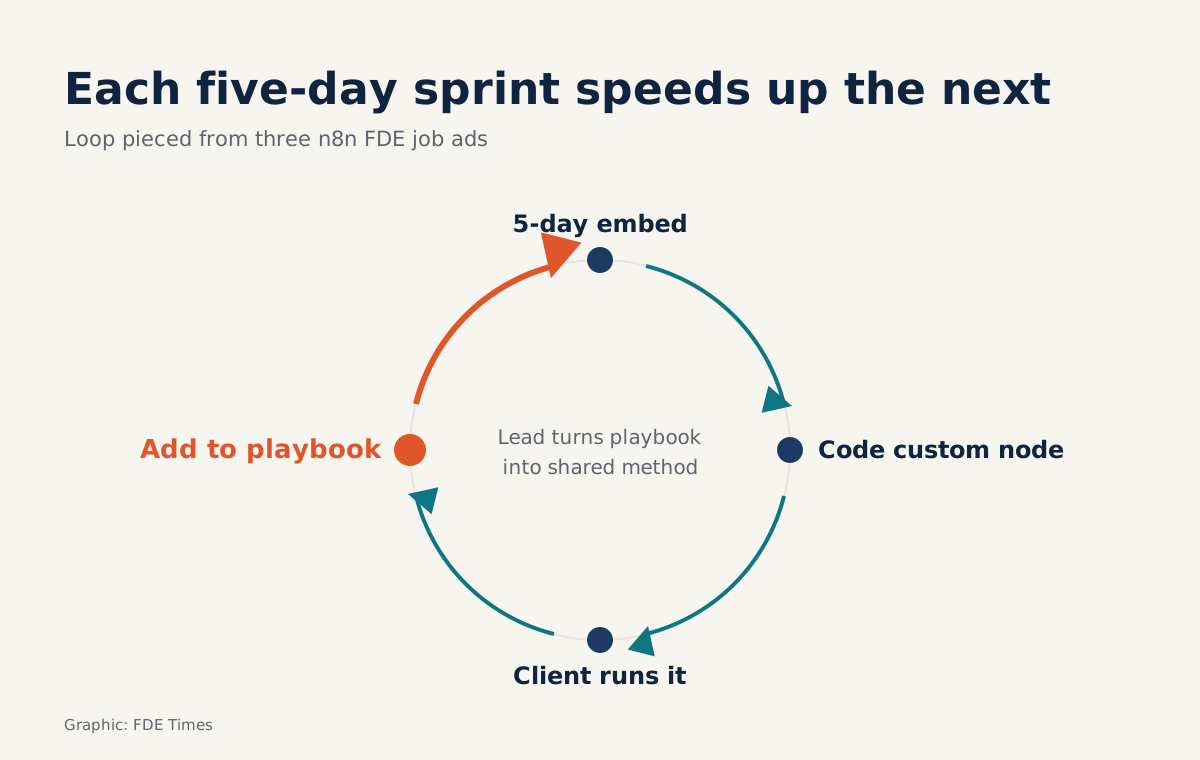
n8n sells drag-and-drop workflow automation. Yet its job ad for a Forward Deployed Engineer in EMEA makes “strong full-stack or backend engineering experience” a hard requirement, and lists familiarity with n8n only as a plus. That looks like a contradiction. It is actually a good guide to what platform companies use FDEs for.
n8n has three related openings: FDE, FDE EMEA, and a Lead role to build a Forward Deployment function from scratch. Taken together, they describe a kind of FDE quite unlike the familiar picture of an engineer embedded with one customer for months.
If you are aiming for an FDE job at a low-code, integration-platform or AI orchestration company, these ads spell out what such companies want: someone who writes code in the layer beneath the drag-and-drop tool, and who knows when to stop.
Where low-code runs out, the FDE takes over
The EMEA ad is blunt about the work. The FDE must be able to create custom nodes, extend existing integrations and work confidently with APIs and authentication schemes. This is not wiring a few nodes together on a canvas. It is writing software that gives the canvas new nodes.
The reason is easy to work out. Pre-packaged integrations work well with popular services. Large enterprises have internal systems, home-grown APIs and their own authentication schemes that no node library can anticipate.
Deployments tend to get stuck in the gap between the standard product and the customer’s real infrastructure, and FDEs are hired to close it. The ad states the end goal plainly: get n8n’s most important enterprise deployments into production and running successfully. A demo that runs on a laptop does not count as done.
Five days, not five months
The original FDE ad describes a precise rhythm: working directly inside customer organisations in focused deployment sprints of five days. Candidates must be ready to travel roughly 30–40% of the time, mostly within Europe.
Five days changes the whole way of working. Picture a week like this. Day one is discovery: sitting with the customer’s operations team, mapping the process they want to automate, finding which internal systems have no integration yet.
Days two and three go on writing a custom node that wraps that internal API, handling the authentication flow and the errors it returns.
Day four is for testing with real data and hardening the fragile points, such as expiring tokens or an API that fails halfway through. Day five is handover. On a schedule like that, every minute spent on a feature “we might need later” is a minute taken from handover day.
This is an illustration, not a schedule n8n has published. But the problem is real. When the clock gives you five days, the skill that decides the outcome is cutting scope, not typing fast.
The hardest skill is not writing more
The most striking line in all three ads sits in the candidate description. n8n wants someone who knows when to build and when to push back, and who avoids gold-plating solutions that should stay simple. For a low-code company, that sentence is close to a product philosophy.
It comes paired with another requirement: build solutions the customer can own and operate themselves. Put the two together and an n8n FDE is not measured by how much code they write. The measure is how much of the system runs without the customer ever needing to read the code.
Go back to the hypothetical week above. Suppose the customer asks for a separate orchestration layer written in code, with a home-made retry mechanism and its own dashboard. An engineer used to building products would find that exciting.
A good FDE here would write a custom node only for the internal system the tool cannot yet connect to, and leave everything else on the standard nodes the customer’s team already knows how to drag and drop.
That is not laziness. Every line of custom code is a line the customer has to maintain after you fly home. If the customer’s operations team cannot read TypeScript, that home-made orchestration layer becomes a liability the following week.
Every visit must leave something reusable behind
Short engagements are only worth it if the experience accumulates. The EMEA ad asks FDEs to contribute lessons learned, workflows, custom nodes and reusable integration patterns to an internal playbook library. The custom node you write for the first customer should make the fifth customer’s deployment faster.
The Lead ad makes the same point at the level of the organisation. The hire will build and lead n8n’s Forward Deployment function from the ground up, then distil each engagement into a template approach for each use case so that the next deployment is faster than the last.
The role also includes on-site boot camps with enterprise customers. The Lead does not need to write code, but must understand technical architecture.
The table below sets the three ads side by side. None of them shows the full loop on its own.
| Aspect | FDE | FDE EMEA | FDE Lead |
|---|---|---|---|
| Working rhythm | On site with customers in five-day sprints, 30–40% travel, mostly in Europe | Get the most important enterprise deployments into production | Build the function from scratch, run on-site boot camps |
| How much code | Knows when to build, when to push back, no gold-plating | Writes custom nodes, extends integrations, works with APIs and authentication | No coding required, must understand architecture |
| What must be left behind | Solutions the customer owns and operates | Contributions to the internal playbook library | Template approaches by use case, reused in every deployment |
Read across the rows and a closed loop appears. The FDE goes in, writes what is missing, hands over, then packages the reusable parts into the playbook. The Lead turns that playbook into a shared method. For an engineer weighing this role, it means being judged both customer by customer and by how much you add to the team’s shared assets.
Read the job ad as a practice brief
If you want to apply for this kind of role, at n8n or any other platform company, do not start by memorising the drag-and-drop interface. The ad already says that is only a plus.
Start from the layer underneath: write a custom node that wraps a real API with OAuth or API-key authentication, and handle pagination, rate limits and expiring tokens. Add handover documentation good enough for someone other than you to install it and fix basic faults.
On your CV, do not just write “built integrations”. Say how long the handover took, who ran the system afterwards, and what you deliberately chose not to build.
When you read FDE job ads at other companies, look for the four signals seen here: the length of engagements, the share of travel, phrases like “the customer owns and operates”, and any mention of playbooks or reuse. They tell you whether the job is long-term consulting at a single customer or short deployments repeated many times.
For interviews, prepare a true story about a time you pushed back on a customer request and kept the solution simple, along with what happened afterwards. Many strong engineers can only talk about what they built. In this role, what you chose not to build counts just as much.
Any low-code company big enough to sell to enterprises ends up back at code. The person it needs is an engineer who writes exactly that code, then turns each piece into a faster start for the next customer.
Was this article useful?
Thanks for the feedback!