Chase ownership of outcomes, not the FDE job title
The same label can cover three different jobs, and the real test is who keeps the system running once the demo is over.
In brief
- Palantir created the role in the early 2010s under the name Delta; today the FDE label covers many very different jobs.
- The reliable test is who is responsible for a system that runs and that the customer uses, not just for one passing eval.
- At Palantir, accountability is built into multi-year, outcome-based contracts; look at how a company makes money before trusting the title.
In the early 2010s, when Palantir created the role of software engineer working on site with customers, it did not call it FDE. It called it “Delta”.
The detail is worth remembering because it shows the name was never the core of the job. More than a decade later, “forward deployed engineer” has become a sought-after hiring label, and the more widespread it gets, the less it says about the actual work behind it.
If you are an engineer with two to eight years of experience weighing a career shift, the practical question is this: when the label can no longer be trusted, where should you invest your effort?
From investors and writers on the profession to critics of the trend, the answer is almost the same: the ability to take a customer’s ambiguous problem and own it until there is a result.
The original idea: one customer, many capabilities
Palantir distinguished between two kinds of engineer. Dev focused on “one capability, many customers”, building a feature that works across the whole customer base. Delta was the reverse: one customer, many capabilities, pulling together whatever a particular organisation needed to reach its goals.
Palantir’s description of the work also revolved around the word “own”: working in small teams and taking responsibility for the end-to-end execution of high-stakes projects. CIO summed up the original idea in a single sentence: FDEs are how Palantir delivers outcomes to customers, not tools.
The key word is “outcomes”. With a tool, you can hand it over and leave. An outcome exists only when the customer actually achieves what they need.
One title, at least three jobs
As the label spread, its meaning thinned out. The Pragmatic Engineer notes that roles almost identical to FDE can still carry many different names. CIO goes further, calling “forward deployed engineer” a vague term whose meaning depends on each company’s business model.
FullStack counts three different jobs sharing the FDE title. The two easiest to tell apart sit at opposite ends: the builder FDE, who creates production systems in the customer’s environment, and the sales-engineer FDE, who mainly runs demos. The two can list the same title on their profiles, yet their working days look nothing alike.
The reverse happens too. Chad Horenfeldt argues that relabelling customer success teams as FDEs is a trap: once they dive into solution details, CSMs no longer have time to understand the outcomes their customers want. By that reasoning, a new name does not by itself increase ownership of outcomes.
The eval passed. Who is still there?
FullStack offers a neat test: look for responsibility for a working system and for the customer actually using it, not just for one successful evaluation.
Insight Partners defines the role along the same lines: an FDE takes an ambiguous, unscoped problem, builds the last-mile solution and owns the outcome. An investor quoted by Insight puts it even more briefly: everything has to revolve around outcomes.
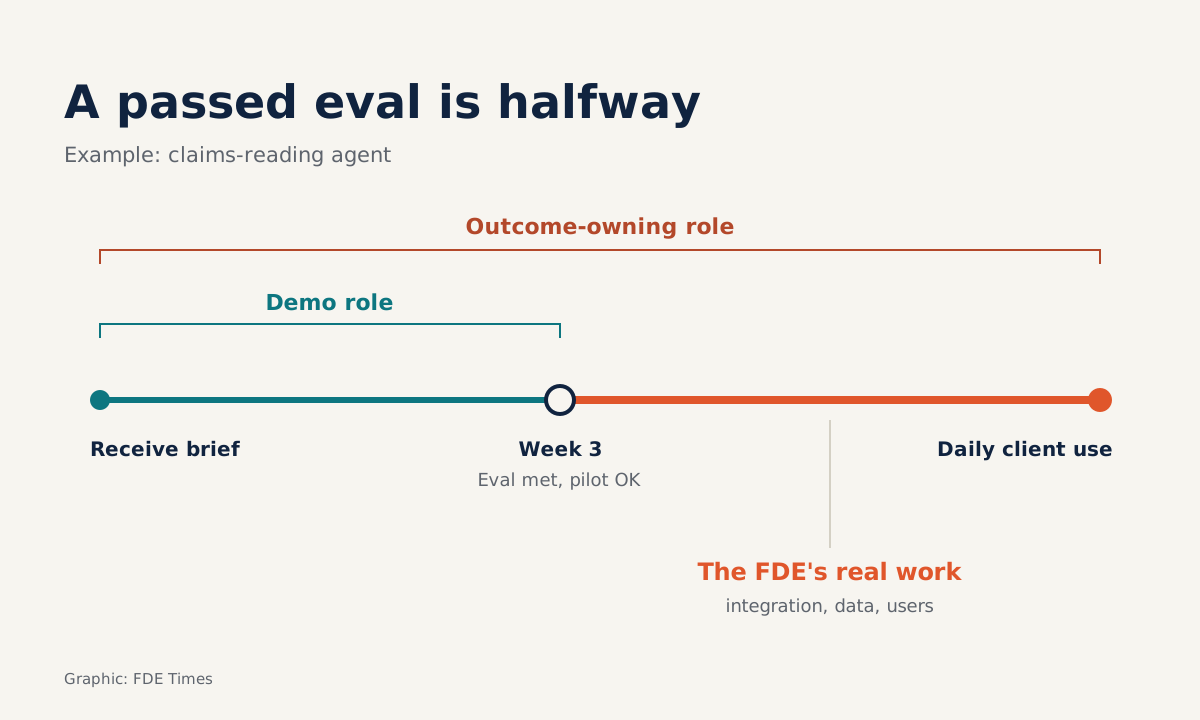
Picture a scenario. You are sent to an insurance company to build an agent that reads claims files. After three weeks, the eval suite clears the threshold both sides agreed on, the demo goes smoothly and the customer signs off on the pilot.
For a demo role, the job is done. For an outcome-owning role, you are only halfway there: is the agent connected to the real document store, do claims handlers open it every morning, and who fixes it when the model misreads a type of document?
If only two people are still using it a month later, the customer has not got an outcome, even though the eval once passed.
The real work of an FDE lies between the moment the eval passes and the moment real users rely on the system every day. There you need technical skills such as integration, data and reliability, along with the skills of working with people: understanding the customer’s processes, winning users over, and being willing to hear their complaints.
Ownership cannot be faked
a16z explains that Palantir’s model works because beneath the work tailored to each customer sits a real platform, while any company that copies FDE-style deployment without such a platform simply builds a services company.
Insight also lists the idea that “FDE is just professional services rebranded” among its misconceptions. The two views meet at one point: on-site work is valuable only when it is tied to something bigger than any single contract.
a16z points to a deeper layer as well: Palantir’s revenue comes from multi-year contracts tied to outcomes. Accountability here is not a slogan; it is written into the commercial model. When a company’s money depends on whether customers achieve results, its engineers on site can hardly stop at the demo.
So before accepting an offer, look at how the company earns money from its customers rather than reading only the job description. If success is counted in pilots signed, the role will most likely pull you towards demos, whatever it is called.
| Checking question | Demo-style role | Outcome-owning role |
|---|---|---|
| What do you deliver? | Demos | A production system in the customer’s environment |
| When is the job done? | After one successful evaluation | When the system runs and the customer really uses it |
| At company level, what sits beneath the custom work? | Without a platform, the company easily becomes a services firm | A real platform, contracts tied to outcomes |
Mistakes that lead you to the wrong role
The most common mistake is trusting the title. Because the same word FDE can mean a builder, a sales engineer or a third kind of role, reading the job name and drawing conclusions about the work is no better than guessing.
The second mistake is subtler: treating a signed pilot or a passed eval as the finish line. In the insurance example, that is precisely when the hardest part begins. A candidate who describes a project that ends at the sign-off meeting is unwittingly showing they have not gone the full distance.
The third mistake is assuming that being close to the customer is enough. Horenfeldt’s warning about CSMs shows the other side: getting lost in solution details while forgetting to ask what the customer wants to achieve is not owning outcomes either.
Where to invest while the label keeps shifting
Start with how you read job postings. Look for words such as “own”, “production”, “adoption” or “end users” alongside the customer’s environment. Be wary when every metric is demos, POCs or deals won: that is a different role, one that may suit you, but choose it knowingly.
In interviews, ask two questions directly: “After the pilot passes evaluation, who is responsible until real users use it every day?” and “What do customers pay the company for?” The answers tell you more than the title.
On your CV, write in terms of outcomes rather than deliverables. Instead of “built a RAG agent PoC”, use a template such as “brought an agent into the customer’s claims-processing workflow, [number] daily users after [number] weeks, handled incidents myself when the model misread documents”.
If you have no such numbers yet, the fastest way to practise is to get a side project into the hands of a few real users and fix it yourself every time it breaks.
The name Delta gave way to FDE, and this label may change too. What you carry through every rename is evidence that you once kept a system running until the customer really used it.
Was this article useful?
Thanks for the feedback!
6 sources
- What are Forward Deployed Engineers, and why are they so in demand? · 2025-08-12
- 'FDE' can mean two completely different roles | CIO · 2026-08-07
- Demystifying the forward deployed engineer | Insight Partners · 2026-07-14
- The Palantirization of everything | Andreessen Horowitz · 2026-01-16
- Three jobs, one title: not every 'FDE' is an FDE · 2026-11-11
- Forward deployed engineers as CSMs: It's a trap · 2025-08-26