Accenture is building 1,000 Google-trained FDEs. Is it still FDE work?
The force will belong to Accenture, not Google, and a Gemini certificate proves platform knowledge, not ownership of results at the client.
In brief
- Google Cloud will train up to 1,000 FDEs for Accenture and certify these teams, but the new organisation belongs to Accenture.
- Forrester defines an FDE team as one that owns an outcome, not a project; SD Times measures the difference as weeks versus months or years.
- For engineers, the title says very little. Ask who owns the outcome, who writes the code and whether the scope is locked into the contract.
In September 2026 Google Cloud committed to training up to 1,000 Accenture FDEs to work with enterprises. The more telling detail was elsewhere: a Google spokesperson told TechCrunch that the organisation would belong to Accenture, not to Google.
The two companies’ official announcement uses a stronger word: they will “establish” a 1,000-strong FDE force. According to CIO Dive, Accenture’s Gemini deployment teams will be certified by Google Cloud as part of an FDE certification process.
If you work as an FDE or want to, this has practical consequences. A title once associated with software companies such as Palantir is now being multiplied into thousands of people by a consulting firm, with a platform vendor’s certificate attached.
Before you take a job like that, you need to answer one question: is it still FDE work?
One consulting firm, three vendors
The Google deal was not the first step. Forrester notes that Accenture launched an FDE practice with Microsoft on 18 March and joined ServiceNow’s FDE programme at its Knowledge conference in May. To Forrester, this is a sign that services firms are taking over the FDE model.
So in less than six months the same consulting firm has attached the FDE title to three different vendors. This kind of FDE follows the platform: the Microsoft FDE, the ServiceNow FDE, the Gemini FDE.
A Google certification tells you how well someone knows Gemini. It does not tell you whether that person owns the outcome at the customer. That ownership is what defines the role.
The wording matters too. The press wrote that Google will “train” up to 1,000 FDEs; the announcement says the two sides will “establish” a 1,000-person force.
The two are not the same. “Train” describes a course; “establish” describes an organisation. A title can be handed out after a course. A way of working has to be organised.
Where the real line falls
Forrester offers a short definition: an FDE team owns an outcome, not a project. A member of the Palantir community forum, where the role was born, describes it in the same terms: working deeply with customers on site and committing to the outcome.
Tech Wire Asia is more specific about the daily work. FDEs work directly with the customer’s team, including connecting models to the company’s data and existing systems. SD Times puts it bluntly: FDEs build the necessary solution themselves.
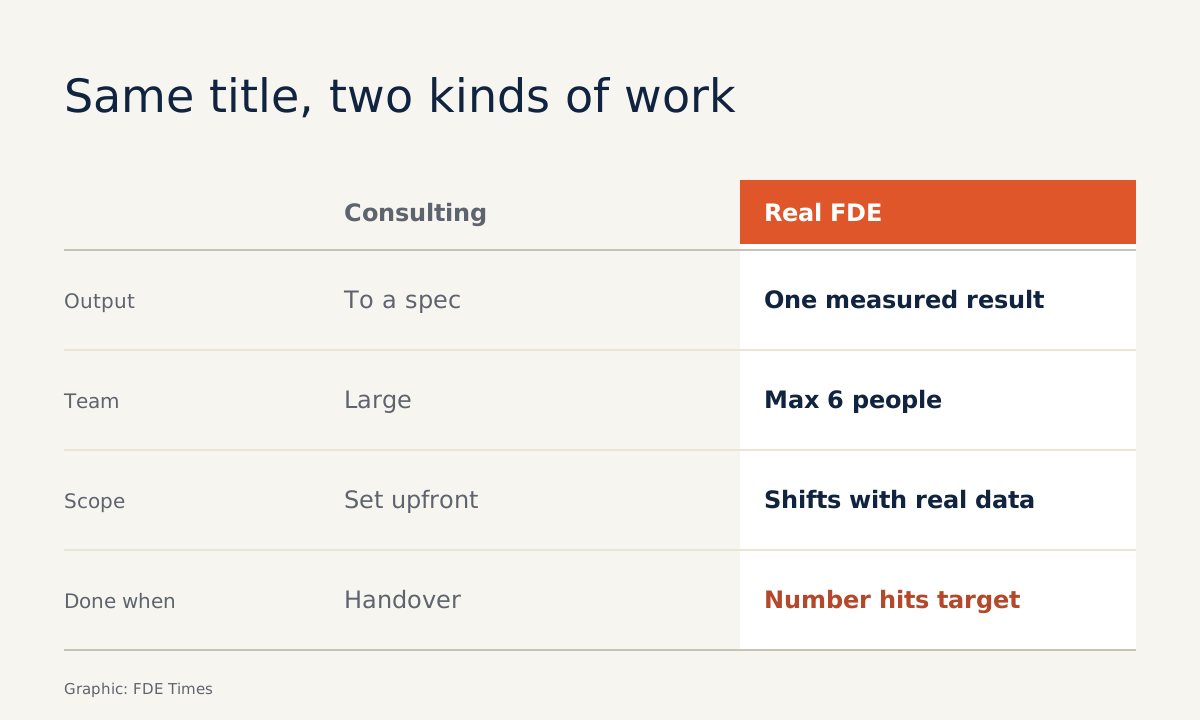
Put those descriptions together and you have a set of criteria for testing any role that carries the FDE title, whoever is hiring:
| Aspect | Project consulting | Outcome-owning FDE |
|---|---|---|
| What is delivered | A project (Forrester) | An outcome the team commits to (Forrester, Palantir) |
| Speed | Months, sometimes years, before a solution appears (SD Times) | Value within weeks, with production-ready products (SD Times) |
| Proof of done | The project has been handed over | The product is running on the customer’s real data and systems |
The table does not say which is better. It shows two ways of organising work that differ at the root, and the same title can be attached to either.
One project, two ways to deliver
Imagine a bank that wants an AI agent to classify customer complaints and route them to the right department. In the project model, it starts with a few weeks of requirements gathering. The team then builds to the spec, runs the acceptance criteria agreed in advance, hands over and moves to the next contract.
The problem is that those criteria were written before anyone had seen how the agent handles real complaints. The agent can pass every criterion on paper and still misroute the hardest cases, which are exactly the ones the customer cares about most. By then the team has gone, because the contract defined scope by deliverables.
In the FDE model, a small team takes on a measurable target, such as the share of complaints routed to the right department the first time.
They run the agent on real data and look at where it goes wrong. Then they fix the prompt, fix the data pipeline, write evals for the failing cases and repeat that loop every week. The job is done only when the number reaches the committed level.
Both approaches can use the same technology, the same vendor certificate and the same title. The deciding difference is who owns the final number, and that is what you need to find out before you sign an employment contract.
Is consulting the enemy of FDE work?
Consulting skills do not dilute the FDE role. Another member of the Palantir community forum describes an FDE as a combination of software engineer and consultant, working directly with customers. The consulting part was always in the definition.
Forrester goes further, calling the FDE a temporary “prosthetic” for organisations whose operating models have not yet caught up.
In other words, even this role may be a transitional phase. What remains once that phase passes is the ability to take a system to a real outcome, not the title.
So the risk is not that consulting firms hire FDEs. The risk is that the “engineer” half is cut away, leaving only the “consultant” half wearing a new title. If you can genuinely do both, at any kind of company, that is a big advantage.
How to read an FDE job ad
When an ad comes from a consulting firm, don’t stop at the title or the name of the certificate. Check whether the responsibilities contain engineering verbs: build, deploy to production, write evals, connect models to the customer’s data.
If that whole section is workshops, requirements gathering and report writing, you have your answer.
In interviews, four questions will show you what the job really is. Who owns an engagement’s success metric? Do FDEs commit code to systems that are running in production? How long before the customer sees a first result? Is scope locked into the contract from the start, or adjusted once the team meets real data?
The answers don’t need to be perfect. A team with a clear metric that writes its own code and shows the customer value within weeks is a good sign, whether the employer is a consulting firm or a software company.
A team that works from a requirements document for months and leaves once it has handed over is running a consulting project, whatever the job ad says.
Apply the same thinking to your CV. “Built a chatbot for the customer service department” is just a deliverable. “Raised the first-contact resolution rate from A to B in N weeks”, with your real figures, is an outcome.
Google can certify 1,000 people after a training programme. Nobody can certify ownership of outcomes: you can only prove it with the numbers you have been accountable for.
Was this article useful?
Thanks for the feedback!
7 sources
- Forward-Deployed Engineers Are The Training Wheels For AI Reinvention · 2026-07-30
- Google Cloud races to catch up in the AI deployment wars with Accenture deal · 2026-09-08
- Accenture, Google Cloud Gemini Enterprise forward deployed engineers (CIO Dive) · 2026-09-10
- Accenture and Google Cloud Deepen Partnership with Formation of New Accenture Gemini Enterprise Business Group · 2026-09-08
- Google Cloud, Accenture 1,000 AI engineers (Tech Wire Asia) · 2026-09-09
- Forward-Deployed Engineers vs. Implementation Consultants: The Crucial Distinctions · 2026-07-23
- Who are Palantir FDEs? · 2026-07-15