Stripe's FDE role asks for five years in Dublin and ten in the US
The pay gap grabs attention, but the more telling detail is where Stripe puts the team, which is inside consulting.
In brief
- Stripe's FDE team sits in Professional Services, serves its most strategic customers, and is described as an extension of consulting: the engineers build software for customers themselves.
- The Dublin ad asks for 5+ years and pays a base salary of €84,000–€126,000. The US ad asks for 10+ years and pays $190,400–$285,600, so the gap of roughly 2.2 times is not just about country.
- What sets an FDE apart from a consultant is working closely with Product & Engineering to help shape features, and your CV should show that.
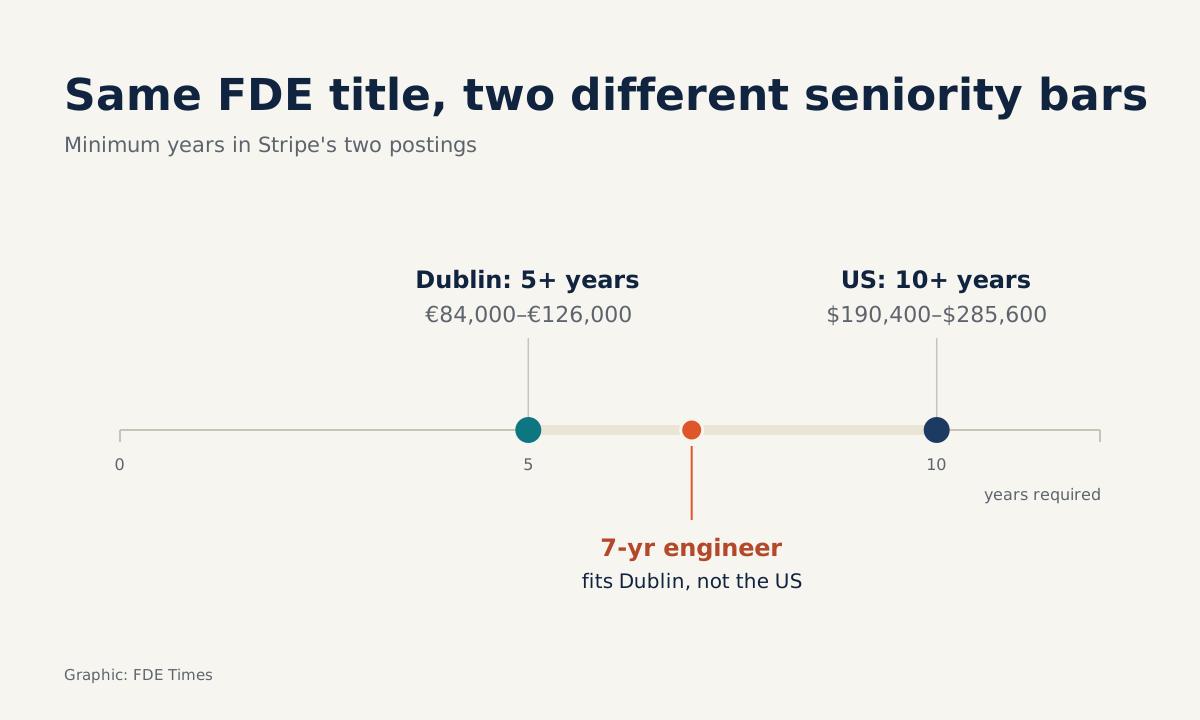
Stripe is hiring for the same position, Forward Deployed Engineer in Professional Services, through two job ads. The Dublin ad asks for at least 5 years of full-stack experience and offers a base salary of €84,000–€126,000 a year. The US ad asks for at least 10 years and offers $190,400–$285,600.
The salary figures draw the eye first, but the more instructive part lies elsewhere. Together the two ads show how a payments company defines the FDE role, and why pay cannot be compared simply by putting two numbers side by side.
If you are thinking of moving into FDE work, both points bear directly on which ads you apply to and how you write your CV.
Why put FDEs in consulting?
According to the Dublin ad, the Professional Services team the FDEs belong to serves Stripe’s most strategic users. The FDE team is described as an extension of the consulting practice. Rather than only advising customers on what to do, its engineers build and deliver software for them directly.
This is a new service covering two kinds of work: scalable integrations with Stripe, and standalone applications. The ad says maintenance is part of the job, but that you will regularly get to start new projects. Its list of preferred experience explicitly names software consulting.
So the role has services roots, and Stripe does not hide it. The company has placed FDEs in the part of the business that already works with large customers project by project.
It is easy to see why this suits a payments product, where every large customer has its own infrastructure and money flows. The consulting team already understands the customer’s problems; now it has people who write the code to solve them.
Is it just consulting under a new name?
Not quite, and the difference shows up in the US ad. It says FDEs will work closely with Stripe’s Product & Engineering team to help shape features. An outside consultant usually has no channel for giving feedback directly to a vendor’s product team.
The origin of the title points the same way. Palantir has used the name Forward Deployed Engineer since the 2000s for engineers it placed on site with customers.
Under the definition most widely used today, an FDE is sent by the vendor itself to integrate its product for the customer. Unlike an outside consultant, part of the job is improving the product based on what they see in the field.
On Stripe’s org chart, then, FDEs sit in services, but their responsibilities remain tied to the product team. Picture this: you build a reconciliation application for a large customer that runs outside Stripe.
If three other customers need exactly the same thing, a good FDE reports that shared need back to Product & Engineering instead of writing it a fourth time.
What does the 2.2x gap actually measure?
In nominal terms, the US salary range is about 2.2 times the Dublin range. But take an engineer with 7 years of full-stack experience. On the criteria as written, this person qualifies for the Dublin ad but falls short of the US ad’s 10 years.
When you compare the two ranges, you are really comparing three things mixed together: country, currency and seniority. The Dublin ad also states that its range applies to the primary location and may differ elsewhere.
How much of the gap comes from the market and how much from seniority, these two ads cannot tell you, and you should not try to split it yourself without more data.
To compare properly, find two ads at the same experience level in two places. If these two are all you have, treat them as two rungs of the same career, and the practical question is which rung you are on.
With 5 to 9 years, a Dublin-style ad may be the more realistic way in, a place to build up the field stories that a 10-year role will ask about.
What does “in the office or with customers” say about the daily work?
The Dublin ad contains a rule that is easy to miss. Most office-assigned Stripe employees must spend at least half of each month in the office or at customer sites. Time spent working with customers counts towards this.
For an FDE, this signals the rhythm of the work. Time at a customer is not treated as absence; it is part of how the job is done. If you are used to sitting in one place writing code from tickets, ask yourself honestly: do you want to spend many days a month alongside a customer’s engineering team, untangling a payment flow on their own systems?
This also ties back to why Stripe placed the FDE team in services. A new project for a strategic customer needs people who understand the customer’s context, and that kind of understanding is hard to gain from requirements documents alone.
How to prepare if you are aiming for this kind of role
Put the ads together and the candidate profile is fairly clear: a full-stack engineer, comfortable starting new projects, possibly with a software consulting background, and able to turn field work into product feedback. All four can show up on a CV if you write it the right way.
For each project, do not just list technologies. Say what kind of thing you built: an integration that had to scale with the customer’s traffic, or a standalone application running alongside the platform.
Then add a sentence on the feedback you brought back to the product team, because that is exactly where the FDE role differs from a consultant’s. If you have worked in software consulting, pick a project you started from scratch and tell it that way.
Stripe is trying out a new service within its consulting practice, and the title borrowed from Palantir is its name for people who both write code for customers and bring that experience back to the product team. Those who can hold both roles are the ones who will be hired, in Dublin or in the US.
Was this article useful?
Thanks for the feedback!