The tools you build yourself are the best proof that you can 'own'
They only count if someone owns them, their lifespan has been decided, and other people can still run them after you have moved on to the next customer.
In brief
- SnapLogic and Palantir job ads define 'own' as seeing problems through, codifying ways of working and contributing to internal tools, not as holding a title.
- At Kepler, a solution built for one customer must be generalised into a product capability, which is why building tools counts as leadership.
- A tool only one person can maintain is a liability: to turn it into evidence, decide at the start who owns it and how long it lives.
SnapLogic’s job ad for a Forward Deployed Engineer uses the two heaviest verbs an engineer can be handed. The FDE will “lead” end-to-end deployments of the Jean-Paul agent with strategic customers, and “own” the full deployment lifecycle at the company’s most important accounts.
That is easy to read. It is much harder to prove in an interview. The obvious answer is to point to positions held: team lead, chair of customer meetings, main point of contact.
But a close reading of job ads, and of what practitioners say about the work, turns up more convincing evidence in a place few people look: the internal tools you build to make your own work faster.
There is a condition. The tool has to pass a test of ownership, and most home-built tools fail exactly that test.
“Own” is not a job title
The same SnapLogic ad has a line that is easy to skim past. The FDE must turn one-off successes into repeatable ways of working for the field team, and bring what happens in the field back to engineering.
In other words, packaging tools and processes is part of the job description, not something done after hours.
Palantir is blunter still. Its ad for a Forward Deployed Enablement Engineer wants candidates to contribute their ideas and debugging skill to internal processes and tools. Elsewhere, “ownership” is spelled out in concrete terms: taking responsibility as first responder when an incident occurs.
Put the two ads together and “own” has two halves. The first is being accountable when something breaks. The second is making the fix reusable, so that nobody has to solve the problem from scratch next time. A good internal tool proves both halves at once, which a job title cannot do.
Why tools are a strategic matter
Vinoo Ganesh of Kepler argued in a talk at the AI Engineer World’s Fair 2026 that FDE is not a role but a product strategy.
On that view, a solution built for one customer has to be generalised into a capability of the product. Read the other way round, an FDE team that generalises nothing is doing consulting more than building a product.
A summary of Kepler’s talk in ZenML’s LLMOps database describes good FDEs as people who take responsibility for fixing problems all the way through within the product ecosystem, rather than handing each customer a bespoke solution.
The measure of success is leverage for the product. That is why building tools counts as leadership: it is the shortest path from one customer to many.
Another talk at the same conference told the story of an FDE team building an internal assistant for itself. The stated goal was for a single engineer or forward-deployed strategist to sustain several customer relationships at once.
When a tool lets one person do the work of several, that is the most measurable form of leadership you can put on a CV.
Every hack can end up in production
Ganesh offers an easy rule of thumb. If a fix genuinely takes less than a day, build it yourself, ship it yourself and close the feedback loop yourself; do not wait for anyone.
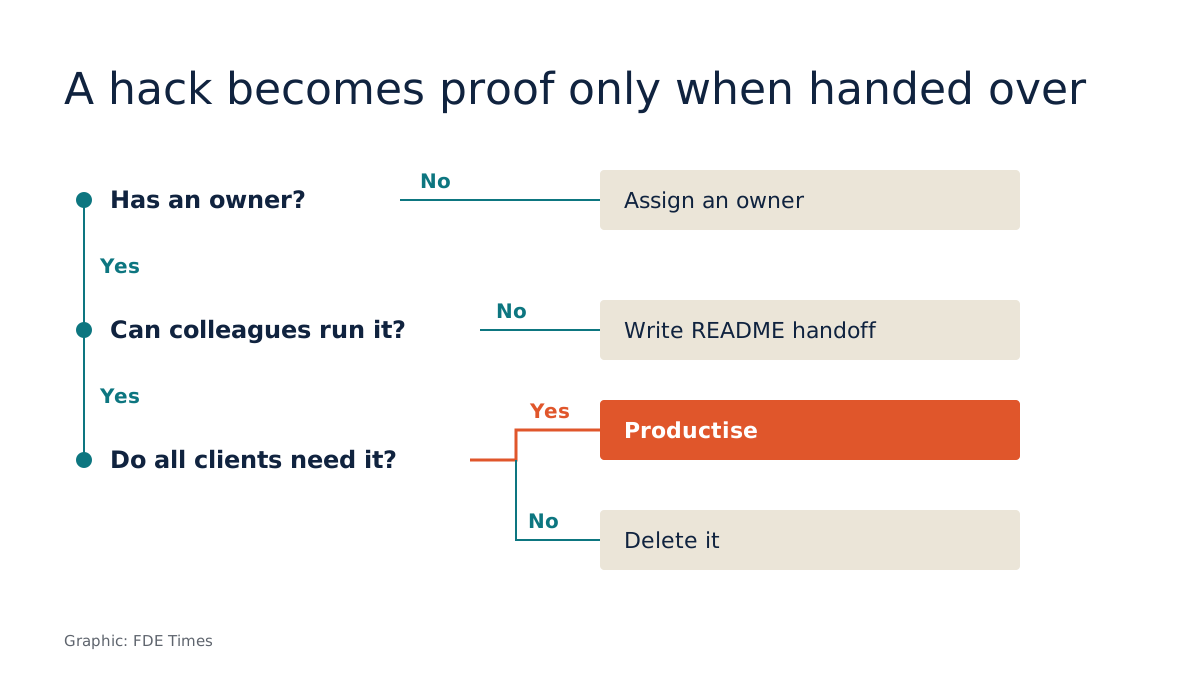
The rule sounds like licence to hack freely, but he attaches a warning: even a quick fix needs a decision about its lifespan and its owner, because every hack can end up in production.
The downside of the build-it-yourself spirit is described by Monterail in a guide to scaling FDE teams for enterprises. It cites research showing that every quick fix becomes an asset someone has to maintain. An engineer who builds lots of small tools creates a support burden that nobody has yet been assigned.
BD Emerson sets an even stricter standard: a deployed system that only the FDE can maintain is a liability. It requires every object and application to have a named owner, along with documentation written for whoever takes over. Put differently, a tool you built is only worth something if it can be handed over.
From these points, the line between a hack that becomes a liability and a tool that becomes evidence of leadership is fairly clear:
| Aspect | Hack that becomes a liability | Tool that becomes evidence of leadership |
|---|---|---|
| When it is built | Whenever it seems convenient | When the fix takes under a day: build it and close the feedback loop at once |
| Owner | Implicitly whoever wrote it | A named owner, written down |
| Lifespan | Nobody decides, so it lives for ever | Decided at the start: delete after the deployment or keep it |
| Successor | Only runs if you ask the author | Documented for whoever takes over |
| Destination | A bespoke solution for one customer | A repeatable way of working for the field team, or a product capability |
A worked example, start to finish
Imagine you are deploying an AI agent for three customers in one quarter. With every customer, the first few days go on the same chores: checking that the API keys have the right permissions, that the data fields the agent needs exist, that the connector returns the right format. Suppose each round takes about four hours by hand.
At the first customer, you write a validation script in an afternoon. The fix takes under a day, so under Ganesh’s rule you build it and use it straight away, without asking permission. At this point it is still just a hack, and it proves nothing beyond the fact that you can write Python.
Before the second customer comes the moment of decision. You answer Ganesh’s two questions: how long does this script live, and who owns it?
Suppose the answer is that it lives for as long as the product supports this type of connector, and you own it until it is handed to the field team.
Then you write a README for someone who has never met you, exactly the standard BD Emerson sets.
At the third customer, a colleague runs the script without messaging you once. That is the moment a one-off success becomes a repeatable way of working, in the very language of SnapLogic’s ad. The four hours saved each time are the small part; the big part is that you are no longer the bottleneck.
The last step is to take it back to the product team. If every customer needs this check, it belongs in the product rather than in the FDE team’s scripts folder. That is the product leverage Kepler uses as its yardstick.
And if, after three customers, nobody needs it any more, deliberately deleting it is also an ownership decision, and it spares you exactly the support burden Monterail warns about.
How to tell the story on a CV and in interviews
A CV line such as “Built a Python script to validate data connections” describes the tool only as a technical feat. It proves you can write code, but not that you owned or led anything. Rewrite it with a three-part formula: how long it took to build, who owns it, and who has reused it without you.
A better version reads: “Built a connector validation tool in one afternoon, assigned an owner and wrote handover documentation; the field team reused it unaided in the next two deployments, and the check was built into the product.” Each clause answers a question the interviewer is silently asking on reading the word “own”.
When asked about a time you led something, a story about a tool is usually stronger than a story about a meeting, because it has a concrete product and real users.
Prepare for the reverse question too: which tool did you delete, and why? The answer shows you understand that every quick fix is an asset to be maintained, not just a trophy.
When reading job ads, look for phrases such as “internal tools”, “codify” and “repeatable” sitting next to “own” and “lead”. They show the team has written the codifying of working methods into the job description, so your tool story maps directly onto what they have put down.
If an ad says “own” but mentions nothing about tools or processes, do not guess. Ask the interviewer directly whether “own” on this team means being on call for incidents, or also includes packaging ways of working for others to reuse, then pick the story that fits the answer.
The word “own” in a job ad is not asking how many things you have built. It is asking whether what you built still runs once you have moved on to the next customer.
Was this article useful?
Thanks for the feedback!
7 sources
- Forward Deployed Engineer (SnapLogic, Built In Austin)
- Forward Deployed Enablement Engineer - Customer Success (Palantir Technologies)
- How Forward Deployed Engineering is done at Kepler (AI Engineer World's Fair 2026)
- Forward Deployed Engineering as Product Strategy for AI Platform Development (ZenML LLMOps Database) · 2026
- What Is a Forward Deployed Engineer? (BD Emerson) · 2026-07-23
- AI tools for Forward Deployed Engineering (AI Engineer World's Fair 2026)
- Scaling FDE Teams Guide for Enterprise AI Leaders (Monterail) · 2026-08-31